






Cat.No:GM-88031MAB
Product :Anti-IL13 hIgG4 Reference Antibody (Lebribio)







Cat.No:GM-88031MAB
Product :Anti-IL13 hIgG4 Reference Antibody (Lebribio)
GM-88031MAB-1mg / 1 mg
GM-88031MAB-5mg / 5 mg
GM-88031MAB-25mg / 5 mg * 5 vials
GM-88031MAB-50mg / 50 mg
GM-88031MAB-100mg / 50 mg * 2 vials
Expression System | CHO |
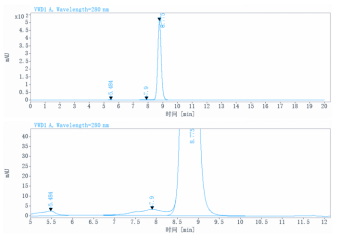
Aggregation | < 5% as determined by SEC-HPLC |
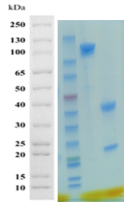
Purity | > 95% as determined by SDS-PAGE |
Species Reactivity | Human |
Clone | lebrikizumab |
Source/Isotype | hIgG4 (S228P),Kappa |
Application | Bioactivity-ELISA |
Specificity | Detects IL13 |
Gene | IL13 |
Other Names | IL-13, P600 |
Gene ID | 3596 (human); 9541(Cynomolgus) |
Background | IL-13 is a pleiotropic cytokine produced mainly by Th2 cells, ILC2s, mast cells, and eosinophils. It signals through the IL-4Rα chain, often in conjunction with the γc or IL-13Rα1, activating downstream pathways such as STAT6, driving type 2 immune responses, promoting IgE class switching, mucus production, airway hyperresponsiveness, eosinophilic inflammation, and tissue remodeling. IL-13 is closely involved in the pathogenesis of diseases such as asthma and allergic rhinitis and certain fibrotic states, and it also participates in defense against parasites. The IL-13 gene is located in a region with upstream and downstream shared elements, and its expression is regulated by transcription factors responsive to Th2-skewing signals, such as GATA3 and STAT6. IL-13 signaling can be regulated by receptor availability, soluble decoys, and genetic variants that affect receptor binding or expression. Therapeutic strategies targeting IL-13 or its signaling axis (for example, monoclonal antibodies against IL-13 or IL-4Rα) have shown efficacy in reducing mucus hypersecretion, airway inflammation, and remodeling in various allergic diseases, highlighting the key role of IL-13 in type II (Type 2) immunity. |
Storage | Store at 2-8°C short term (1-2 weeks). Store at ≤ -20°C long term.Avoid repeated freeze-thaw. |
Formulation | Phosphate-buffered solution, pH 7.2-7.4. |



Cat.No:GM-88031MAB
Product :Anti-IL13 hIgG4 Reference Antibody (Lebribio)
Cat.No:GM-88031MAB
Product :Anti-IL13 hIgG4 Reference Antibody (Lebribio)
GM-88031MAB-1mg / 1 mg
GM-88031MAB-5mg / 5 mg
GM-88031MAB-25mg / 5 mg * 5 vials
GM-88031MAB-50mg / 50 mg
GM-88031MAB-100mg / 50 mg * 2 vials
GM-88031MAB-1mg / 1 mg
GM-88031MAB-5mg / 5 mg
GM-88031MAB-25mg / 5 mg * 5 vials
GM-88031MAB-50mg / 50 mg
GM-88031MAB-100mg / 50 mg * 2 vials
Expression System | CHO |
Aggregation | < 5% as determined by SEC-HPLC |
Purity | > 95% as determined by SDS-PAGE |
Species Reactivity | Human |
Clone | lebrikizumab |
Source/Isotype | hIgG4 (S228P),Kappa |
Application | Bioactivity-ELISA |
Specificity | Detects IL13 |
Gene | IL13 |
Other Names | IL-13, P600 |
Gene ID | 3596 (human); 9541(Cynomolgus) |
Background | IL-13 is a pleiotropic cytokine produced mainly by Th2 cells, ILC2s, mast cells, and eosinophils. It signals through the IL-4Rα chain, often in conjunction with the γc or IL-13Rα1, activating downstream pathways such as STAT6, driving type 2 immune responses, promoting IgE class switching, mucus production, airway hyperresponsiveness, eosinophilic inflammation, and tissue remodeling. IL-13 is closely involved in the pathogenesis of diseases such as asthma and allergic rhinitis and certain fibrotic states, and it also participates in defense against parasites. The IL-13 gene is located in a region with upstream and downstream shared elements, and its expression is regulated by transcription factors responsive to Th2-skewing signals, such as GATA3 and STAT6. IL-13 signaling can be regulated by receptor availability, soluble decoys, and genetic variants that affect receptor binding or expression. Therapeutic strategies targeting IL-13 or its signaling axis (for example, monoclonal antibodies against IL-13 or IL-4Rα) have shown efficacy in reducing mucus hypersecretion, airway inflammation, and remodeling in various allergic diseases, highlighting the key role of IL-13 in type II (Type 2) immunity. |
Storage | Store at 2-8°C short term (1-2 weeks). Store at ≤ -20°C long term.Avoid repeated freeze-thaw. |
Formulation | Phosphate-buffered solution, pH 7.2-7.4. |
Expression System | CHO |
Aggregation | < 5% as determined by SEC-HPLC |
Purity | > 95% as determined by SDS-PAGE |
Species Reactivity | Human |
Clone | lebrikizumab |
Source/Isotype | hIgG4 (S228P),Kappa |
Application | Bioactivity-ELISA |
Specificity | Detects IL13 |
Gene | IL13 |
Other Names | IL-13, P600 |
Gene ID | 3596 (human); 9541(Cynomolgus) |
Background | IL-13 is a pleiotropic cytokine produced mainly by Th2 cells, ILC2s, mast cells, and eosinophils. It signals through the IL-4Rα chain, often in conjunction with the γc or IL-13Rα1, activating downstream pathways such as STAT6, driving type 2 immune responses, promoting IgE class switching, mucus production, airway hyperresponsiveness, eosinophilic inflammation, and tissue remodeling. IL-13 is closely involved in the pathogenesis of diseases such as asthma and allergic rhinitis and certain fibrotic states, and it also participates in defense against parasites. The IL-13 gene is located in a region with upstream and downstream shared elements, and its expression is regulated by transcription factors responsive to Th2-skewing signals, such as GATA3 and STAT6. IL-13 signaling can be regulated by receptor availability, soluble decoys, and genetic variants that affect receptor binding or expression. Therapeutic strategies targeting IL-13 or its signaling axis (for example, monoclonal antibodies against IL-13 or IL-4Rα) have shown efficacy in reducing mucus hypersecretion, airway inflammation, and remodeling in various allergic diseases, highlighting the key role of IL-13 in type II (Type 2) immunity. |
Storage | Store at 2-8°C short term (1-2 weeks). Store at ≤ -20°C long term.Avoid repeated freeze-thaw. |
Formulation | Phosphate-buffered solution, pH 7.2-7.4. |