












| Alternative Names | DIF, TNF-alpha, TNFA, TNFSF2, TNFα |
| Source | Human TNF alpha Protein; His Tag (GM-88209RP) is expressed from human 293 cells (HEK-293). It contains AA Val 77 - Leu 233 (Accession # P01375). This protein carries a His tag at the C-terminus. |
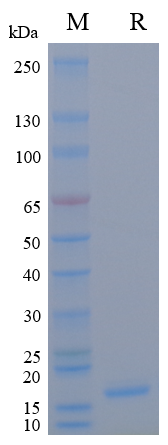
| Purity | > 95% as determined by SDS-PAGE |
| Endotoxin | < 1 EU/μg, determined by LAL gel clotting assay |
| Predicted Mol Mass | 18.2 KDa |
| Formulation | Supplied as a 0.2 μm filtered solution of PBS, pH7.2-7.4. |
| Description | TNF-α is a key pro-inflammatory cytokine in the TNF superfamily, encoded by the TNFA (TNF) gene and commonly referred to as TNF-α or TNFSF2. It is produced by a broad range of cells, including macrophages, T cells, and other immune and non-immune cells, and exists in membrane-bound and soluble forms. TNF-α plays a central role in mediating inflammation, apoptosis, cell proliferation, and host defense, with dysregulation linked to inflammatory diseases, sepsis, and cancer. TNF-α signals primarily through its receptors TNFR1 (p55) and TNFR2 (p75), triggering multiple pathways. TNFR1 activation commonly leads to NF-κB and MAPK signaling, promoting transcription of inflammatory genes, survival factors, and sometimes apoptosis via caspase cascades. TNFR2 mainly modulates immune cell activation and can enhance TNF-α–driven responses. Cross-talk with other cytokines shapes the intensity and duration of inflammation. Therapeutically, TNF-α inhibitors are used to treat autoimmune diseases, but neutralization must balance infection risk and immune suppression. |
| Alternative Names | DIF, TNF-alpha, TNFA, TNFSF2, TNFα |
| Source | Human TNF alpha Protein; His Tag (GM-88209RP) is expressed from human 293 cells (HEK-293). It contains AA Val 77 - Leu 233 (Accession # P01375). This protein carries a His tag at the C-terminus. |
| Purity | > 95% as determined by SDS-PAGE |
| Endotoxin | < 1 EU/μg, determined by LAL gel clotting assay |
| Predicted Mol Mass | 18.2 KDa |
| Formulation | Supplied as a 0.2 μm filtered solution of PBS, pH7.2-7.4. |
| Description | TNF-α is a key pro-inflammatory cytokine in the TNF superfamily, encoded by the TNFA (TNF) gene and commonly referred to as TNF-α or TNFSF2. It is produced by a broad range of cells, including macrophages, T cells, and other immune and non-immune cells, and exists in membrane-bound and soluble forms. TNF-α plays a central role in mediating inflammation, apoptosis, cell proliferation, and host defense, with dysregulation linked to inflammatory diseases, sepsis, and cancer. TNF-α signals primarily through its receptors TNFR1 (p55) and TNFR2 (p75), triggering multiple pathways. TNFR1 activation commonly leads to NF-κB and MAPK signaling, promoting transcription of inflammatory genes, survival factors, and sometimes apoptosis via caspase cascades. TNFR2 mainly modulates immune cell activation and can enhance TNF-α–driven responses. Cross-talk with other cytokines shapes the intensity and duration of inflammation. Therapeutically, TNF-α inhibitors are used to treat autoimmune diseases, but neutralization must balance infection risk and immune suppression. |