




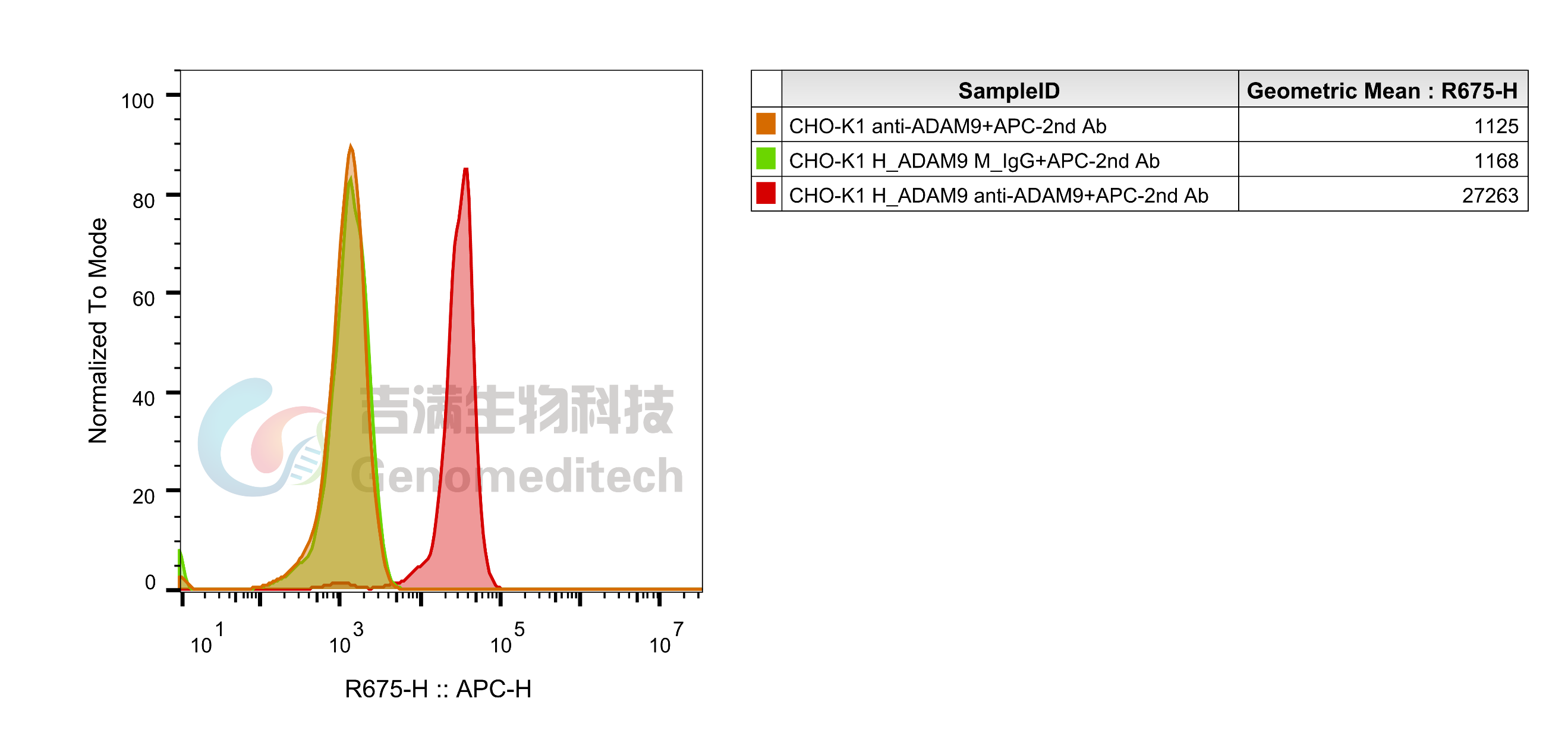




| Species Reactivity | Human |
| Clone | hMAB-A(2I.2) |
| Source/Isotype | Mouse IgG2a, Kappa |
| Application | Flow cytometry |
| Specificity | Detects ADAM9 |
| Gene | ADAM9 |
| Other Names | KIAA0021, MCMP, MDC9, MLTNG |
| Gene ID | 8754 (Human) |
| Background | Adam9(a Disintegrin and Metalloprotease 9) , a multifunctional transmembrane protein in the Adam family, is localized on the human genome 8p11.22, encoding a multidomain type I transmembrane protein, which is a key component of the Adam family, it is widely expressed in monocytes, macrophages and a variety of tumor cells, but limited in normal tissues. Adam9 Cleaves Tek, KDR and other proteins through its metalloproteinase domain, and participates in tumorigenesis and angiogenesis. At the same time, Adam9 regulates cell movement through integrin interaction, affecting cell adhesion, migration and signal transduction. In addition, Adam9 may also act as an α-secretase of amyloid precursor protein, be associated with neurodegeneration diseases, and mediate cell adhesion through non-protease-dependent functions to promote cancer metastasis. ADAM9 is overexpressed in a variety of cancers, such as non-small-cell lung carcinoma, pancreatic cancer, gastric cancer and breast cancer, and is closely related to tumor invasiveness, poor prognosis and drug resistance, based on its key role in tumor initiation, progression and drug resistance. |
| Storage | Store at 2-8℃ short term (1-2 weeks).Store at ≤ -20℃ long term. Avoid repeated freeze-thaw. |
| Formulation | Phosphate-buffered solution, pH 7.2-7.4. |
| Endotoxin | < 1 EU/mg, determined by LAL gel clotting assay |
| Species Reactivity | Human |
| Clone | hMAB-A(2I.2) |
| Source/Isotype | Mouse IgG2a, Kappa |
| Application | Flow cytometry |
| Specificity | Detects ADAM9 |
| Gene | ADAM9 |
| Other Names | KIAA0021, MCMP, MDC9, MLTNG |
| Gene ID | 8754 (Human) |
| Background | Adam9(a Disintegrin and Metalloprotease 9) , a multifunctional transmembrane protein in the Adam family, is localized on the human genome 8p11.22, encoding a multidomain type I transmembrane protein, which is a key component of the Adam family, it is widely expressed in monocytes, macrophages and a variety of tumor cells, but limited in normal tissues. Adam9 Cleaves Tek, KDR and other proteins through its metalloproteinase domain, and participates in tumorigenesis and angiogenesis. At the same time, Adam9 regulates cell movement through integrin interaction, affecting cell adhesion, migration and signal transduction. In addition, Adam9 may also act as an α-secretase of amyloid precursor protein, be associated with neurodegeneration diseases, and mediate cell adhesion through non-protease-dependent functions to promote cancer metastasis. ADAM9 is overexpressed in a variety of cancers, such as non-small-cell lung carcinoma, pancreatic cancer, gastric cancer and breast cancer, and is closely related to tumor invasiveness, poor prognosis and drug resistance, based on its key role in tumor initiation, progression and drug resistance. |
| Storage | Store at 2-8℃ short term (1-2 weeks).Store at ≤ -20℃ long term. Avoid repeated freeze-thaw. |
| Formulation | Phosphate-buffered solution, pH 7.2-7.4. |
| Endotoxin | < 1 EU/mg, determined by LAL gel clotting assay |