




Anti-EGFR×LGR5 hIgG1 Bispecific Antibody(petosemtamab)
Cat. No.
GM-88121AB
Size
10 μg
100 μg
1 mg
Quote
Data display
Decription
Related products
Data display
Bioactivity-ELISA
Human EGFR Protein; His Tag (Catalog # GM-87561RP) was immobilized at 1 μg/ml (100 μL/well)). Increasing concentrations of Anti-EGFR×LGR5 hIgG1 Bispecific Antibody (petosemtamab) (Catalog # GM-88121AB) were added.
Flow cytometry
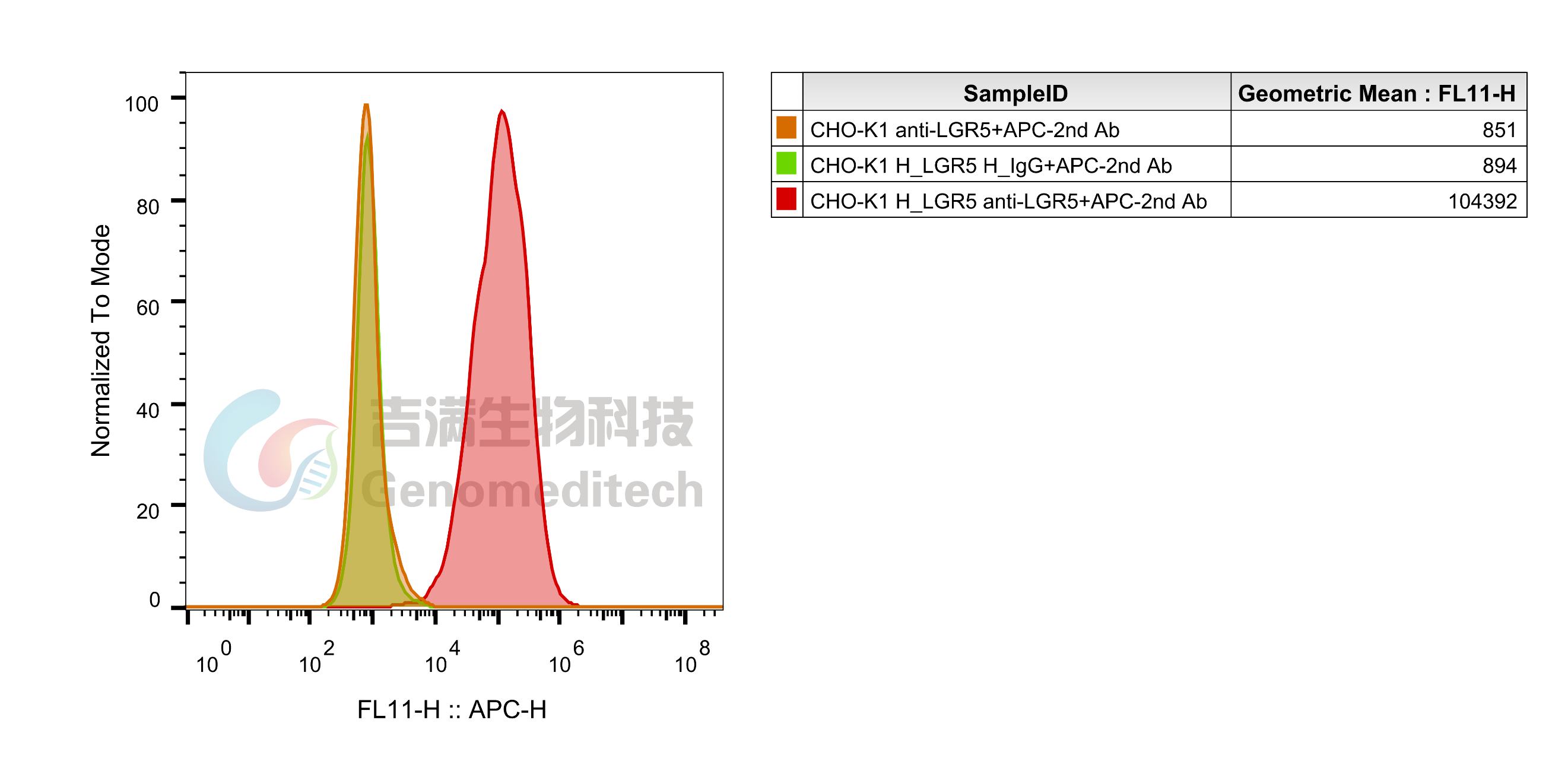
H_LGR5 CHO-K1 Cell Line (Catalog # GM-C22690) was stained with Anti-EGFR×LGR5 hIgG1 Bispecific Antibody (petosemtamab) (Catalog # GM-88121AB) or isotype control antibody, followed by anti-Human IgG APC-conjugated Secondary Antibody.
Decription
Species Reactivity Human
Clone petosemtamab
Source/Isotype Human IgG1(K214R,L351D,D356E,L358M,L368E,delta447K), Kappa
Application Bioactivity-ELISA; Flow Cytometry
Target Detects EGFR&LGR5
Gene EGFR&LGR5
Other Names EGFR:ERBB, ERBB1, ERRP, HER1, NISBD2, NNCIS, PIG61, mENA
LGR5:FEX, GPR49, GPR67, GRP49, HG38
Gene ID EGFR: 1956 (Human)
LGR5: 8549 (Human)
Background Petosemtamab (MCLA-158) is an EGFR/LGR5 bispecific monoclonal antibody drug with a research background derived from the unmet need that exists in the treatment of solid tumors such as head and neck squamous-cell carcinoma (HNSCC) . EGFR, as a key driver of tumor growth, is overexpressed in HNSCC, while LGR5, as a cancer stem cell marker, is closely related to tumor recurrence and metastasis. Traditional single-targeted drugs can not simultaneously block EGFR signaling and eliminate LGR5 + cancer stem cells, resulting in limited efficacy and drug resistance. PETOSEMTAMAB, developed through the Biclonics dual antibody platform, has a triple mechanism of action: direct blockade of the EGFR signaling pathway, induction of LGR5-mediated endocytic degradation of EGFR, and enhancement of antibody-dependent cytotoxicity (ADCC) and phagocytosis (ADCP) , which may be beneficial for the development of anti-EGFR drugs, thus, multi-dimensional inhibition of tumor growth and metastasis is achieved. Preclinical studies have shown that the drug significantly inhibits tumor growth and does not interfere with the function of healthy stem cells in models of head and neck cancer and colorectal cancer.
Storage Store at 2-8℃ short term (1-2 weeks).Store at ≤ -20℃ long term. Avoid repeated freeze-thaw.
Formulation Phosphate-buffered solution, pH 7.2-7.4.
Endotoxin < 1 EU/mg, determined by LAL gel clotting assay
Species Reactivity Human
Clone petosemtamab
Source/Isotype Human IgG1(K214R,L351D,D356E,L358M,L368E,delta447K), Kappa
Application Bioactivity-ELISA; Flow Cytometry
Target Detects EGFR&LGR5
Gene EGFR&LGR5
Other Names EGFR:ERBB, ERBB1, ERRP, HER1, NISBD2, NNCIS, PIG61, mENA
LGR5:FEX, GPR49, GPR67, GRP49, HG38
Gene ID EGFR: 1956 (Human)
LGR5: 8549 (Human)
Background Petosemtamab (MCLA-158) is an EGFR/LGR5 bispecific monoclonal antibody drug with a research background derived from the unmet need that exists in the treatment of solid tumors such as head and neck squamous-cell carcinoma (HNSCC) . EGFR, as a key driver of tumor growth, is overexpressed in HNSCC, while LGR5, as a cancer stem cell marker, is closely related to tumor recurrence and metastasis. Traditional single-targeted drugs can not simultaneously block EGFR signaling and eliminate LGR5 + cancer stem cells, resulting in limited efficacy and drug resistance. PETOSEMTAMAB, developed through the Biclonics dual antibody platform, has a triple mechanism of action: direct blockade of the EGFR signaling pathway, induction of LGR5-mediated endocytic degradation of EGFR, and enhancement of antibody-dependent cytotoxicity (ADCC) and phagocytosis (ADCP) , which may be beneficial for the development of anti-EGFR drugs, thus, multi-dimensional inhibition of tumor growth and metastasis is achieved. Preclinical studies have shown that the drug significantly inhibits tumor growth and does not interfere with the function of healthy stem cells in models of head and neck cancer and colorectal cancer.
Storage Store at 2-8℃ short term (1-2 weeks).Store at ≤ -20℃ long term. Avoid repeated freeze-thaw.
Formulation Phosphate-buffered solution, pH 7.2-7.4.
Endotoxin < 1 EU/mg, determined by LAL gel clotting assay
Related products
For laboratory research use only. Direct human use, including taking orally and injection and clinical use are forbidden.
Anti-EGFR×LGR5 hIgG1 Bispecific Antibody(petosemtamab)
Cat. No.
GM-88121AB
Size
10 μg
100 μg
1 mg
Quote
Data display
Decription
Related products
Data display
Bioactivity-ELISA
Human EGFR Protein; His Tag (Catalog # GM-87561RP) was immobilized at 1 μg/ml (100 μL/well)). Increasing concentrations of Anti-EGFR×LGR5 hIgG1 Bispecific Antibody (petosemtamab) (Catalog # GM-88121AB) were added.
Flow cytometry
H_LGR5 CHO-K1 Cell Line (Catalog # GM-C22690) was stained with Anti-EGFR×LGR5 hIgG1 Bispecific Antibody (petosemtamab) (Catalog # GM-88121AB) or isotype control antibody, followed by anti-Human IgG APC-conjugated Secondary Antibody.
Decription
Species Reactivity Human
Clone petosemtamab
Source/Isotype Human IgG1(K214R,L351D,D356E,L358M,L368E,delta447K), Kappa
Application Bioactivity-ELISA; Flow Cytometry
Target Detects EGFR&LGR5
Gene EGFR&LGR5
Other Names EGFR:ERBB, ERBB1, ERRP, HER1, NISBD2, NNCIS, PIG61, mENA
LGR5:FEX, GPR49, GPR67, GRP49, HG38
Gene ID EGFR: 1956 (Human)
LGR5: 8549 (Human)
Background Petosemtamab (MCLA-158) is an EGFR/LGR5 bispecific monoclonal antibody drug with a research background derived from the unmet need that exists in the treatment of solid tumors such as head and neck squamous-cell carcinoma (HNSCC) . EGFR, as a key driver of tumor growth, is overexpressed in HNSCC, while LGR5, as a cancer stem cell marker, is closely related to tumor recurrence and metastasis. Traditional single-targeted drugs can not simultaneously block EGFR signaling and eliminate LGR5 + cancer stem cells, resulting in limited efficacy and drug resistance. PETOSEMTAMAB, developed through the Biclonics dual antibody platform, has a triple mechanism of action: direct blockade of the EGFR signaling pathway, induction of LGR5-mediated endocytic degradation of EGFR, and enhancement of antibody-dependent cytotoxicity (ADCC) and phagocytosis (ADCP) , which may be beneficial for the development of anti-EGFR drugs, thus, multi-dimensional inhibition of tumor growth and metastasis is achieved. Preclinical studies have shown that the drug significantly inhibits tumor growth and does not interfere with the function of healthy stem cells in models of head and neck cancer and colorectal cancer.
Storage Store at 2-8℃ short term (1-2 weeks).Store at ≤ -20℃ long term. Avoid repeated freeze-thaw.
Formulation Phosphate-buffered solution, pH 7.2-7.4.
Endotoxin < 1 EU/mg, determined by LAL gel clotting assay
Species Reactivity Human
Clone petosemtamab
Source/Isotype Human IgG1(K214R,L351D,D356E,L358M,L368E,delta447K), Kappa
Application Bioactivity-ELISA; Flow Cytometry
Target Detects EGFR&LGR5
Gene EGFR&LGR5
Other Names EGFR:ERBB, ERBB1, ERRP, HER1, NISBD2, NNCIS, PIG61, mENA
LGR5:FEX, GPR49, GPR67, GRP49, HG38
Gene ID EGFR: 1956 (Human)
LGR5: 8549 (Human)
Background Petosemtamab (MCLA-158) is an EGFR/LGR5 bispecific monoclonal antibody drug with a research background derived from the unmet need that exists in the treatment of solid tumors such as head and neck squamous-cell carcinoma (HNSCC) . EGFR, as a key driver of tumor growth, is overexpressed in HNSCC, while LGR5, as a cancer stem cell marker, is closely related to tumor recurrence and metastasis. Traditional single-targeted drugs can not simultaneously block EGFR signaling and eliminate LGR5 + cancer stem cells, resulting in limited efficacy and drug resistance. PETOSEMTAMAB, developed through the Biclonics dual antibody platform, has a triple mechanism of action: direct blockade of the EGFR signaling pathway, induction of LGR5-mediated endocytic degradation of EGFR, and enhancement of antibody-dependent cytotoxicity (ADCC) and phagocytosis (ADCP) , which may be beneficial for the development of anti-EGFR drugs, thus, multi-dimensional inhibition of tumor growth and metastasis is achieved. Preclinical studies have shown that the drug significantly inhibits tumor growth and does not interfere with the function of healthy stem cells in models of head and neck cancer and colorectal cancer.
Storage Store at 2-8℃ short term (1-2 weeks).Store at ≤ -20℃ long term. Avoid repeated freeze-thaw.
Formulation Phosphate-buffered solution, pH 7.2-7.4.
Endotoxin < 1 EU/mg, determined by LAL gel clotting assay
Related products
Message consultation
reset
submit
Message
Message consultation
reset
submit