




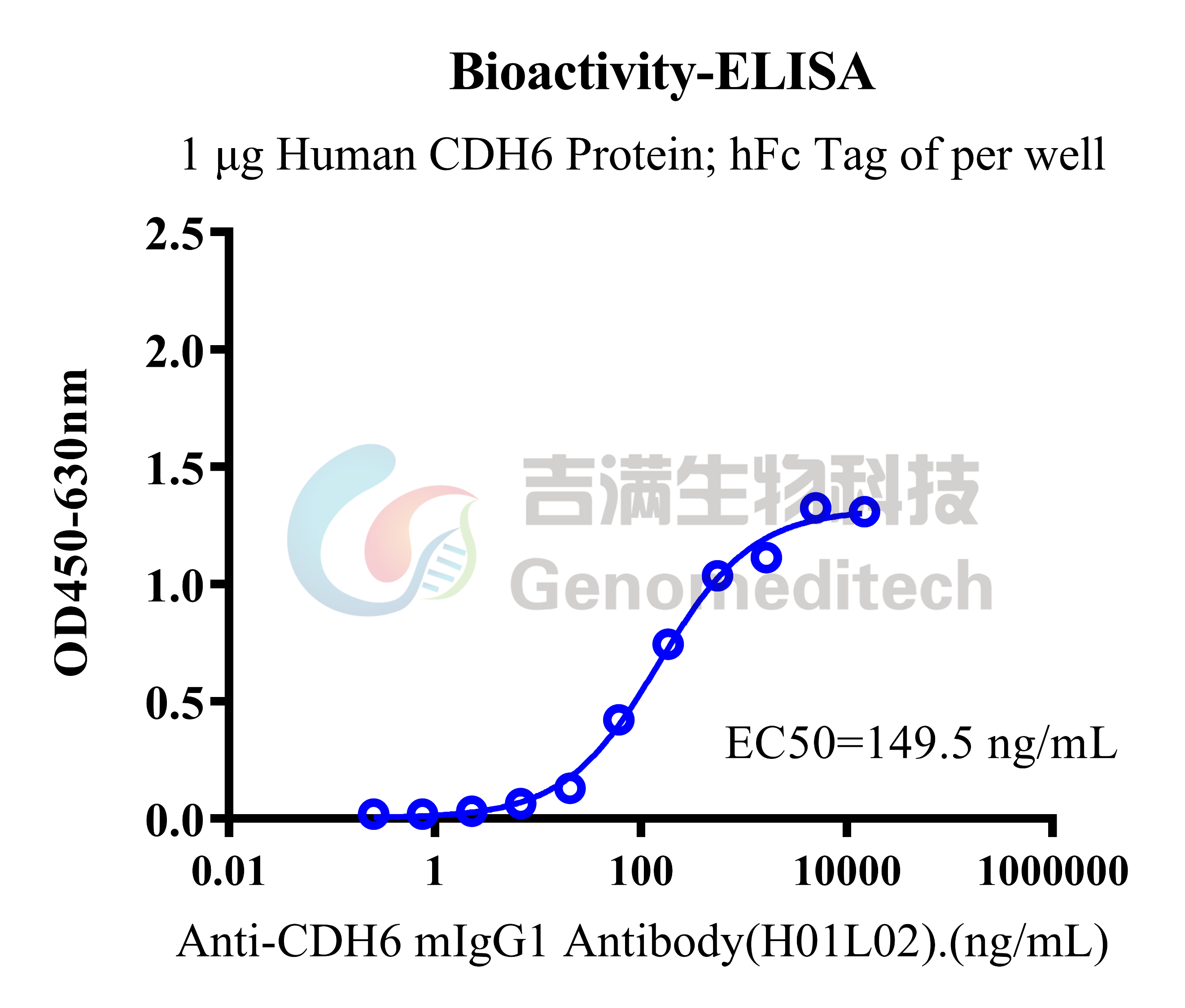




| Species Reactivity | Human |
| Clone | H01L02 |
| Source/Isotype | Mouse IgG1, Kappa |
| Application | Bioactivity-ELISA |
| Target | Detects CDH6 |
| Gene | CDH6 |
| Other Names | CAD6, KCAD, K-cadherin, Cadherin-6 |
| Gene ID | 1004 (Human) |
| Background | CDH6, also known as cadherin-6 (K-cadherin, KCAD; CAD6), is a calcium-dependent cell–cell adhesion molecule in the classical cadherin family. It is a transmembrane glycoprotein with an extracellular domain of cadherin repeats, a single-pass transmembrane region, and a cytoplasmic tail that binds catenins to link to the actin cytoskeleton. CDH6 mediates homophilic calcium-dependent adhesion and contributes to tissue morphogenesis, cell sorting, and epithelial integrity. Its expression is tissue- and development-stage dependent, with roles reported in neural, renal, and reproductive tissues, among others. |
| Besides adhesion, CDH6 participates in signaling through catenin-dependent and cadherin-associated pathways. Its intracellular domain binds β-catenin and p120-catenin, connecting cell adhesion to actin dynamics and potentially modulating Wnt/β-catenin signaling in specific contexts. CDH6 can be regulated via endocytosis and proteolytic cleavage, affecting adhesion strength and signaling cues. Dysregulated CDH6 expression or function has been linked to developmental abnormalities and certain cancers, where it may influence adhesion, migration, and invasiveness. | |
| Storage | Store at 2-8℃ short term (1-2 weeks).Store at ≤ -20℃ long term. Avoid repeated freeze-thaw. |
| Formulation | Supplied as a 0.2 μm filtered solution of PBS, pH7.2-7.4. |
| Endotoxin | < 1 EU/mg, determined by LAL gel clotting assay |
| Species Reactivity | Human |
| Clone | H01L02 |
| Source/Isotype | Mouse IgG1, Kappa |
| Application | Bioactivity-ELISA |
| Target | Detects CDH6 |
| Gene | CDH6 |
| Other Names | CAD6, KCAD, K-cadherin, Cadherin-6 |
| Gene ID | 1004 (Human) |
| Background | CDH6, also known as cadherin-6 (K-cadherin, KCAD; CAD6), is a calcium-dependent cell–cell adhesion molecule in the classical cadherin family. It is a transmembrane glycoprotein with an extracellular domain of cadherin repeats, a single-pass transmembrane region, and a cytoplasmic tail that binds catenins to link to the actin cytoskeleton. CDH6 mediates homophilic calcium-dependent adhesion and contributes to tissue morphogenesis, cell sorting, and epithelial integrity. Its expression is tissue- and development-stage dependent, with roles reported in neural, renal, and reproductive tissues, among others. |
| Besides adhesion, CDH6 participates in signaling through catenin-dependent and cadherin-associated pathways. Its intracellular domain binds β-catenin and p120-catenin, connecting cell adhesion to actin dynamics and potentially modulating Wnt/β-catenin signaling in specific contexts. CDH6 can be regulated via endocytosis and proteolytic cleavage, affecting adhesion strength and signaling cues. Dysregulated CDH6 expression or function has been linked to developmental abnormalities and certain cancers, where it may influence adhesion, migration, and invasiveness. | |
| Storage | Store at 2-8℃ short term (1-2 weeks).Store at ≤ -20℃ long term. Avoid repeated freeze-thaw. |
| Formulation | Supplied as a 0.2 μm filtered solution of PBS, pH7.2-7.4. |
| Endotoxin | < 1 EU/mg, determined by LAL gel clotting assay |