




Anti-ITGB4 hIgG1 Antibody(H86.2)
Cat. No.
GM-88291AB
Size
10 μg
100 μg
1 mg
Quote
Data display
Decription
Related products
Data display
Flow cytometry
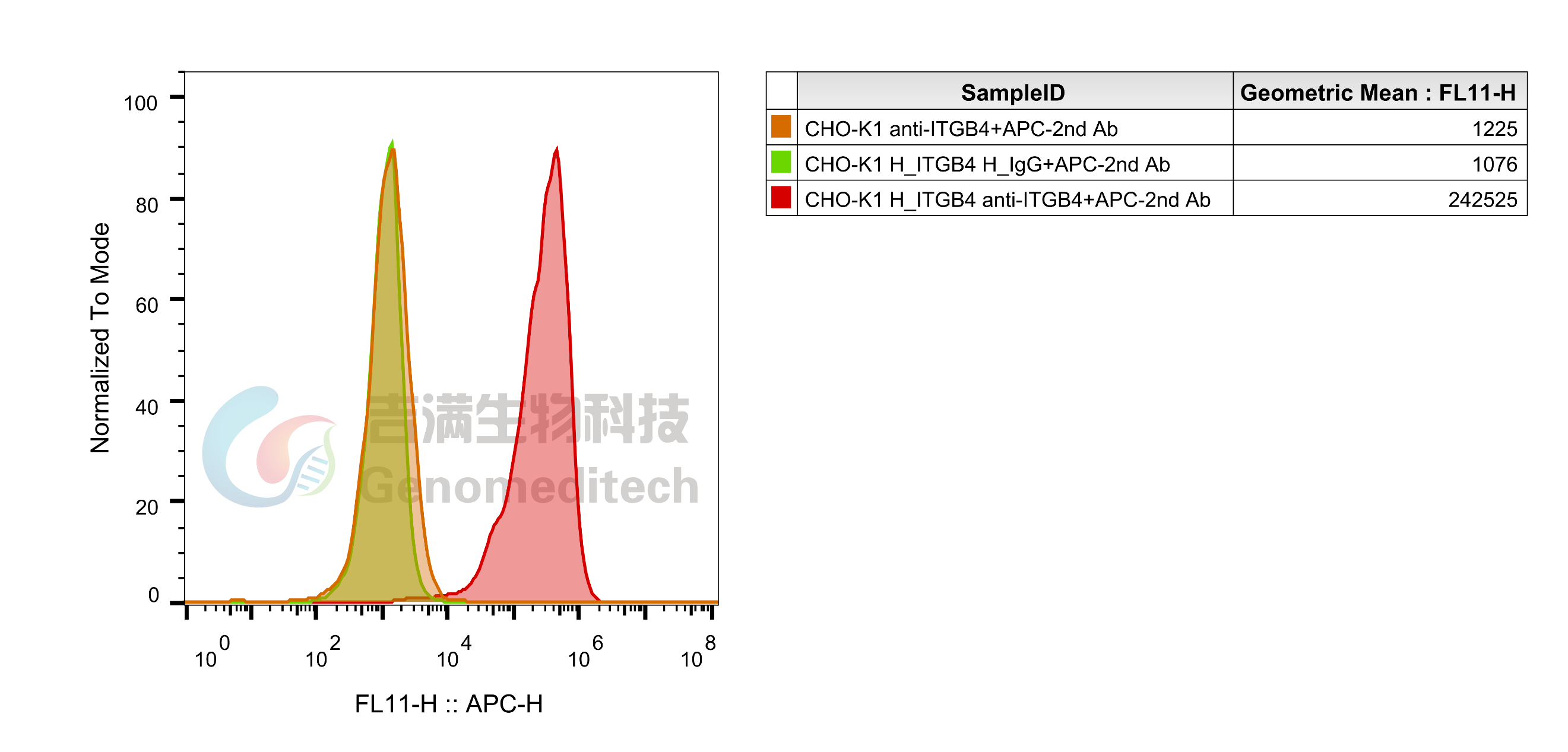
H_ITGB4 CHO-K1 Cell Line (Catalog # GM-C41956) was stained with Anti-ITGB4 hIgG1 Antibody(H86.2) (Catalog # GM-88291AB) or isotype control antibody, followed by anti-Human IgG APC-conjugated Secondary Antibody.
Decription
Species Reactivity Human
Clone H86.2
Source/Isotype Human IgG1,Kappa
Application Flow Cytometry
Target Detects ITGB4
Gene ITGB4
Other Names CD104, GP150, JEB5A, JEB5B
Gene ID 3691 (Human)
Background The ITGB4 gene, located in region 25 of the long arm of human chromosome 17, encodes an integrin Β4 transmembrane glycoprotein that binds to the α6 subunit to form the laminin receptor complex, which is responsible for the formation of the laminin receptor complex, through the regulation of FAK/SRC, EGFR-AKT and other signaling pathways involved in cell adhesion, migration and tumor biological processes. Its mutations are directly related to genetic diseases such as epidermolysis bullosa with pyloric atresia, while playing a key role in the mechanisms of malignant tumors such as colorectal cancer resistance, prostate cancer progression, non-small-cell lung carcinoma metastasis, etc. , its expression level is significantly correlated with tumor invasion and prognosis, and it is an important target for tumor treatment and prognosis evaluation.
Storage Store at 2-8℃ short term (1-2 weeks).Store at ≤ -20℃ long term. Avoid repeated freeze-thaw.
Formulation Supplied as a 0.2 μm filtered solution of PBS, pH7.2-7.4.
Endotoxin < 1 EU/mg, determined by LAL gel clotting assay
Species Reactivity Human
Clone H86.2
Source/Isotype Human IgG1,Kappa
Application Flow Cytometry
Target Detects ITGB4
Gene ITGB4
Other Names CD104, GP150, JEB5A, JEB5B
Gene ID 3691 (Human)
Background The ITGB4 gene, located in region 25 of the long arm of human chromosome 17, encodes an integrin Β4 transmembrane glycoprotein that binds to the α6 subunit to form the laminin receptor complex, which is responsible for the formation of the laminin receptor complex, through the regulation of FAK/SRC, EGFR-AKT and other signaling pathways involved in cell adhesion, migration and tumor biological processes. Its mutations are directly related to genetic diseases such as epidermolysis bullosa with pyloric atresia, while playing a key role in the mechanisms of malignant tumors such as colorectal cancer resistance, prostate cancer progression, non-small-cell lung carcinoma metastasis, etc. , its expression level is significantly correlated with tumor invasion and prognosis, and it is an important target for tumor treatment and prognosis evaluation.
Storage Store at 2-8℃ short term (1-2 weeks).Store at ≤ -20℃ long term. Avoid repeated freeze-thaw.
Formulation Supplied as a 0.2 μm filtered solution of PBS, pH7.2-7.4.
Endotoxin < 1 EU/mg, determined by LAL gel clotting assay
Related products
For laboratory research use only. Direct human use, including taking orally and injection and clinical use are forbidden.
Anti-ITGB4 hIgG1 Antibody(H86.2)
Cat. No.
GM-88291AB
Size
10 μg
100 μg
1 mg
Quote
Data display
Decription
Related products
Data display
Flow cytometry
H_ITGB4 CHO-K1 Cell Line (Catalog # GM-C41956) was stained with Anti-ITGB4 hIgG1 Antibody(H86.2) (Catalog # GM-88291AB) or isotype control antibody, followed by anti-Human IgG APC-conjugated Secondary Antibody.
Decription
Species Reactivity Human
Clone H86.2
Source/Isotype Human IgG1,Kappa
Application Flow Cytometry
Target Detects ITGB4
Gene ITGB4
Other Names CD104, GP150, JEB5A, JEB5B
Gene ID 3691 (Human)
Background The ITGB4 gene, located in region 25 of the long arm of human chromosome 17, encodes an integrin Β4 transmembrane glycoprotein that binds to the α6 subunit to form the laminin receptor complex, which is responsible for the formation of the laminin receptor complex, through the regulation of FAK/SRC, EGFR-AKT and other signaling pathways involved in cell adhesion, migration and tumor biological processes. Its mutations are directly related to genetic diseases such as epidermolysis bullosa with pyloric atresia, while playing a key role in the mechanisms of malignant tumors such as colorectal cancer resistance, prostate cancer progression, non-small-cell lung carcinoma metastasis, etc. , its expression level is significantly correlated with tumor invasion and prognosis, and it is an important target for tumor treatment and prognosis evaluation.
Storage Store at 2-8℃ short term (1-2 weeks).Store at ≤ -20℃ long term. Avoid repeated freeze-thaw.
Formulation Supplied as a 0.2 μm filtered solution of PBS, pH7.2-7.4.
Endotoxin < 1 EU/mg, determined by LAL gel clotting assay
Species Reactivity Human
Clone H86.2
Source/Isotype Human IgG1,Kappa
Application Flow Cytometry
Target Detects ITGB4
Gene ITGB4
Other Names CD104, GP150, JEB5A, JEB5B
Gene ID 3691 (Human)
Background The ITGB4 gene, located in region 25 of the long arm of human chromosome 17, encodes an integrin Β4 transmembrane glycoprotein that binds to the α6 subunit to form the laminin receptor complex, which is responsible for the formation of the laminin receptor complex, through the regulation of FAK/SRC, EGFR-AKT and other signaling pathways involved in cell adhesion, migration and tumor biological processes. Its mutations are directly related to genetic diseases such as epidermolysis bullosa with pyloric atresia, while playing a key role in the mechanisms of malignant tumors such as colorectal cancer resistance, prostate cancer progression, non-small-cell lung carcinoma metastasis, etc. , its expression level is significantly correlated with tumor invasion and prognosis, and it is an important target for tumor treatment and prognosis evaluation.
Storage Store at 2-8℃ short term (1-2 weeks).Store at ≤ -20℃ long term. Avoid repeated freeze-thaw.
Formulation Supplied as a 0.2 μm filtered solution of PBS, pH7.2-7.4.
Endotoxin < 1 EU/mg, determined by LAL gel clotting assay
Related products
Message consultation
reset
submit
Message
Message consultation
reset
submit