










| Alternative Names | BTN3A1,CD277,BTF5 |
| Source | Human BTN3A1 Protein; His Tag (GM-88576RP) is expressed from human 293 cells (HEK-293). It contains AA Gln 30 - Gly 254 (Accession # O00481-1). This protein carries a His tag at the C-terminus. |
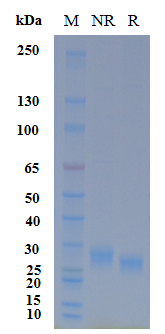
| Purity | > 95% as determined by SDS-PAGE |
| Endotoxin | < 1 EU/μg, determined by LAL gel clotting assay |
| Predicted Mol Mass | 25.0 KDa |
| Formulation | Supplied as a 0.2 μm filtered solution of PBS, pH7.2-7.4. |
| Description | BTN3A1 (butyrophilin subfamily 3 member A1, also known as CD277) is an immunoregulatory receptor belonging to the BTN/BTNL family within the extended B7 superfamily. It is broadly expressed on antigen-presenting cells, many hematopoietic cells, and various epithelial and tumor cells. BTN3A1 plays a pivotal role in modulating both innate and adaptive immunity, most notably by controlling the activation of human Vγ9Vδ2 cells. Through its intracellular B30.2 domain, BTN3A1 senses phosphoantigens derived from microbes or dysregulated cell metabolism and transduces conformational changes to the cell surface, thereby triggering Vγ9Vδ2 cell activation, cytokine production, and cytotoxic responses. |
| Alternative Names | BTN3A1,CD277,BTF5 |
| Source | Human BTN3A1 Protein; His Tag (GM-88576RP) is expressed from human 293 cells (HEK-293). It contains AA Gln 30 - Gly 254 (Accession # O00481-1). This protein carries a His tag at the C-terminus. |
| Purity | > 95% as determined by SDS-PAGE |
| Endotoxin | < 1 EU/μg, determined by LAL gel clotting assay |
| Predicted Mol Mass | 25.0 KDa |
| Formulation | Supplied as a 0.2 μm filtered solution of PBS, pH7.2-7.4. |
| Description | BTN3A1 (butyrophilin subfamily 3 member A1, also known as CD277) is an immunoregulatory receptor belonging to the BTN/BTNL family within the extended B7 superfamily. It is broadly expressed on antigen-presenting cells, many hematopoietic cells, and various epithelial and tumor cells. BTN3A1 plays a pivotal role in modulating both innate and adaptive immunity, most notably by controlling the activation of human Vγ9Vδ2 cells. Through its intracellular B30.2 domain, BTN3A1 senses phosphoantigens derived from microbes or dysregulated cell metabolism and transduces conformational changes to the cell surface, thereby triggering Vγ9Vδ2 cell activation, cytokine production, and cytotoxic responses. |