



Anti-MUC1 hIgG1 Antibody(3D1)
Cat. No.
GM-88514AB
Size
10 μg
100 μg
1 mg
Quote
Data display
Description
Related products
Data display
Flow cytometry
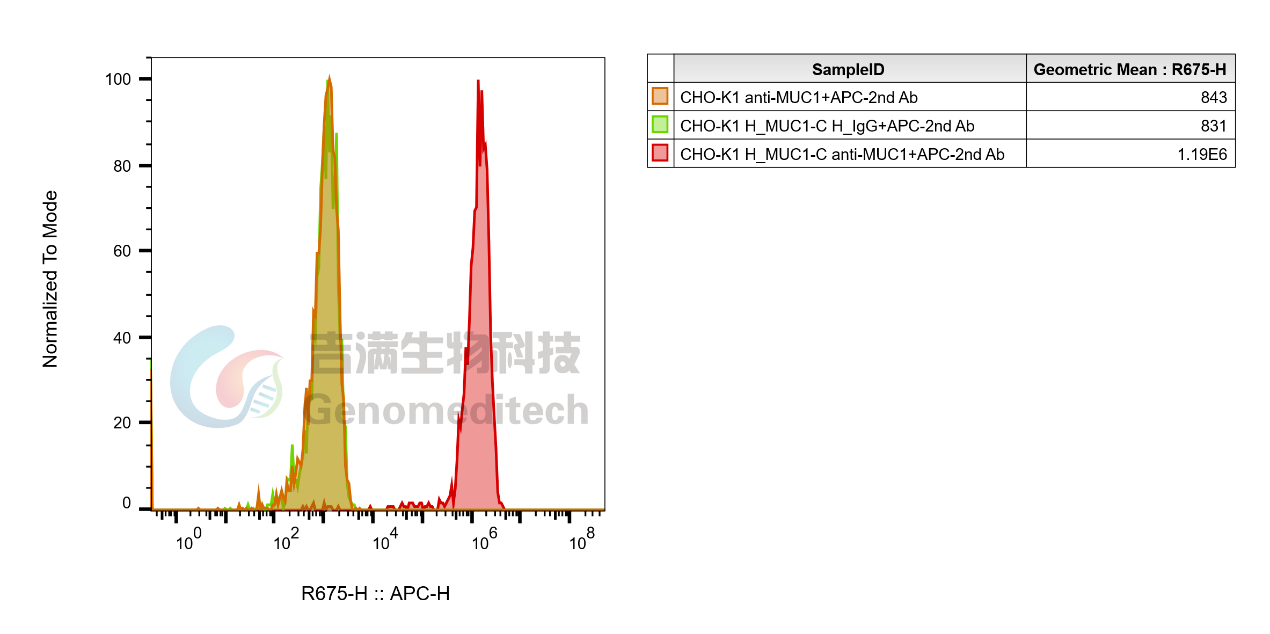
H_MUC1-C(Flag-p62-p58-heterodimer) CHO-K1 Cell Line (Catalog # GM-C44931) was stained with Anti-MUC1 hIgG1 Antibody(3D1) (Catalog # GM-88514AB) or isotype control antibody, followed by anti-Human IgG APC-conjugated Secondary Antibody.
Description
Species Reactivity Human
Clone 3D1
Source/Isotype Human IgG1, Kappa
Application Flow Cytometry
Target Detects MUC1
Gene MUC1
Other Names Mucin 1, CD227, EMA, H23AG
Gene ID 4582 (Human)
Background The research value of MUC1 stems from its role as a tumor-associated antigen aberrantly overexpressed and hypoglycosylated across a broad spectrum of epithelial cancers, including breast, lung, pancreatic, and ovarian malignancies. As a transmembrane glycoprotein that activates oncogenic pathways and promotes immune suppression by upregulating PD-L1 expression, MUC1 represents an ideal pan-cancer target with limited expression in normal tissues.
Targeting MUC1 via diverse modalities-monoclonal antibodies, antibody-drug conjugates, bispecific NK cell engagers, CAR-T/NK cell therapies, and glycopeptide vaccines-offers a versatile therapeutic platform. Recent clinical advances, including promising phase I/II data for MUC1-targeted ADCs and dual-targeted CAR-NK strategies in solid tumors, underscore the transformative potential of anti-MUC1 interventions in reshaping the landscape of precision oncology.
Storage Store at 2-8℃ short term (1-2 weeks).Store at ≤ -20℃ long term. Avoid repeated freeze-thaw.
Formulation Supplied as a 0.2 μm filtered solution of PBS, pH7.2-7.4.
Endotoxin < 1 EU/mg, determined by LAL gel clotting assay
Species Reactivity Human
Clone 3D1
Source/Isotype Human IgG1, Kappa
Application Flow Cytometry
Target Detects MUC1
Gene MUC1
Other Names Mucin 1, CD227, EMA, H23AG
Gene ID 4582 (Human)
Background The research value of MUC1 stems from its role as a tumor-associated antigen aberrantly overexpressed and hypoglycosylated across a broad spectrum of epithelial cancers, including breast, lung, pancreatic, and ovarian malignancies. As a transmembrane glycoprotein that activates oncogenic pathways and promotes immune suppression by upregulating PD-L1 expression, MUC1 represents an ideal pan-cancer target with limited expression in normal tissues.
Targeting MUC1 via diverse modalities-monoclonal antibodies, antibody-drug conjugates, bispecific NK cell engagers, CAR-T/NK cell therapies, and glycopeptide vaccines-offers a versatile therapeutic platform. Recent clinical advances, including promising phase I/II data for MUC1-targeted ADCs and dual-targeted CAR-NK strategies in solid tumors, underscore the transformative potential of anti-MUC1 interventions in reshaping the landscape of precision oncology.
Storage Store at 2-8℃ short term (1-2 weeks).Store at ≤ -20℃ long term. Avoid repeated freeze-thaw.
Formulation Supplied as a 0.2 μm filtered solution of PBS, pH7.2-7.4.
Endotoxin < 1 EU/mg, determined by LAL gel clotting assay
Related products
For laboratory research use only. Direct human use, including taking orally and injection and clinical use are forbidden.
Anti-MUC1 hIgG1 Antibody(3D1)
Cat. No.
GM-88514AB
Size
10 μg
100 μg
1 mg
Quote
Data display
Description
Related products
Data display
Flow cytometry
H_MUC1-C(Flag-p62-p58-heterodimer) CHO-K1 Cell Line (Catalog # GM-C44931) was stained with Anti-MUC1 hIgG1 Antibody(3D1) (Catalog # GM-88514AB) or isotype control antibody, followed by anti-Human IgG APC-conjugated Secondary Antibody.
Description
Species Reactivity Human
Clone 3D1
Source/Isotype Human IgG1, Kappa
Application Flow Cytometry
Target Detects MUC1
Gene MUC1
Other Names Mucin 1, CD227, EMA, H23AG
Gene ID 4582 (Human)
Background The research value of MUC1 stems from its role as a tumor-associated antigen aberrantly overexpressed and hypoglycosylated across a broad spectrum of epithelial cancers, including breast, lung, pancreatic, and ovarian malignancies. As a transmembrane glycoprotein that activates oncogenic pathways and promotes immune suppression by upregulating PD-L1 expression, MUC1 represents an ideal pan-cancer target with limited expression in normal tissues.
Targeting MUC1 via diverse modalities-monoclonal antibodies, antibody-drug conjugates, bispecific NK cell engagers, CAR-T/NK cell therapies, and glycopeptide vaccines-offers a versatile therapeutic platform. Recent clinical advances, including promising phase I/II data for MUC1-targeted ADCs and dual-targeted CAR-NK strategies in solid tumors, underscore the transformative potential of anti-MUC1 interventions in reshaping the landscape of precision oncology.
Storage Store at 2-8℃ short term (1-2 weeks).Store at ≤ -20℃ long term. Avoid repeated freeze-thaw.
Formulation Supplied as a 0.2 μm filtered solution of PBS, pH7.2-7.4.
Endotoxin < 1 EU/mg, determined by LAL gel clotting assay
Species Reactivity Human
Clone 3D1
Source/Isotype Human IgG1, Kappa
Application Flow Cytometry
Target Detects MUC1
Gene MUC1
Other Names Mucin 1, CD227, EMA, H23AG
Gene ID 4582 (Human)
Background The research value of MUC1 stems from its role as a tumor-associated antigen aberrantly overexpressed and hypoglycosylated across a broad spectrum of epithelial cancers, including breast, lung, pancreatic, and ovarian malignancies. As a transmembrane glycoprotein that activates oncogenic pathways and promotes immune suppression by upregulating PD-L1 expression, MUC1 represents an ideal pan-cancer target with limited expression in normal tissues.
Targeting MUC1 via diverse modalities-monoclonal antibodies, antibody-drug conjugates, bispecific NK cell engagers, CAR-T/NK cell therapies, and glycopeptide vaccines-offers a versatile therapeutic platform. Recent clinical advances, including promising phase I/II data for MUC1-targeted ADCs and dual-targeted CAR-NK strategies in solid tumors, underscore the transformative potential of anti-MUC1 interventions in reshaping the landscape of precision oncology.
Storage Store at 2-8℃ short term (1-2 weeks).Store at ≤ -20℃ long term. Avoid repeated freeze-thaw.
Formulation Supplied as a 0.2 μm filtered solution of PBS, pH7.2-7.4.
Endotoxin < 1 EU/mg, determined by LAL gel clotting assay
Related products
Message consultation
reset
submit
Message
Message consultation
reset
submit