




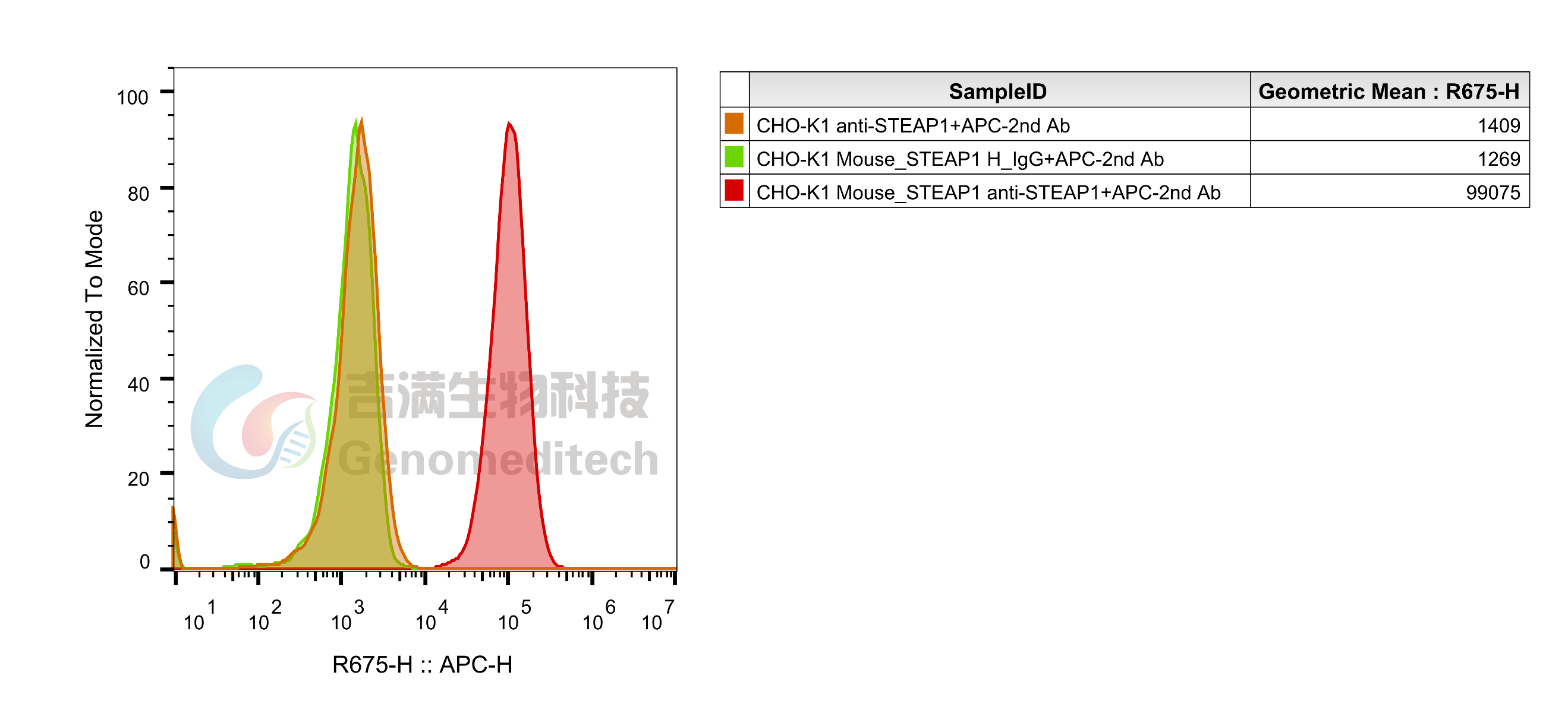




| Species Reactivity | Mouse |
| Clone | Xmab-A1 |
| Source/Isotype | Human IgG1, Kappa |
| Application | Flow Cytometry |
| Target | Detects STEAP1 |
| Gene | STEAP1 |
| Other Names | STEAP1, PRSS24, STEAP |
| Gene ID | 26872 (Mouse) |
| Background | STEAP1 is a cell surface protein highly expressed in most of prostate cancers, and its expression remains elevated even after progression to castration-resistant prostate cancer, while being almost absent in normal tissues, demonstrating excellent tumor specificity. Subsequent studies have also found its overexpression beyond prostate cancer, including in breast cancer, gastric cancer, non‑small cell lung cancer, and other solid tumors, further expanding its potential as a pan‑cancer target. Based on its unique expression profile, STEAP1 has become an ideal target for multiple cutting‑edge anti‑cancer therapies, leading to a rich drug development pipeline. Several innovative therapies have entered clinical stages, including bispecific T‑cell engagers, antibody‑drug conjugates, and CAR‑T therapies that have demonstrated potent anti‑tumor activity in preclinical models. In summary, STEAP1 combines precise tumor targeting with broad drug development adaptability, representing not only a novel target for multiple refractory cancers but also a frontier in next‑generation targeted therapies. |
| Storage | Store at 2-8℃ short term (1-2 weeks).Store at ≤ -20℃ long term. Avoid repeated freeze-thaw. |
| Formulation | Supplied as a 0.2 μm filtered solution of PBS, pH7.2-7.4. |
| Endotoxin | < 1 EU/mg, determined by LAL gel clotting assay |
| Species Reactivity | Mouse |
| Clone | Xmab-A1 |
| Source/Isotype | Human IgG1, Kappa |
| Application | Flow Cytometry |
| Target | Detects STEAP1 |
| Gene | STEAP1 |
| Other Names | STEAP1, PRSS24, STEAP |
| Gene ID | 26872 (Mouse) |
| Background | STEAP1 is a cell surface protein highly expressed in most of prostate cancers, and its expression remains elevated even after progression to castration-resistant prostate cancer, while being almost absent in normal tissues, demonstrating excellent tumor specificity. Subsequent studies have also found its overexpression beyond prostate cancer, including in breast cancer, gastric cancer, non‑small cell lung cancer, and other solid tumors, further expanding its potential as a pan‑cancer target. Based on its unique expression profile, STEAP1 has become an ideal target for multiple cutting‑edge anti‑cancer therapies, leading to a rich drug development pipeline. Several innovative therapies have entered clinical stages, including bispecific T‑cell engagers, antibody‑drug conjugates, and CAR‑T therapies that have demonstrated potent anti‑tumor activity in preclinical models. In summary, STEAP1 combines precise tumor targeting with broad drug development adaptability, representing not only a novel target for multiple refractory cancers but also a frontier in next‑generation targeted therapies. |
| Storage | Store at 2-8℃ short term (1-2 weeks).Store at ≤ -20℃ long term. Avoid repeated freeze-thaw. |
| Formulation | Supplied as a 0.2 μm filtered solution of PBS, pH7.2-7.4. |
| Endotoxin | < 1 EU/mg, determined by LAL gel clotting assay |