





Anti-TREM1 mIgG1 Antibody(PY159)
Cat. No.
GM-88439AB
Size
10 μg
100 μg
1mg
Quote
Data display
Description
Related products
Data display
Flow cytometry
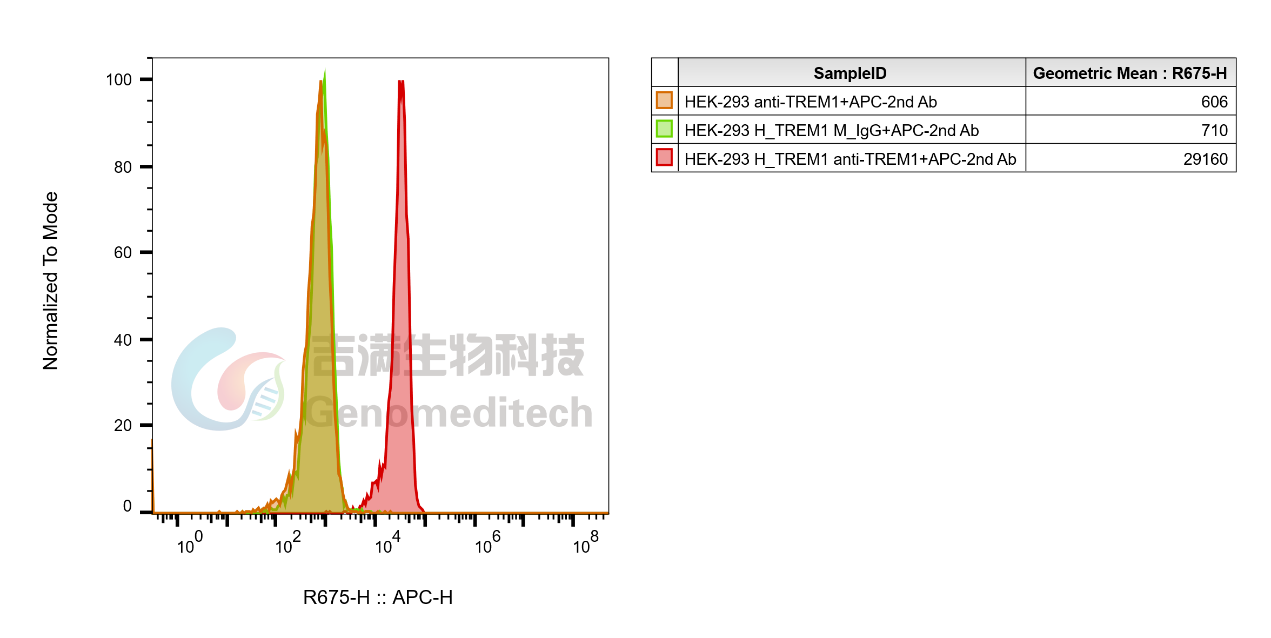
H_TREM1 HEK-293 Cell Line (Catalog # GM-C13365) was stained with Anti-TREM1 mIgG1 Antibody (PY159) (Catalog # GM-88439AB) or isotype control antibody, followed by anti-Mouse IgG APC-conjugated Secondary Antibody.
Bioactivity-ELISA
Human TREM1 Protein; His Tag (Catalog # GM-88422RP) was immobilized at 2 μg/ml (100 μL/well). Increasing concentrations of Anti-TREM1 mIgG1 Antibody(PY159) (Catalog # GM-88439AB) were added.
Description
Species Reactivity Human
Clone PY159
Source/Isotype Mouse IgG1, Kappa
Application Flow Cytometry; Bioactivity-ELISA
Target Detects TREM1
Gene TREM1
Other Names CD354, TREM-1
Gene ID 54210 (Human)
Background Targeting TREM1 (Triggering Receptor Expressed on Myeloid cells 1) with specific antibodies holds significant therapeutic promise. TREM1 is a key amplifier of innate immune responses, and its overactivation drives pathological inflammation in sepsis, ischemic stroke, inflammatory bowel disease, and COVID-19.
Anti-TREM1 antibodies can selectively block this amplification loop without completely abolishing host defense, offering a safer immunomodulatory strategy than broad anti-inflammatory agents. Emerging evidence also implicates TREM1 in tumor immune evasion and fibrosis, expanding potential applications to oncology and chronic organ diseases. Thus, developing anti-TREM1 biologics represents a valuable approach for “resetting” dysregulated inflammation across diverse conditions.
Storage Store at 2-8℃ short term (1-2 weeks). Store at ≤ -20℃ long term. Avoid repeated freeze-thaw.
Formulation Supplied as a 0.2 μm filtered solution of PBS, pH7.2-7.4.
Endotoxin < 1 EU/mg, determined by LAL gel clotting assay
Species Reactivity Human
Clone PY159
Source/Isotype Mouse IgG1, Kappa
Application Flow Cytometry; Bioactivity-ELISA
Target Detects TREM1
Gene TREM1
Other Names CD354, TREM-1
Gene ID 54210 (Human)
Background Targeting TREM1 (Triggering Receptor Expressed on Myeloid cells 1) with specific antibodies holds significant therapeutic promise. TREM1 is a key amplifier of innate immune responses, and its overactivation drives pathological inflammation in sepsis, ischemic stroke, inflammatory bowel disease, and COVID-19.
Anti-TREM1 antibodies can selectively block this amplification loop without completely abolishing host defense, offering a safer immunomodulatory strategy than broad anti-inflammatory agents. Emerging evidence also implicates TREM1 in tumor immune evasion and fibrosis, expanding potential applications to oncology and chronic organ diseases. Thus, developing anti-TREM1 biologics represents a valuable approach for “resetting” dysregulated inflammation across diverse conditions.
Storage Store at 2-8℃ short term (1-2 weeks). Store at ≤ -20℃ long term. Avoid repeated freeze-thaw.
Formulation Supplied as a 0.2 μm filtered solution of PBS, pH7.2-7.4.
Endotoxin < 1 EU/mg, determined by LAL gel clotting assay
Related products
For laboratory research use only. Direct human use, including taking orally and injection and clinical use are forbidden.
Anti-TREM1 mIgG1 Antibody(PY159)
Cat. No.
GM-88439AB
Size
10 μg
100 μg
1mg
Quote
Data display
Description
Related products
Data display
Flow cytometry
H_TREM1 HEK-293 Cell Line (Catalog # GM-C13365) was stained with Anti-TREM1 mIgG1 Antibody (PY159) (Catalog # GM-88439AB) or isotype control antibody, followed by anti-Mouse IgG APC-conjugated Secondary Antibody.
Bioactivity-ELISA
Human TREM1 Protein; His Tag (Catalog # GM-88422RP) was immobilized at 2 μg/ml (100 μL/well). Increasing concentrations of Anti-TREM1 mIgG1 Antibody(PY159) (Catalog # GM-88439AB) were added.
Description
Species Reactivity Human
Clone PY159
Source/Isotype Mouse IgG1, Kappa
Application Flow Cytometry; Bioactivity-ELISA
Target Detects TREM1
Gene TREM1
Other Names CD354, TREM-1
Gene ID 54210 (Human)
Background Targeting TREM1 (Triggering Receptor Expressed on Myeloid cells 1) with specific antibodies holds significant therapeutic promise. TREM1 is a key amplifier of innate immune responses, and its overactivation drives pathological inflammation in sepsis, ischemic stroke, inflammatory bowel disease, and COVID-19.
Anti-TREM1 antibodies can selectively block this amplification loop without completely abolishing host defense, offering a safer immunomodulatory strategy than broad anti-inflammatory agents. Emerging evidence also implicates TREM1 in tumor immune evasion and fibrosis, expanding potential applications to oncology and chronic organ diseases. Thus, developing anti-TREM1 biologics represents a valuable approach for “resetting” dysregulated inflammation across diverse conditions.
Storage Store at 2-8℃ short term (1-2 weeks). Store at ≤ -20℃ long term. Avoid repeated freeze-thaw.
Formulation Supplied as a 0.2 μm filtered solution of PBS, pH7.2-7.4.
Endotoxin < 1 EU/mg, determined by LAL gel clotting assay
Species Reactivity Human
Clone PY159
Source/Isotype Mouse IgG1, Kappa
Application Flow Cytometry; Bioactivity-ELISA
Target Detects TREM1
Gene TREM1
Other Names CD354, TREM-1
Gene ID 54210 (Human)
Background Targeting TREM1 (Triggering Receptor Expressed on Myeloid cells 1) with specific antibodies holds significant therapeutic promise. TREM1 is a key amplifier of innate immune responses, and its overactivation drives pathological inflammation in sepsis, ischemic stroke, inflammatory bowel disease, and COVID-19.
Anti-TREM1 antibodies can selectively block this amplification loop without completely abolishing host defense, offering a safer immunomodulatory strategy than broad anti-inflammatory agents. Emerging evidence also implicates TREM1 in tumor immune evasion and fibrosis, expanding potential applications to oncology and chronic organ diseases. Thus, developing anti-TREM1 biologics represents a valuable approach for “resetting” dysregulated inflammation across diverse conditions.
Storage Store at 2-8℃ short term (1-2 weeks). Store at ≤ -20℃ long term. Avoid repeated freeze-thaw.
Formulation Supplied as a 0.2 μm filtered solution of PBS, pH7.2-7.4.
Endotoxin < 1 EU/mg, determined by LAL gel clotting assay
Related products
Message consultation
reset
submit
Message
Message consultation
reset
submit