H_CLEC5A Reporter Jurkat Cell Line
Cat. No.
GM-C25939
Size
1 vial
Quote
Description
Data Display
Specifications
Materials
Cell Culture
Related products
Description
C-type lectin domain family 5 member A (CLEC5A)​ is a receptor protein primarily found on immune cells like macrophages. It recognizes pathogens and triggers strong inflammatory responses, playing a key role in diseases such as severe viral infections and sepsis, making it a potential drug target.

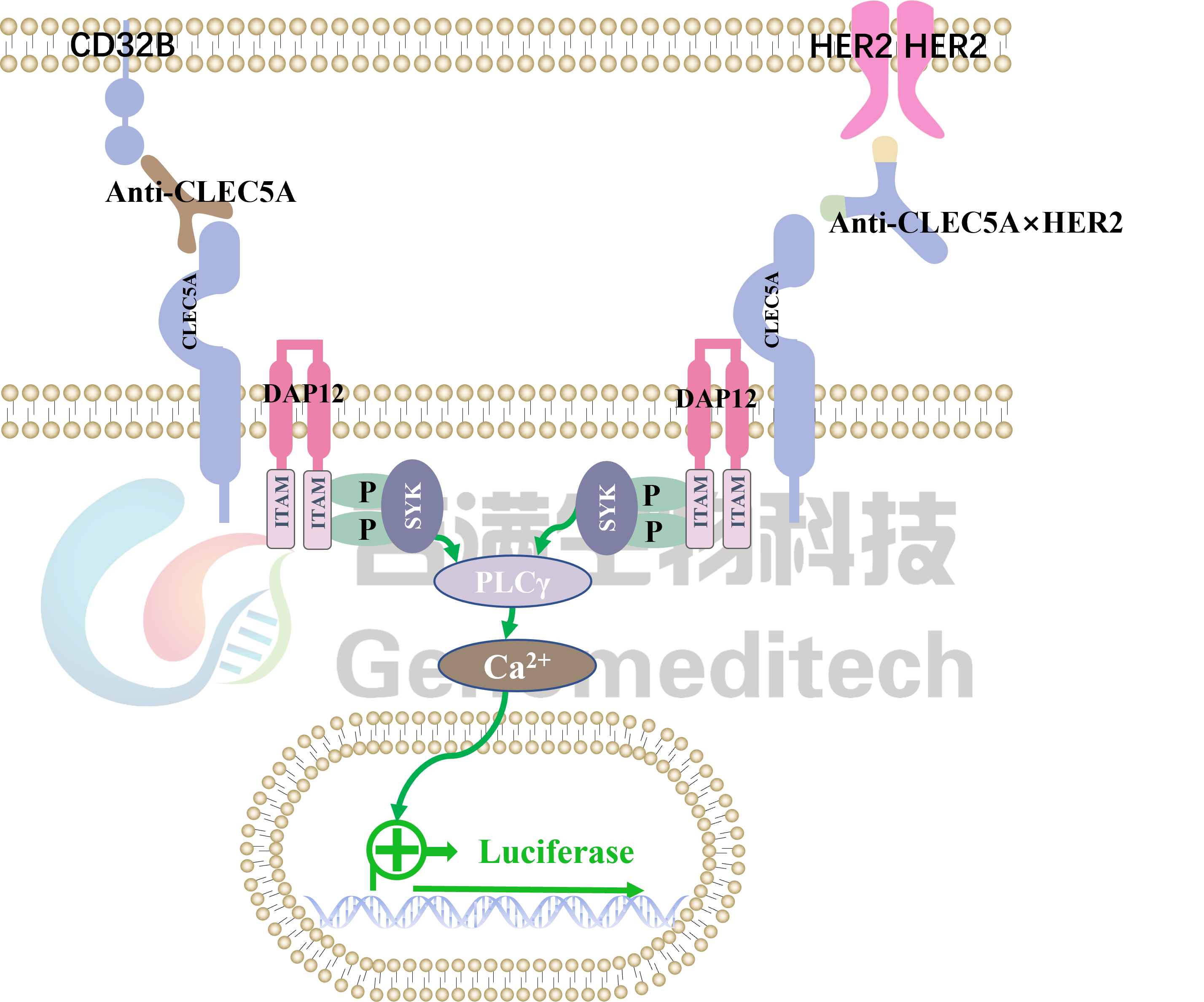
CLEC5A activates through the adapter protein DAP12. Ligand binding initiates a signaling cascade involving Syk kinase and PLCγ, leading to increased calcium levels and, importantly, activation of the NF-κB pathway. This ultimately drives the production of potent pro-inflammatory signals.

H_CLEC5A Reporter Jurkat Cell Line is a clonal stable Jurkat cell line constructed using lentiviral technology, constitutive expression of the CLEC5A and DAP12 gene, along with signal-dependent expression of a luciferase reporter gene. When CLEC5A Activators binds to CLEC5A, it activates downstream signaling pathways, leading to the expression of luciferase. The luciferase activity measurement indicates the activation level of the signaling pathway and can thus be used to evaluate the in vitro effects of drugs related to CLEC5A.
C-type lectin domain family 5 member A (CLEC5A)​ is a receptor protein primarily found on immune cells like macrophages. It recognizes pathogens and triggers strong inflammatory responses, playing a key role in diseases such as severe viral infections and sepsis, making it a potential drug target.

CLEC5A activates through the adapter protein DAP12. Ligand binding initiates a signaling cascade involving Syk kinase and PLCγ, leading to increased calcium levels and, importantly, activation of the NF-κB pathway. This ultimately drives the production of potent pro-inflammatory signals.

H_CLEC5A Reporter Jurkat Cell Line is a clonal stable Jurkat cell line constructed using lentiviral technology, constitutive expression of the CLEC5A and DAP12 gene, along with signal-dependent expression of a luciferase reporter gene. When CLEC5A Activators binds to CLEC5A, it activates downstream signaling pathways, leading to the expression of luciferase. The luciferase activity measurement indicates the activation level of the signaling pathway and can thus be used to evaluate the in vitro effects of drugs related to CLEC5A.
Data Display
Applications
Response to Anti-CLEC5A×HER2 hIgG1 Bispecific Antibody(HER2/5C7). The H_HER2(ERBB2) CHO-K1 Cell Line (Cat. GM-C18996) and CHO-K1 Cell Line were seeded at a density of 1E4 cells per well in a 96-well plate and incubated overnight. The next day, serial dilutions of Anti-CLEC5A×HER2 hIgG1 Bispecific Antibody(HER2/5C7)(Cat. GM-88513AB) and the H_CLEC5A Reporter Jurkat Cell Line (Cat. GM-C25939) at a concentration of 5E4 cells per well were added to the pre-seeded cells. The mixture was incubated for an additional 6 hours. The firefly luciferase activity was measured using the Luciferase Reporter Assay Kit (Genomeditech).The maximum induction fold was approximately [1012.5]. Data are shown by drug mass concentration.
Response to Anti-Human CLEC5A/MDL1 Antibody(DX246). The H_FCGR2B(CD32B) CHO-K1 Cell Line (Cat. GM-C16925) and CHO-K1 Cell Line were seeded at a density of 1E4 cells per well in a 96-well plate and incubated overnight. The next day, serial dilutions of Anti-Human CLEC5A/MDL1 Antibody(DX246)(antibodysystem/FHK16010) and the H_CLEC5A Reporter Jurkat Cell Line (Cat. GM-C25939) at a concentration of 5E4 cells per well were added to the pre-seeded cells. The mixture was incubated for an additional 6 hours. The firefly luciferase activity was measured using the Luciferase Reporter Assay Kit (Genomeditech).The maximum induction fold was approximately [740.6]. Data are shown by drug mass concentration.
Expression
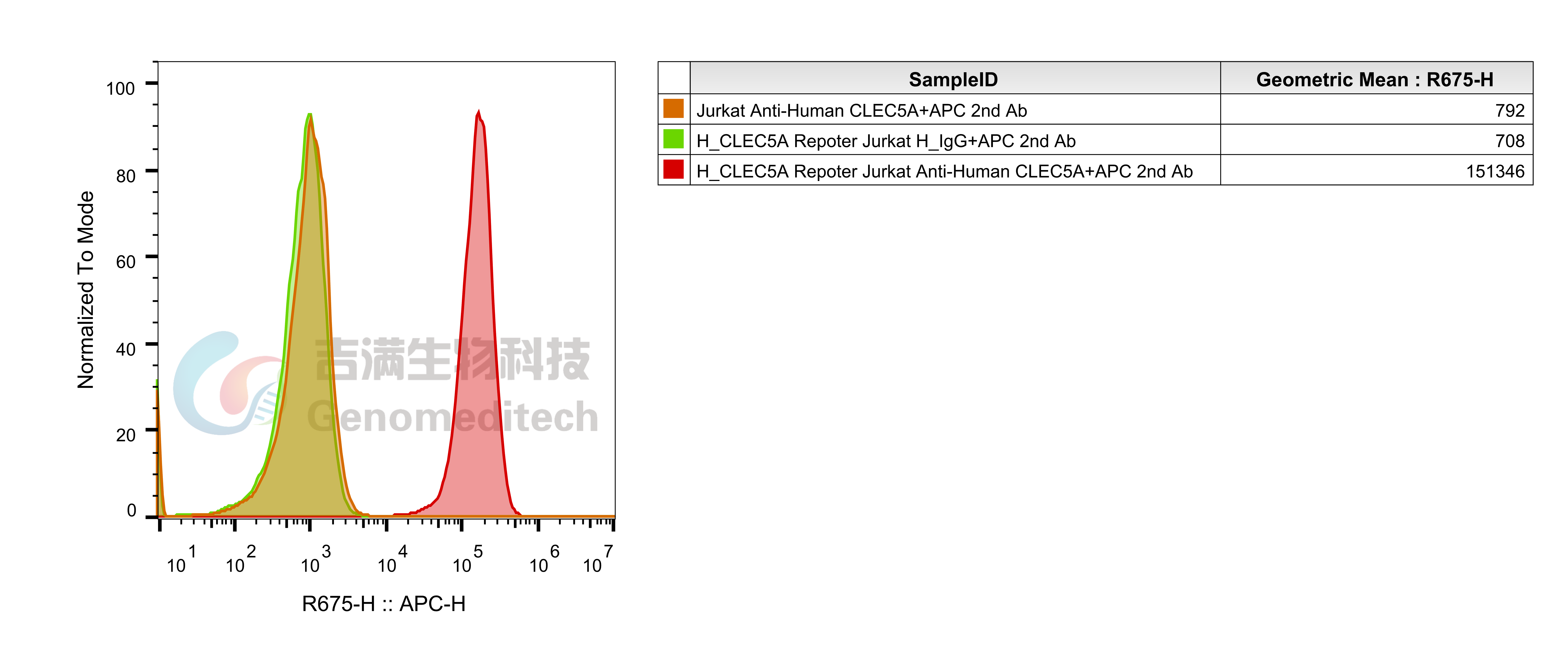
H_CLEC5A Reporter Jurkat Cell Line (Cat. GM-C25939) was determined by flow cytometry using Anti-Human CLEC5A/MDL1 Antibody (DX246)(antibodysystem/FHK16010).
Specifications
Cat. No GM-C25939
Product H_CLEC5A Reporter Jurkat Cell Line
Product Format 1 vial of frozen cells
Quantity 5E6 Cells per vial,1 mL
Storage Conditions Liquid nitrogen immediately upon receipt
Recovery Medium RPMI 1640+10% FBS+1% P.S
Growth medium RPMI 1640+10% FBS+1% P.S+3.5 μg/mL Blasticidin+400 μg/mL G418+0.75 μg/mL Puromycin
Note None
Freezing Medium 90% FBS+10% DMSO
Growth properties Suspension
Growth Conditions 37°C, 5% CO₂
Safety considerations Biosafety Level 2
Mycoplasma Testing The cell line has been screened to confirm the absence of Mycoplasma species.
Cat. No GM-C25939
Product H_CLEC5A Reporter Jurkat Cell Line
Product Format 1 vial of frozen cells
Quantity 5E6 Cells per vial,1 mL
Storage Conditions Liquid nitrogen immediately upon receipt
Recovery Medium RPMI 1640+10% FBS+1% P.S
Growth medium RPMI 1640+10% FBS+1% P.S+3.5 μg/mL Blasticidin+400 μg/mL G418+0.75 μg/mL Puromycin
Note None
Freezing Medium 90% FBS+10% DMSO
Growth properties Suspension
Growth Conditions 37°C, 5% CO₂
Safety considerations Biosafety Level 2
Mycoplasma Testing The cell line has been screened to confirm the absence of Mycoplasma species.
Materials
Reagent Ordering Information
RPMI 1640 gibco/C11875500BT
Fetal Bovine Serum ExCell/FSP500
Pen/Strep Thermo/15140-122
Blasticidin Genomeditech/GM-040404
G418 Genomeditech/GM-040402
Puromycin Genomeditech/GM-040401
H_HER2(ERBB2) CHO-K1 Cell Line Genomeditech/GM-C18996
H_FCGR2B(CD32B) CHO-K1 Cell Line Genomeditech/GM-C16925
Anti-CLEC5A×HER2 hIgG1 Bispecific Antibody(HER2/5C7) Genomeditech/GM-88513AB
GMOne-Step 2.0 Luciferase Reporter Gene Assay Kit Genomeditech/GM-040513
Anti-Human CLEC5A/MDL1 Antibody(DX246) antibodysystem/FHK16010
Reagent Ordering Information
RPMI 1640 gibco/C11875500BT
Fetal Bovine Serum ExCell/FSP500
Pen/Strep Thermo/15140-122
Blasticidin Genomeditech/GM-040404
G418 Genomeditech/GM-040402
Puromycin Genomeditech/GM-040401
H_HER2(ERBB2) CHO-K1 Cell Line Genomeditech/GM-C18996
H_FCGR2B(CD32B) CHO-K1 Cell Line Genomeditech/GM-C16925
Anti-CLEC5A×HER2 hIgG1 Bispecific Antibody(HER2/5C7) Genomeditech/GM-88513AB
GMOne-Step 2.0 Luciferase Reporter Gene Assay Kit Genomeditech/GM-040513
Anti-Human CLEC5A/MDL1 Antibody(DX246) antibodysystem/FHK16010
Cell Culture

Cell Recovery

Recovery Medium: RPMI 1640+10% FBS+1% P.S

To insure the highest level of viability, thaw the vial and initiate the culture as soon as possible upon receipt. If upon arrival, continued storage of the frozen culture is necessary, it should be stored in liquid nitrogen vapor phase and not at -70°C. Storage at -70°C will result in loss of viability.

a)       Thaw the vial by gentle agitation in a 37°C water bath. To reduce the possibility of contamination, keep the O-ring and cap out of the water. Thawing should be rapid (approximately 2 - 3 minutes).

b)       Remove the vial from the water bath as soon as the contents are thawed, and decontaminate by dipping in or spraying with 70% ethanol. All of the operations from this point on should be carried out under strict aseptic conditions.

c)       Transfer the vial contents to a centrifuge tube containing 5.0 mL complete culture medium. And spin at approximately 176 x g for 5 minutes. Discard supernatant.

d)       Resuspend cell pellet with the recommended complete medium. And dispense the suspension into 1 - 2 T-25 culture flasks.

e)       Incubate the culture at 37°C in a suitable incubator. A 5% CO₂ in air atmosphere is recommended if using the medium described on this product sheet.

Cell Freezing

Freezing Medium: 90% FBS+10% DMSO

a)          Centrifuge at 176 x g for 3 minutes to collect cells.

b)         Resuspend the cells in pre-cooled freezing medium and adjust the cell density to 5E6 cells/mL.

c)          Aliquot 1 mL into each vial.

d)         Place the vial in a controlled-rate freezing container and store at -80°C for at least 1 day, then transfer to liquid nitrogen as soon as possible.

Cell passage

Growth medium: RPMI 1640+10% FBS+1% P.S+3.5 μg/mL Blasticidin+400 μg/mL G418+0.75 μg/mL Puromycin

Approximately 48-72 hours after the initial thawing, the cells can be passaged for the first time. After this initial passage, the culture medium can be adjusted to growth medium supplemented with antibiotics. If cells are not passaged within 48 hours, it is recommended to add some fresh recovery medium and place the flask horizontally.

a)          When the cell density reaches 1.5 - 2E6 cells/mL, subculture the cells. Do not allow the cell density to exceed 2E6 cells/mL.

b)         It is recommended to use T-25 flasks for subculturing.

c)          These cells are suspension cells, and it is recommended to use the "half-medium change" method to maintain optimal cell conditions during passaging.

d)         During passaging, you can directly add fresh growth medium to the culture flask, gently pipette to resuspend the cells, and then transfer the cell suspension to a new T-25 flask for continued culture.

Subcultivation Ratio: Maintain cultures at a cell concentraion between 3E5 and 1E6 viable cells/mL.

Medium Renewal: Every 2 to 3 days

Notes

a)          These cells are sensitive to density, so please ensure that the cell density is maintained within an appropriate range during culture and subculturing.

b)         During the first passage, pay attention to the nutrient supply; if not subculturing, make sure to add fresh recovery medium every other day as needed.

Cell Recovery

Recovery Medium: RPMI 1640+10% FBS+1% P.S

To insure the highest level of viability, thaw the vial and initiate the culture as soon as possible upon receipt. If upon arrival, continued storage of the frozen culture is necessary, it should be stored in liquid nitrogen vapor phase and not at -70°C. Storage at -70°C will result in loss of viability.

a)       Thaw the vial by gentle agitation in a 37°C water bath. To reduce the possibility of contamination, keep the O-ring and cap out of the water. Thawing should be rapid (approximately 2 - 3 minutes).

b)       Remove the vial from the water bath as soon as the contents are thawed, and decontaminate by dipping in or spraying with 70% ethanol. All of the operations from this point on should be carried out under strict aseptic conditions.

c)       Transfer the vial contents to a centrifuge tube containing 5.0 mL complete culture medium. And spin at approximately 176 x g for 5 minutes. Discard supernatant.

d)       Resuspend cell pellet with the recommended complete medium. And dispense the suspension into 1 - 2 T-25 culture flasks.

e)       Incubate the culture at 37°C in a suitable incubator. A 5% CO₂ in air atmosphere is recommended if using the medium described on this product sheet.

Cell Freezing

Freezing Medium: 90% FBS+10% DMSO

a)          Centrifuge at 176 x g for 3 minutes to collect cells.

b)         Resuspend the cells in pre-cooled freezing medium and adjust the cell density to 5E6 cells/mL.

c)          Aliquot 1 mL into each vial.

d)         Place the vial in a controlled-rate freezing container and store at -80°C for at least 1 day, then transfer to liquid nitrogen as soon as possible.

Cell passage

Growth medium: RPMI 1640+10% FBS+1% P.S+3.5 μg/mL Blasticidin+400 μg/mL G418+0.75 μg/mL Puromycin

Approximately 48-72 hours after the initial thawing, the cells can be passaged for the first time. After this initial passage, the culture medium can be adjusted to growth medium supplemented with antibiotics. If cells are not passaged within 48 hours, it is recommended to add some fresh recovery medium and place the flask horizontally.

a)          When the cell density reaches 1.5 - 2E6 cells/mL, subculture the cells. Do not allow the cell density to exceed 2E6 cells/mL.

b)         It is recommended to use T-25 flasks for subculturing.

c)          These cells are suspension cells, and it is recommended to use the "half-medium change" method to maintain optimal cell conditions during passaging.

d)         During passaging, you can directly add fresh growth medium to the culture flask, gently pipette to resuspend the cells, and then transfer the cell suspension to a new T-25 flask for continued culture.

Subcultivation Ratio: Maintain cultures at a cell concentraion between 3E5 and 1E6 viable cells/mL.

Medium Renewal: Every 2 to 3 days

Notes

a)          These cells are sensitive to density, so please ensure that the cell density is maintained within an appropriate range during culture and subculturing.

b)         During the first passage, pay attention to the nutrient supply; if not subculturing, make sure to add fresh recovery medium every other day as needed.

Related products
CLEC5a
Cynomolgus_CLEC5a CHO-K1 Cell Line H_CLEC5a CHO-K1 Cell Line H_CLEC5a HEK-293 Cell Line
Anti-CLEC5A hIgG1 Antibody(DX-244) Anti-CLEC5A hIgG1 Antibody(h5C7) Anti-CLEC5A×CD79B hIgG1 Bispecific Antibody(CD79b/5C7)
Anti-CLEC5A×HER2 hIgG1 Bispecific Antibody(HER2/5C7)    
For laboratory research use only. Direct human use, including taking orally and injection and clinical use are forbidden.
H_CLEC5A Reporter Jurkat Cell Line
Cat. No.
GM-C25939
Size
1 vial
Quote
Description
Data Display
Specifications
Materials
Cell Culture
Related products
Description
C-type lectin domain family 5 member A (CLEC5A)​ is a receptor protein primarily found on immune cells like macrophages. It recognizes pathogens and triggers strong inflammatory responses, playing a key role in diseases such as severe viral infections and sepsis, making it a potential drug target.

CLEC5A activates through the adapter protein DAP12. Ligand binding initiates a signaling cascade involving Syk kinase and PLCγ, leading to increased calcium levels and, importantly, activation of the NF-κB pathway. This ultimately drives the production of potent pro-inflammatory signals.

H_CLEC5A Reporter Jurkat Cell Line is a clonal stable Jurkat cell line constructed using lentiviral technology, constitutive expression of the CLEC5A and DAP12 gene, along with signal-dependent expression of a luciferase reporter gene. When CLEC5A Activators binds to CLEC5A, it activates downstream signaling pathways, leading to the expression of luciferase. The luciferase activity measurement indicates the activation level of the signaling pathway and can thus be used to evaluate the in vitro effects of drugs related to CLEC5A.

C-type lectin domain family 5 member A (CLEC5A)​ is a receptor protein primarily found on immune cells like macrophages. It recognizes pathogens and triggers strong inflammatory responses, playing a key role in diseases such as severe viral infections and sepsis, making it a potential drug target.

CLEC5A activates through the adapter protein DAP12. Ligand binding initiates a signaling cascade involving Syk kinase and PLCγ, leading to increased calcium levels and, importantly, activation of the NF-κB pathway. This ultimately drives the production of potent pro-inflammatory signals.

H_CLEC5A Reporter Jurkat Cell Line is a clonal stable Jurkat cell line constructed using lentiviral technology, constitutive expression of the CLEC5A and DAP12 gene, along with signal-dependent expression of a luciferase reporter gene. When CLEC5A Activators binds to CLEC5A, it activates downstream signaling pathways, leading to the expression of luciferase. The luciferase activity measurement indicates the activation level of the signaling pathway and can thus be used to evaluate the in vitro effects of drugs related to CLEC5A.

Data Display
Applications
Response to Anti-CLEC5A×HER2 hIgG1 Bispecific Antibody(HER2/5C7). The H_HER2(ERBB2) CHO-K1 Cell Line (Cat. GM-C18996) and CHO-K1 Cell Line were seeded at a density of 1E4 cells per well in a 96-well plate and incubated overnight. The next day, serial dilutions of Anti-CLEC5A×HER2 hIgG1 Bispecific Antibody(HER2/5C7)(Cat. GM-88513AB) and the H_CLEC5A Reporter Jurkat Cell Line (Cat. GM-C25939) at a concentration of 5E4 cells per well were added to the pre-seeded cells. The mixture was incubated for an additional 6 hours. The firefly luciferase activity was measured using the Luciferase Reporter Assay Kit (Genomeditech).The maximum induction fold was approximately [1012.5]. Data are shown by drug mass concentration.
Response to Anti-Human CLEC5A/MDL1 Antibody(DX246). The H_FCGR2B(CD32B) CHO-K1 Cell Line (Cat. GM-C16925) and CHO-K1 Cell Line were seeded at a density of 1E4 cells per well in a 96-well plate and incubated overnight. The next day, serial dilutions of Anti-Human CLEC5A/MDL1 Antibody(DX246)(antibodysystem/FHK16010) and the H_CLEC5A Reporter Jurkat Cell Line (Cat. GM-C25939) at a concentration of 5E4 cells per well were added to the pre-seeded cells. The mixture was incubated for an additional 6 hours. The firefly luciferase activity was measured using the Luciferase Reporter Assay Kit (Genomeditech).The maximum induction fold was approximately [740.6]. Data are shown by drug mass concentration.
Expression
H_CLEC5A Reporter Jurkat Cell Line (Cat. GM-C25939) was determined by flow cytometry using Anti-Human CLEC5A/MDL1 Antibody (DX246)(antibodysystem/FHK16010).
Specifications
Cat. No GM-C25939
Product H_CLEC5A Reporter Jurkat Cell Line
Product Format 1 vial of frozen cells
Quantity 5E6 Cells per vial,1 mL
Storage Conditions Liquid nitrogen immediately upon receipt
Recovery Medium RPMI 1640+10% FBS+1% P.S
Growth medium RPMI 1640+10% FBS+1% P.S+3.5 μg/mL Blasticidin+400 μg/mL G418+0.75 μg/mL Puromycin
Note None
Freezing Medium 90% FBS+10% DMSO
Growth properties Suspension
Growth Conditions 37°C, 5% CO₂
Safety considerations Biosafety Level 2
Mycoplasma Testing The cell line has been screened to confirm the absence of Mycoplasma species.
Cat. No GM-C25939
Product H_CLEC5A Reporter Jurkat Cell Line
Product Format 1 vial of frozen cells
Quantity 5E6 Cells per vial,1 mL
Storage Conditions Liquid nitrogen immediately upon receipt
Recovery Medium RPMI 1640+10% FBS+1% P.S
Growth medium RPMI 1640+10% FBS+1% P.S+3.5 μg/mL Blasticidin+400 μg/mL G418+0.75 μg/mL Puromycin
Note None
Freezing Medium 90% FBS+10% DMSO
Growth properties Suspension
Growth Conditions 37°C, 5% CO₂
Safety considerations Biosafety Level 2
Mycoplasma Testing The cell line has been screened to confirm the absence of Mycoplasma species.
Materials
Reagent Ordering Information
RPMI 1640 gibco/C11875500BT
Fetal Bovine Serum ExCell/FSP500
Pen/Strep Thermo/15140-122
Blasticidin Genomeditech/GM-040404
G418 Genomeditech/GM-040402
Puromycin Genomeditech/GM-040401
H_HER2(ERBB2) CHO-K1 Cell Line Genomeditech/GM-C18996
H_FCGR2B(CD32B) CHO-K1 Cell Line Genomeditech/GM-C16925
Anti-CLEC5A×HER2 hIgG1 Bispecific Antibody(HER2/5C7) Genomeditech/GM-88513AB
GMOne-Step 2.0 Luciferase Reporter Gene Assay Kit Genomeditech/GM-040513
Anti-Human CLEC5A/MDL1 Antibody(DX246) antibodysystem/FHK16010
Reagent Ordering Information
RPMI 1640 gibco/C11875500BT
Fetal Bovine Serum ExCell/FSP500
Pen/Strep Thermo/15140-122
Blasticidin Genomeditech/GM-040404
G418 Genomeditech/GM-040402
Puromycin Genomeditech/GM-040401
H_HER2(ERBB2) CHO-K1 Cell Line Genomeditech/GM-C18996
H_FCGR2B(CD32B) CHO-K1 Cell Line Genomeditech/GM-C16925
Anti-CLEC5A×HER2 hIgG1 Bispecific Antibody(HER2/5C7) Genomeditech/GM-88513AB
GMOne-Step 2.0 Luciferase Reporter Gene Assay Kit Genomeditech/GM-040513
Anti-Human CLEC5A/MDL1 Antibody(DX246) antibodysystem/FHK16010
Cell Culture

Cell Recovery

Recovery Medium: RPMI 1640+10% FBS+1% P.S

To insure the highest level of viability, thaw the vial and initiate the culture as soon as possible upon receipt. If upon arrival, continued storage of the frozen culture is necessary, it should be stored in liquid nitrogen vapor phase and not at -70°C. Storage at -70°C will result in loss of viability.

a)       Thaw the vial by gentle agitation in a 37°C water bath. To reduce the possibility of contamination, keep the O-ring and cap out of the water. Thawing should be rapid (approximately 2 - 3 minutes).

b)       Remove the vial from the water bath as soon as the contents are thawed, and decontaminate by dipping in or spraying with 70% ethanol. All of the operations from this point on should be carried out under strict aseptic conditions.

c)       Transfer the vial contents to a centrifuge tube containing 5.0 mL complete culture medium. And spin at approximately 176 x g for 5 minutes. Discard supernatant.

d)       Resuspend cell pellet with the recommended complete medium. And dispense the suspension into 1 - 2 T-25 culture flasks.

e)       Incubate the culture at 37°C in a suitable incubator. A 5% CO₂ in air atmosphere is recommended if using the medium described on this product sheet.

Cell Freezing

Freezing Medium: 90% FBS+10% DMSO

a)          Centrifuge at 176 x g for 3 minutes to collect cells.

b)         Resuspend the cells in pre-cooled freezing medium and adjust the cell density to 5E6 cells/mL.

c)          Aliquot 1 mL into each vial.

d)         Place the vial in a controlled-rate freezing container and store at -80°C for at least 1 day, then transfer to liquid nitrogen as soon as possible.

Cell passage

Growth medium: RPMI 1640+10% FBS+1% P.S+3.5 μg/mL Blasticidin+400 μg/mL G418+0.75 μg/mL Puromycin

Approximately 48-72 hours after the initial thawing, the cells can be passaged for the first time. After this initial passage, the culture medium can be adjusted to growth medium supplemented with antibiotics. If cells are not passaged within 48 hours, it is recommended to add some fresh recovery medium and place the flask horizontally.

a)          When the cell density reaches 1.5 - 2E6 cells/mL, subculture the cells. Do not allow the cell density to exceed 2E6 cells/mL.

b)         It is recommended to use T-25 flasks for subculturing.

c)          These cells are suspension cells, and it is recommended to use the "half-medium change" method to maintain optimal cell conditions during passaging.

d)         During passaging, you can directly add fresh growth medium to the culture flask, gently pipette to resuspend the cells, and then transfer the cell suspension to a new T-25 flask for continued culture.

Subcultivation Ratio: Maintain cultures at a cell concentraion between 3E5 and 1E6 viable cells/mL.

Medium Renewal: Every 2 to 3 days

Notes

a)          These cells are sensitive to density, so please ensure that the cell density is maintained within an appropriate range during culture and subculturing.

b)         During the first passage, pay attention to the nutrient supply; if not subculturing, make sure to add fresh recovery medium every other day as needed.

Cell Recovery

Recovery Medium: RPMI 1640+10% FBS+1% P.S

To insure the highest level of viability, thaw the vial and initiate the culture as soon as possible upon receipt. If upon arrival, continued storage of the frozen culture is necessary, it should be stored in liquid nitrogen vapor phase and not at -70°C. Storage at -70°C will result in loss of viability.

a)       Thaw the vial by gentle agitation in a 37°C water bath. To reduce the possibility of contamination, keep the O-ring and cap out of the water. Thawing should be rapid (approximately 2 - 3 minutes).

b)       Remove the vial from the water bath as soon as the contents are thawed, and decontaminate by dipping in or spraying with 70% ethanol. All of the operations from this point on should be carried out under strict aseptic conditions.

c)       Transfer the vial contents to a centrifuge tube containing 5.0 mL complete culture medium. And spin at approximately 176 x g for 5 minutes. Discard supernatant.

d)       Resuspend cell pellet with the recommended complete medium. And dispense the suspension into 1 - 2 T-25 culture flasks.

e)       Incubate the culture at 37°C in a suitable incubator. A 5% CO₂ in air atmosphere is recommended if using the medium described on this product sheet.

Cell Freezing

Freezing Medium: 90% FBS+10% DMSO

a)          Centrifuge at 176 x g for 3 minutes to collect cells.

b)         Resuspend the cells in pre-cooled freezing medium and adjust the cell density to 5E6 cells/mL.

c)          Aliquot 1 mL into each vial.

d)         Place the vial in a controlled-rate freezing container and store at -80°C for at least 1 day, then transfer to liquid nitrogen as soon as possible.

Cell passage

Growth medium: RPMI 1640+10% FBS+1% P.S+3.5 μg/mL Blasticidin+400 μg/mL G418+0.75 μg/mL Puromycin

Approximately 48-72 hours after the initial thawing, the cells can be passaged for the first time. After this initial passage, the culture medium can be adjusted to growth medium supplemented with antibiotics. If cells are not passaged within 48 hours, it is recommended to add some fresh recovery medium and place the flask horizontally.

a)          When the cell density reaches 1.5 - 2E6 cells/mL, subculture the cells. Do not allow the cell density to exceed 2E6 cells/mL.

b)         It is recommended to use T-25 flasks for subculturing.

c)          These cells are suspension cells, and it is recommended to use the "half-medium change" method to maintain optimal cell conditions during passaging.

d)         During passaging, you can directly add fresh growth medium to the culture flask, gently pipette to resuspend the cells, and then transfer the cell suspension to a new T-25 flask for continued culture.

Subcultivation Ratio: Maintain cultures at a cell concentraion between 3E5 and 1E6 viable cells/mL.

Medium Renewal: Every 2 to 3 days

Notes

a)          These cells are sensitive to density, so please ensure that the cell density is maintained within an appropriate range during culture and subculturing.

b)         During the first passage, pay attention to the nutrient supply; if not subculturing, make sure to add fresh recovery medium every other day as needed.

Related products
CLEC5a
Cynomolgus_CLEC5a CHO-K1 Cell Line H_CLEC5a CHO-K1 Cell Line H_CLEC5a HEK-293 Cell Line
Anti-CLEC5A hIgG1 Antibody(DX-244) Anti-CLEC5A hIgG1 Antibody(h5C7) Anti-CLEC5A×CD79B hIgG1 Bispecific Antibody(CD79b/5C7)
Anti-CLEC5A×HER2 hIgG1 Bispecific Antibody(HER2/5C7)    
Message consultation
reset
submit
Message
Message consultation
reset
submit