



Anti-TIE2 hIgG1 Antibody(Tie2 2.38)
Cat. No.
GM-51860AB
Size
10 μg
100 μg
1mg
Quote
Data display
Description
Related products
Data display
Flow cytometry
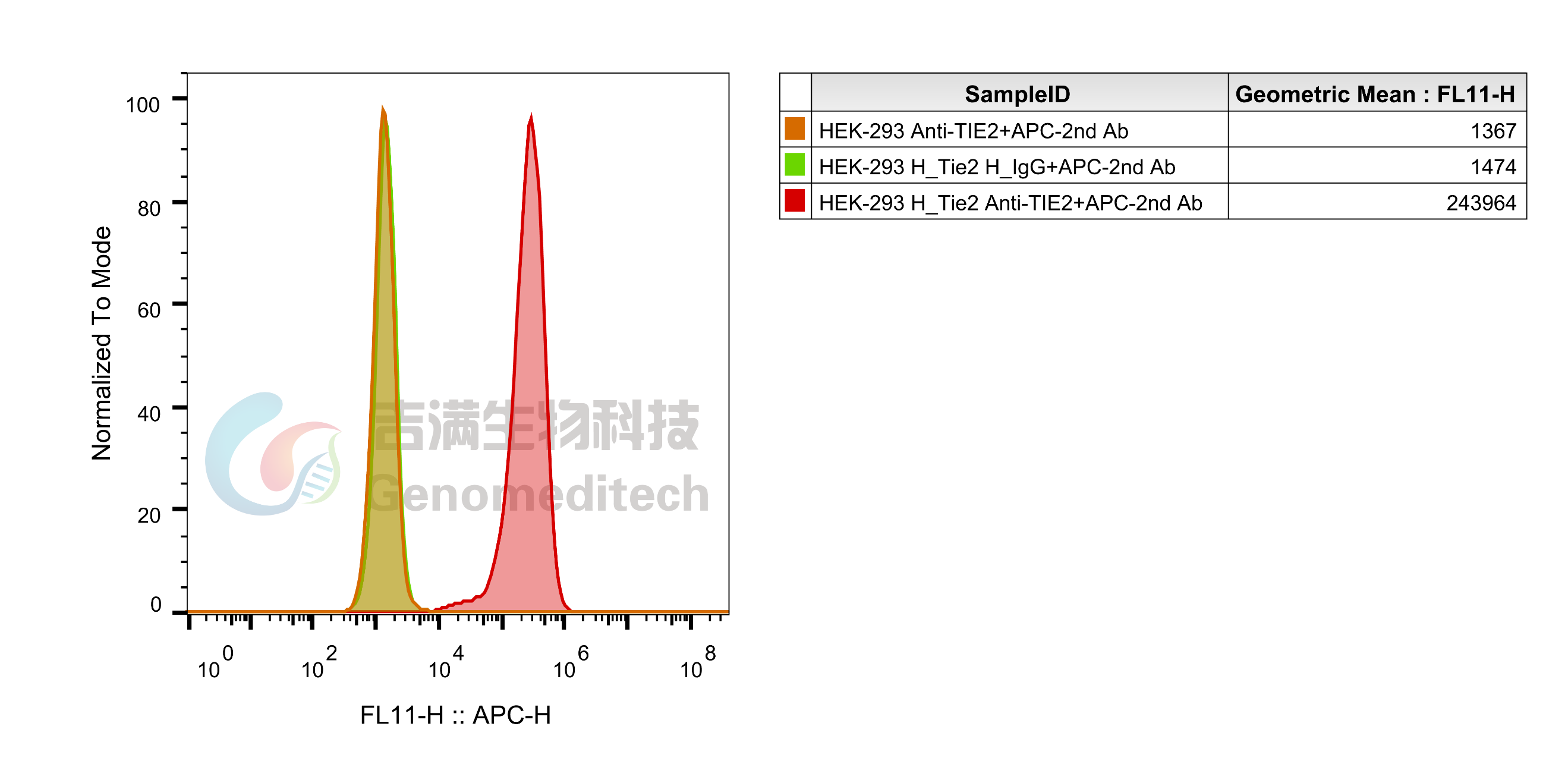
H_Tie2 HEK-293 Cell Line (Catalog # GM-C26518) was stained with Anti-TIE2 hIgG1 Antibody (Tie2 2.38) (Catalog # GM-51860AB) or isotype control antibody, followed by anti-Human IgG APC-conjugated Secondary Antibody.
Description
Species Reactivity Human
Clone Tie2 2.38
Source/Isotype Human IgG1, Kappa
Application Flow Cytometry
Target Detects TIE2
Gene TIE2
Other Names TEK, VMCM, VMCM1, CD202b
Gene ID 7010(Human)
Background TIE2 gene is located in the human genome 1p33-1p34 region, encoding tyrosine kinase receptor TIE2, is the core receptor of Angiopoietin, mainly expressed in vascular endothelium, it plays a key role in physiological and pathological angiogenesis such as embryonic vascular development, wound healing and tumor angiogenesis. Its function is regulated by the ligands Ang-1 and Ang-2: Ang-1 acts as an agonist, induces receptor phosphorylation after binding to TIE2, activates downstream signaling pathways, and activates the signaling pathway of TIE2, it enhances endothelial cell-cell junctions, reduces vascular leakage and promotes tissue homeostasis; Ang-2 often acts as a competitive antagonist under pathological conditions, weakening vascular stability, and exacerbating inflammation and exudation.
Storage Store at 2-8℃ short term (1-2 weeks). Store at ≤ -20℃ long term. Avoid repeated freeze-thaw.
Formulation Supplied as a 0.2 μm filtered solution of PBS, pH7.2-7.4.
Endotoxin < 1 EU/mg, determined by LAL gel clotting assay
Species Reactivity Human
Clone Tie2 2.38
Source/Isotype Human IgG1, Kappa
Application Flow Cytometry
Target Detects TIE2
Gene TIE2
Other Names TEK, VMCM, VMCM1, CD202b
Gene ID 7010(Human)
Background TIE2 gene is located in the human genome 1p33-1p34 region, encoding tyrosine kinase receptor TIE2, is the core receptor of Angiopoietin, mainly expressed in vascular endothelium, it plays a key role in physiological and pathological angiogenesis such as embryonic vascular development, wound healing and tumor angiogenesis. Its function is regulated by the ligands Ang-1 and Ang-2: Ang-1 acts as an agonist, induces receptor phosphorylation after binding to TIE2, activates downstream signaling pathways, and activates the signaling pathway of TIE2, it enhances endothelial cell-cell junctions, reduces vascular leakage and promotes tissue homeostasis; Ang-2 often acts as a competitive antagonist under pathological conditions, weakening vascular stability, and exacerbating inflammation and exudation.
Storage Store at 2-8℃ short term (1-2 weeks). Store at ≤ -20℃ long term. Avoid repeated freeze-thaw.
Formulation Supplied as a 0.2 μm filtered solution of PBS, pH7.2-7.4.
Endotoxin < 1 EU/mg, determined by LAL gel clotting assay
Related products
For laboratory research use only. Direct human use, including taking orally and injection and clinical use are forbidden.
Anti-TIE2 hIgG1 Antibody(Tie2 2.38)
Cat. No.
GM-51860AB
Size
10 μg
100 μg
1mg
Quote
Data display
Description
Related products
Data display
Flow cytometry
H_Tie2 HEK-293 Cell Line (Catalog # GM-C26518) was stained with Anti-TIE2 hIgG1 Antibody (Tie2 2.38) (Catalog # GM-51860AB) or isotype control antibody, followed by anti-Human IgG APC-conjugated Secondary Antibody.
Description
Species Reactivity Human
Clone Tie2 2.38
Source/Isotype Human IgG1, Kappa
Application Flow Cytometry
Target Detects TIE2
Gene TIE2
Other Names TEK, VMCM, VMCM1, CD202b
Gene ID 7010(Human)
Background TIE2 gene is located in the human genome 1p33-1p34 region, encoding tyrosine kinase receptor TIE2, is the core receptor of Angiopoietin, mainly expressed in vascular endothelium, it plays a key role in physiological and pathological angiogenesis such as embryonic vascular development, wound healing and tumor angiogenesis. Its function is regulated by the ligands Ang-1 and Ang-2: Ang-1 acts as an agonist, induces receptor phosphorylation after binding to TIE2, activates downstream signaling pathways, and activates the signaling pathway of TIE2, it enhances endothelial cell-cell junctions, reduces vascular leakage and promotes tissue homeostasis; Ang-2 often acts as a competitive antagonist under pathological conditions, weakening vascular stability, and exacerbating inflammation and exudation.
Storage Store at 2-8℃ short term (1-2 weeks). Store at ≤ -20℃ long term. Avoid repeated freeze-thaw.
Formulation Supplied as a 0.2 μm filtered solution of PBS, pH7.2-7.4.
Endotoxin < 1 EU/mg, determined by LAL gel clotting assay
Species Reactivity Human
Clone Tie2 2.38
Source/Isotype Human IgG1, Kappa
Application Flow Cytometry
Target Detects TIE2
Gene TIE2
Other Names TEK, VMCM, VMCM1, CD202b
Gene ID 7010(Human)
Background TIE2 gene is located in the human genome 1p33-1p34 region, encoding tyrosine kinase receptor TIE2, is the core receptor of Angiopoietin, mainly expressed in vascular endothelium, it plays a key role in physiological and pathological angiogenesis such as embryonic vascular development, wound healing and tumor angiogenesis. Its function is regulated by the ligands Ang-1 and Ang-2: Ang-1 acts as an agonist, induces receptor phosphorylation after binding to TIE2, activates downstream signaling pathways, and activates the signaling pathway of TIE2, it enhances endothelial cell-cell junctions, reduces vascular leakage and promotes tissue homeostasis; Ang-2 often acts as a competitive antagonist under pathological conditions, weakening vascular stability, and exacerbating inflammation and exudation.
Storage Store at 2-8℃ short term (1-2 weeks). Store at ≤ -20℃ long term. Avoid repeated freeze-thaw.
Formulation Supplied as a 0.2 μm filtered solution of PBS, pH7.2-7.4.
Endotoxin < 1 EU/mg, determined by LAL gel clotting assay
Related products
Message consultation
reset
submit
Message
Message consultation
reset
submit