





Cynomolgus FAP Protein; His Tag
Cat. No.
GM-88618RP
Size
100 μg
1 mg
Quote
Description
Data Display
Related products
Description
Alternative Names FAPalpha, SIMP, Seprase, APCE
Source Cynomolgus FAP Protein; His Tag (GM-88618RP) is expressed from human 293 cells (HEK-293). It contains AA Leu 26 - Asp 760 (Accession #
XP_005573377.1).
This protein carries a His tag at the N-terminus.
Purity > 95% as determined by SDS-PAGE
Endotoxin < 1 EU/μg, determined by LAL gel clotting assay
Predicted Mol Mass 85.9 KDa
Formulation Supplied as a 0.2 μm filtered solution of PBS, pH7.2-7.4.
Description FAP protein (Fibroblast Activation Protein) is a transmembrane serine protease that belongs to the dipeptidyl peptidase (DPP) family. It is encoded by the FAP gene and is a protein associated with the human tumor microenvironment and immune system. FAP protein was initially discovered on cancer-associated fibroblasts (CAFs) in solid tumors and later detected on activated fibroblasts in wound healing, chronic inflammation, and certain sarcoma cells.
FAP protein regulates the activity of tumor-associated fibroblasts and immune cells by binding to its substrates, including collagen, gelatin, fibroblast growth factor (FGF), and the cytokine stromal cell-derived factor-1 (SDF-1/CXCL12). Cancer-associated fibroblasts are an important type of stromal cell with the ability to remodel the extracellular matrix, promote tumor growth, and suppress anti-tumor immune responses, making them crucial members of the tumor microenvironment.
Research indicates that FAP protein plays a significant role in regulating fibroblast activity, promoting tumor progression, and modulating immune suppression. Additionally, the expression of FAP protein is associated with tumor development, invasion, and poor prognosis, making it a potential target for immunotherapy, including FAP-targeted CAR-T cells, antibody-drug conjugates (ADCs), and small molecule inhibitors for cancer treatment.
Alternative Names FAPalpha, SIMP, Seprase, APCE
Source Cynomolgus FAP Protein; His Tag (GM-88618RP) is expressed from human 293 cells (HEK-293). It contains AA Leu 26 - Asp 760 (Accession #
XP_005573377.1).
This protein carries a His tag at the N-terminus.
Purity > 95% as determined by SDS-PAGE
Endotoxin < 1 EU/μg, determined by LAL gel clotting assay
Predicted Mol Mass 85.9 KDa
Formulation Supplied as a 0.2 μm filtered solution of PBS, pH7.2-7.4.
Description FAP protein (Fibroblast Activation Protein) is a transmembrane serine protease that belongs to the dipeptidyl peptidase (DPP) family. It is encoded by the FAP gene and is a protein associated with the human tumor microenvironment and immune system. FAP protein was initially discovered on cancer-associated fibroblasts (CAFs) in solid tumors and later detected on activated fibroblasts in wound healing, chronic inflammation, and certain sarcoma cells.
FAP protein regulates the activity of tumor-associated fibroblasts and immune cells by binding to its substrates, including collagen, gelatin, fibroblast growth factor (FGF), and the cytokine stromal cell-derived factor-1 (SDF-1/CXCL12). Cancer-associated fibroblasts are an important type of stromal cell with the ability to remodel the extracellular matrix, promote tumor growth, and suppress anti-tumor immune responses, making them crucial members of the tumor microenvironment.
Research indicates that FAP protein plays a significant role in regulating fibroblast activity, promoting tumor progression, and modulating immune suppression. Additionally, the expression of FAP protein is associated with tumor development, invasion, and poor prognosis, making it a potential target for immunotherapy, including FAP-targeted CAR-T cells, antibody-drug conjugates (ADCs), and small molecule inhibitors for cancer treatment.
Data Display
Purity
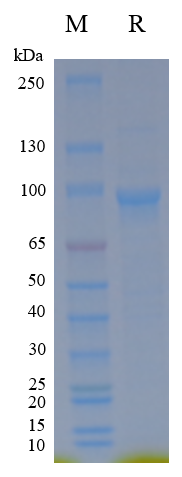
On SDS-PAGE under reducing (R) condition. The gel was stained overnight with Coomassie Blue. The purity of the protein is greater than 95%.
Affinity
Cynomolgus FAP Protein; His Tag (Catalog # GM-88618RP) was immobilized at 2 μg/ml (100 μL/well). Increasing concentrations of Anti-H_FAP hIgG1 Antibod (Simlukafusp) (Catalog # GM-30156AB) were added.
Related products
For laboratory research use only. Direct human use, including taking orally and injection and clinical use are forbidden.
Cynomolgus FAP Protein; His Tag
Cat. No.
GM-88618RP
Size
100 μg
1 mg
Quote
Description
Data Display
Related products
Description
Alternative Names FAPalpha, SIMP, Seprase, APCE
Source Cynomolgus FAP Protein; His Tag (GM-88618RP) is expressed from human 293 cells (HEK-293). It contains AA Leu 26 - Asp 760 (Accession #
XP_005573377.1).
This protein carries a His tag at the N-terminus.
Purity > 95% as determined by SDS-PAGE
Endotoxin < 1 EU/μg, determined by LAL gel clotting assay
Predicted Mol Mass 85.9 KDa
Formulation Supplied as a 0.2 μm filtered solution of PBS, pH7.2-7.4.
Description FAP protein (Fibroblast Activation Protein) is a transmembrane serine protease that belongs to the dipeptidyl peptidase (DPP) family. It is encoded by the FAP gene and is a protein associated with the human tumor microenvironment and immune system. FAP protein was initially discovered on cancer-associated fibroblasts (CAFs) in solid tumors and later detected on activated fibroblasts in wound healing, chronic inflammation, and certain sarcoma cells.
FAP protein regulates the activity of tumor-associated fibroblasts and immune cells by binding to its substrates, including collagen, gelatin, fibroblast growth factor (FGF), and the cytokine stromal cell-derived factor-1 (SDF-1/CXCL12). Cancer-associated fibroblasts are an important type of stromal cell with the ability to remodel the extracellular matrix, promote tumor growth, and suppress anti-tumor immune responses, making them crucial members of the tumor microenvironment.
Research indicates that FAP protein plays a significant role in regulating fibroblast activity, promoting tumor progression, and modulating immune suppression. Additionally, the expression of FAP protein is associated with tumor development, invasion, and poor prognosis, making it a potential target for immunotherapy, including FAP-targeted CAR-T cells, antibody-drug conjugates (ADCs), and small molecule inhibitors for cancer treatment.
Alternative Names FAPalpha, SIMP, Seprase, APCE
Source Cynomolgus FAP Protein; His Tag (GM-88618RP) is expressed from human 293 cells (HEK-293). It contains AA Leu 26 - Asp 760 (Accession #
XP_005573377.1).
This protein carries a His tag at the N-terminus.
Purity > 95% as determined by SDS-PAGE
Endotoxin < 1 EU/μg, determined by LAL gel clotting assay
Predicted Mol Mass 85.9 KDa
Formulation Supplied as a 0.2 μm filtered solution of PBS, pH7.2-7.4.
Description FAP protein (Fibroblast Activation Protein) is a transmembrane serine protease that belongs to the dipeptidyl peptidase (DPP) family. It is encoded by the FAP gene and is a protein associated with the human tumor microenvironment and immune system. FAP protein was initially discovered on cancer-associated fibroblasts (CAFs) in solid tumors and later detected on activated fibroblasts in wound healing, chronic inflammation, and certain sarcoma cells.
FAP protein regulates the activity of tumor-associated fibroblasts and immune cells by binding to its substrates, including collagen, gelatin, fibroblast growth factor (FGF), and the cytokine stromal cell-derived factor-1 (SDF-1/CXCL12). Cancer-associated fibroblasts are an important type of stromal cell with the ability to remodel the extracellular matrix, promote tumor growth, and suppress anti-tumor immune responses, making them crucial members of the tumor microenvironment.
Research indicates that FAP protein plays a significant role in regulating fibroblast activity, promoting tumor progression, and modulating immune suppression. Additionally, the expression of FAP protein is associated with tumor development, invasion, and poor prognosis, making it a potential target for immunotherapy, including FAP-targeted CAR-T cells, antibody-drug conjugates (ADCs), and small molecule inhibitors for cancer treatment.


Data Display
Purity
On SDS-PAGE under reducing (R) condition. The gel was stained overnight with Coomassie Blue. The purity of the protein is greater than 95%.
Affinity
Cynomolgus FAP Protein; His Tag (Catalog # GM-88618RP) was immobilized at 2 μg/ml (100 μL/well). Increasing concentrations of Anti-H_FAP hIgG1 Antibod (Simlukafusp) (Catalog # GM-30156AB) were added.
Related products
Message consultation
reset
submit
Message
Message consultation
reset
submit