








| Alternative Names | BT3.2,BT3.3,BTF3,BTF4 |
| Source | Human BTN3A2 Protein; His Tag (GM-88577RP) is expressed from human 293 cells (HEK-293). It contains AA Gln 30 - Trp 248 (Accession # P78410-1). This protein carries a His tag at the C-terminus. |
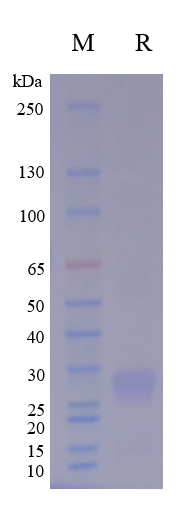
| Purity | > 95% as determined by SDS-PAGE |
| Endotoxin | < 1 EU/μg, determined by LAL gel clotting assay |
| Predicted Mol Mass | 24.4 KDa |
| Formulation | Supplied as a 0.2 μm filtered solution of PBS, pH7.2-7.4. |
| Description | BTN3A2 protein is a member of the butyrophilin (BTN) family, which belongs to the immunoglobulin superfamily. It is encoded by the BTN3A2 gene (also known as CD277) and is a protein associated with the human immune system. BTN3A2 protein was initially discovered in lymphoid tissues and later detected in various other tissues, including epithelial cells and tumor cells. BTN3A2 protein regulates the activity of γδ T cells (gamma-delta T cells) by binding to the T cell receptor (TCR) complex on the surface of γδ T cells, particularly the Vγ9Vδ2 T cell subset. γδ T cells are an important type of lymphocyte with the ability to directly kill tumor cells and infected cells, making them crucial members of the immune system. BTN3A2 functions as a key molecular switch that, upon sensing phosphoantigens produced by stressed or malignant cells, triggers the activation of γδ T cells. Research indicates that BTN3A2 protein plays a significant role in regulating the activity of γδ T cells, promoting cytotoxicity against tumor cells, and modulating immune responses. Additionally, the expression of BTN3A2 protein is associated with tumor development and immune evasion. Dysregulation of BTN3A2 expression or function can impair γδ T cell-mediated immune surveillance, making it a potential target for γδ T cell-based immunotherapies and cancer treatment. |
| Alternative Names | BT3.2,BT3.3,BTF3,BTF4 |
| Source | Human BTN3A2 Protein; His Tag (GM-88577RP) is expressed from human 293 cells (HEK-293). It contains AA Gln 30 - Trp 248 (Accession # P78410-1). This protein carries a His tag at the C-terminus. |
| Purity | > 95% as determined by SDS-PAGE |
| Endotoxin | < 1 EU/μg, determined by LAL gel clotting assay |
| Predicted Mol Mass | 24.4 KDa |
| Formulation | Supplied as a 0.2 μm filtered solution of PBS, pH7.2-7.4. |
| Description | BTN3A2 protein is a member of the butyrophilin (BTN) family, which belongs to the immunoglobulin superfamily. It is encoded by the BTN3A2 gene (also known as CD277) and is a protein associated with the human immune system. BTN3A2 protein was initially discovered in lymphoid tissues and later detected in various other tissues, including epithelial cells and tumor cells. BTN3A2 protein regulates the activity of γδ T cells (gamma-delta T cells) by binding to the T cell receptor (TCR) complex on the surface of γδ T cells, particularly the Vγ9Vδ2 T cell subset. γδ T cells are an important type of lymphocyte with the ability to directly kill tumor cells and infected cells, making them crucial members of the immune system. BTN3A2 functions as a key molecular switch that, upon sensing phosphoantigens produced by stressed or malignant cells, triggers the activation of γδ T cells. Research indicates that BTN3A2 protein plays a significant role in regulating the activity of γδ T cells, promoting cytotoxicity against tumor cells, and modulating immune responses. Additionally, the expression of BTN3A2 protein is associated with tumor development and immune evasion. Dysregulation of BTN3A2 expression or function can impair γδ T cell-mediated immune surveillance, making it a potential target for γδ T cell-based immunotherapies and cancer treatment. |