








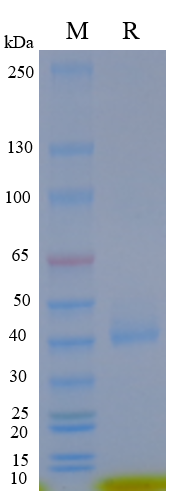





| Alternative Names | FLJ18683, T3E, TCRE, CD3-epsilon |
| Source | Human CD3E Protein; hFc Tag (GM-87535RP) is expressed from human 293 cells (HEK-293). It contains AA Gln 22 - Asp 126 (Accession # P07766). This protein carries a hFc tag at the C-terminus. |
| Purity | > 90% as determined by SDS-PAGE |
| Endotoxin | < 1 EU/μg, determined by LAL gel clotting assay |
| Predicted Mol Mass | 37.8 kDa |
| Formulation | Supplied as a 0.2 μm filtered solution of PBS, pH 7.2–7.4. |
| Description | CD3E, located on human chromosome 11, encodes a 207-amino-acid type I transmembrane glycoprotein and constitutes an essential signaling subunit of the T-cell receptor (TCR)–CD3 complex. Its extracellular immunoglobulin-like domain pairs with CD3D and CD3G to form the CD3δε and CD3γε heterodimers engaging the TCRαβ chains, whereas its cytoplasmic immunoreceptor tyrosine-based activation motif (ITAM) transduces antigen signals through LCK/FYN phosphorylation and ZAP70 recruitment, governing adaptive immunity and T-cell development. The 3.7 Å cryo-EM structure of the human TCRαβ:CD3γε:CD3δε:CD3ζζ complex delineates its octameric assembly, establishing CD3E as a target for anti-CD3 antibodies and T-cell-engaging bispecific immunotherapies. |
| Alternative Names | FLJ18683, T3E, TCRE, CD3-epsilon |
| Source | Human CD3E Protein; hFc Tag (GM-87535RP) is expressed from human 293 cells (HEK-293). It contains AA Gln 22 - Asp 126 (Accession # P07766). This protein carries a hFc tag at the C-terminus. |
| Purity | > 90% as determined by SDS-PAGE |
| Endotoxin | < 1 EU/μg, determined by LAL gel clotting assay |
| Predicted Mol Mass | 37.8 kDa |
| Formulation | Supplied as a 0.2 μm filtered solution of PBS, pH 7.2–7.4. |
| Description | CD3E, located on human chromosome 11, encodes a 207-amino-acid type I transmembrane glycoprotein and constitutes an essential signaling subunit of the T-cell receptor (TCR)–CD3 complex. Its extracellular immunoglobulin-like domain pairs with CD3D and CD3G to form the CD3δε and CD3γε heterodimers engaging the TCRαβ chains, whereas its cytoplasmic immunoreceptor tyrosine-based activation motif (ITAM) transduces antigen signals through LCK/FYN phosphorylation and ZAP70 recruitment, governing adaptive immunity and T-cell development. The 3.7 Å cryo-EM structure of the human TCRαβ:CD3γε:CD3δε:CD3ζζ complex delineates its octameric assembly, establishing CD3E as a target for anti-CD3 antibodies and T-cell-engaging bispecific immunotherapies. |