








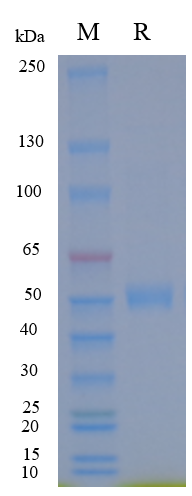







| Alternative Names | CD40LG, CD154, HIGM1, IGM, IMD3, T-BAM, TNFSF5, TRAP, gp39 |
| Source | Human CD40L Protein; His Tag (Trimer Design) (GM-88915RP) is expressed from human 293 cells (HEK-293). It contains AA Gly 116 - Leu 261 (Accession # P29965). This protein carries a His tag at the N-terminus. |
| Purity | > 90% as determined by SDS-PAGE |
| Endotoxin | < 1 EU/μg, determined by LAL gel clotting assay |
| Predicted Mol Mass | 50.1 kDa |
| Formulation | Supplied as a 0.2 μm filtered solution of PBS, pH 7.2–7.4. |
| Description | CD40L is a receptor ligand, also known as CD154. It is a membrane protein mainly expressed by activated T cells. CD40L binds to the CD40 receptor, and this binding plays an important role in the immune system, particularly in the activation of B cells and antibody production. This signaling pathway is crucial for the normal functioning of the immune system. CD40L has also been found in other cell types, such as macrophages and dendritic cells. Due to its significant role in immune regulation, CD40L has become a focus of research and drug development. |
| Alternative Names | CD40LG, CD154, HIGM1, IGM, IMD3, T-BAM, TNFSF5, TRAP, gp39 |
| Source | Human CD40L Protein; His Tag (Trimer Design) (GM-88915RP) is expressed from human 293 cells (HEK-293). It contains AA Gly 116 - Leu 261 (Accession # P29965). This protein carries a His tag at the N-terminus. |
| Purity | > 90% as determined by SDS-PAGE |
| Endotoxin | < 1 EU/μg, determined by LAL gel clotting assay |
| Predicted Mol Mass | 50.1 kDa |
| Formulation | Supplied as a 0.2 μm filtered solution of PBS, pH 7.2–7.4. |
| Description | CD40L is a receptor ligand, also known as CD154. It is a membrane protein mainly expressed by activated T cells. CD40L binds to the CD40 receptor, and this binding plays an important role in the immune system, particularly in the activation of B cells and antibody production. This signaling pathway is crucial for the normal functioning of the immune system. CD40L has also been found in other cell types, such as macrophages and dendritic cells. Due to its significant role in immune regulation, CD40L has become a focus of research and drug development. |