









The recent strategic collaboration between Hengrui Pharma and Bristol Myers Squibb marks a significant step in the ongoing evolution of global pharmaceutical R&D partnerships. Under the agreement, the two companies will jointly advance a portfolio of 13 early-stage programs across oncology and immunology, combining complementary capabilities in discovery, early clinical development, and translational research. The collaboration also includes both in-licensed assets and jointly discovered programs, reflecting an increasingly integrated approach to innovation rather than traditional one-directional licensing structures.
Rather than a conventional asset transfer deal, this partnership highlights a broader industry shift toward earlier-stage collaboration models, where pharmaceutical companies are working together closer to the point of discovery to accelerate proof-of-concept generation and improve R&D efficiency.
From single assets to discovery ecosystems
This shift is also reflected in how pharmaceutical partnerships are being redefined structurally. The collaboration between Jiangsu Hengrui Pharmaceuticals and Bristol Myers Squibb illustrates a broader move away from traditional single-asset licensing toward more integrated, multi-program models. Rather than focusing on one-off molecule transfers, the partnership is designed to support the co-development of multiple early-stage oncology assets in parallel. This structure allows both parties to share not only risk and cost, but also scientific insight across programs, effectively creating a more continuous discovery pipeline rather than isolated transactional milestones.
Expansion toward portfolio-based bispecific antibody development
A similar evolution can also be seen in another collaboration involving Bristol Myers Squibb, this time with BioNTech. The partnership extends beyond conventional co-development agreements and focuses on the global development and commercialization of BNT327, a PD-L1×VEGF-A bispecific antibody candidate designed for multiple solid tumor indications. Under the agreement, both companies share development, manufacturing, and commercialization responsibilities through a 50/50 profit-and-loss structure, while jointly advancing a broad clinical program across several tumor types.
Rather than positioning the collaboration around a single narrowly defined asset, the agreement reflects a broader strategy centered on scalable immuno-oncology platforms and combination-based development. BNT327 is being evaluated across more than 20 ongoing or planned clinical studies, including registrational Phase 3 programs in lung cancer and other solid tumors, with the partnership designed to support expansion into additional indications and combination therapies.
The collaboration also highlights the growing importance of bispecific antibody platforms in oncology R&D. BioNTech previously strengthened its position in this area through the acquisition of Biotheus, securing full global rights to BNT327 and expanding its broader oncology platform strategy before entering the partnership with Bristol Myers Squibb.
Together, these developments reflect an industry-wide preference for platform-oriented collaboration models, where pharmaceutical companies increasingly prioritize multi-indication scalability, shared development infrastructure, and long-term portfolio expansion over traditional single-asset licensing structures.
Integration of external discovery capabilities into internal R&D systems
Roche has increasingly adopted an ecosystem-oriented R&D model by expanding collaborations with discovery-focused biotechnology companies. Rather than relying exclusively on internal research capabilities, the company is building structured partnerships to access early-stage target discovery and disease biology insights, particularly in areas such as immunology and immune-mediated diseases.
A representative example is its collaboration with Repertoire Immune Medicines on T cell-targeted therapies for autoimmune diseases. In this agreement, Repertoire applies its DECODE™ platform to map T cell receptor–antigen interactions and identify novel disease-relevant targets at the discovery stage. Roche’s Genentech division then takes responsibility for downstream development, including preclinical work, clinical development, and eventual commercialization of selected candidates.
This structure enables early-stage scientific discovery to be conducted externally, while being directly integrated into Roche’s internal translational and clinical development system. Rather than functioning as isolated research inputs, externally generated target insights are systematically transferred into a centralized development framework, supporting earlier decision-making and more efficient pipeline progression.
Overall, this collaboration illustrates a model in which early discovery capabilities are increasingly distributed across external innovation partners, but tightly connected to internal R&D systems for downstream development and commercialization.
Embedding external technologies through partnerships and acquisitions
AstraZeneca continues to strengthen its pipeline through acquisitions and technology-focused partnerships, with a growing emphasis on next-generation cell and gene therapy platforms. A representative example is its acquisition of Belgian biotech EsoBiotec, a deal centered on lentiviral vector-based in vivo cell therapy technologies. Through this transaction, AstraZeneca gained access to EsoBiotec’s ENaBL platform, which is designed to deliver genetic instructions directly into immune cells inside the body, potentially simplifying the manufacturing process traditionally required for cell therapies.
This strategy reflects AstraZeneca’s broader effort to integrate external platform technologies directly into its internal R&D system. Rather than treating acquisitions as standalone pipeline additions, the company is using them to expand its technological capabilities in areas such as in vivo cell engineering, gene delivery, and novel therapeutic modalities. The increasing focus on enabling technologies and platform integration highlights how large pharmaceutical companies are positioning external innovation as a core component of long-term drug discovery and development.
Across these examples, the direction of travel is consistent. Pharmaceutical innovation is becoming more distributed across organizations, more dependent on platform-level capabilities, and increasingly concentrated at the early discovery stage. Rather than competing solely on late-stage development strength, companies are building interconnected ecosystems that continuously generate and refine candidate assets, reshaping how pipelines are formed and sustained.
Early-stage assets are becoming the center of pharmaceutical value creation
Across the industry, pharmaceutical companies are increasingly shifting their sourcing strategies toward earlier-stage assets. This reflects a deeper structural change in how R&D value is generated.
An analysis from McKinsey shows a clear and persistent trend: companies that outperform in the biopharmaceutical sector consistently source a larger proportion of their assets at the preclinical stage compared to non-outperformers. Over time, this difference has become more pronounced, indicating that early-stage asset sourcing is strongly correlated with long-term commercial success.
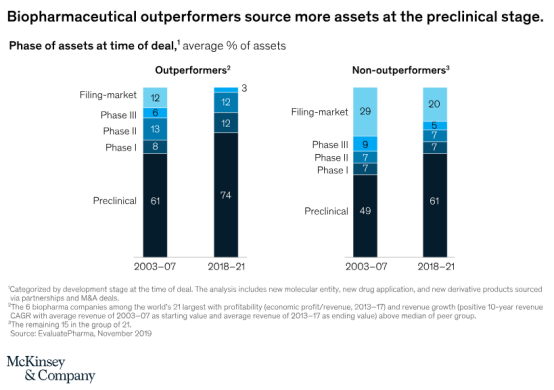
In other words, the center of gravity in drug development is shifting upstream. Competitive advantage is increasingly defined not at approval or late-stage development, but at the earliest phases of discovery and validation.
Functional biology as the foundation of next-generation drug discovery
Across therapeutic modalities and partnership models, pharmaceutical R&D is increasingly shifting toward earlier-stage, more biologically complex decision-making. As illustrated by emerging collaborations such as Hengrui Pharma and Bristol Myers Squibb, drug discovery is no longer defined primarily by single-target progression, but is evolving toward integrated, multi-program and platform-driven approaches.
In parallel, the scientific requirements of early discovery are also becoming more demanding. Modalities such as bispecific antibodies, antibody-drug conjugates, and immune-modulating therapies require not only binding affinity data, but also robust functional evidence that reflects pathway activity, cellular response, and mechanism of action at a systems level. As a result, functional validation has become a key determinant of early-stage confidence and downstream program progression.
However, this shift is also increasing pressure on speed, reproducibility, and experimental standardization. Many research teams still face bottlenecks in developing and optimizing in-house assay systems, which can delay the transition from target identification to translational validation. In this context, standardized and ready-to-use functional models are becoming increasingly important for enabling faster and more consistent early-stage decision-making.
To support this evolving landscape, Genomeditech provides professional reporter gene cell line-based bioassay services for in vitro activity screening and efficacy evaluation of candidate drugs, including antibodies, ADCs, and small molecules. With more than 400 well-characterized target cell lines, we deliver efficient, sensitive, and reliable solutions. Our expertise has supported multiple biopharmaceutical IND submissions, helping clients achieve success in early-stage research and accelerate their drug discovery programs.
Reference
Bristol Myers Squibb. (2026, May 12). Bristol Myers Squibb and Hengrui Pharma announce strategic agreements to advance innovative medicines across oncology, hematology, and immunology. https://news.bms.com/news/details/2026/Bristol-Myers-Squibb-and-Hengrui-Pharma-Announce-Strategic-Agreements-to-Advance-Innovative-Medicines-Across-Oncology-Hematology-and-Immunology-2026-EbQpaI6Zdc/default.aspx
BioNTech SE. (n.d.). BioNTech and Bristol Myers Squibb announce global strategic collaboration. https://investors.biontech.de/news-releases/news-release-details/biontech-and-bristol-myers-squibb-announce-global-strategic
PR Newswire. (n.d.). Repertoire Immune Medicines enters into collaboration and license agreement with Genentech for the development of T-cell targeted therapies for an autoimmune disease. https://www.prnewswire.com/news-releases/repertoire-immune-medicines-enters-into-collaboration-and-license-agreement-with-genentech-for-the-development-of-t-cell-targeted-therapies-for-an-autoimmune-disease-302435298.html
Fierce Biotech. (n.d.). AstraZeneca goes in vivo, penning $1B deal with Belgian lentiviral vector cell therapy biotech. https://www.fiercebiotech.com/biotech/astrazeneca-goes-vivo-penning-1b-deal-belgian-lentiviral-vector-cell-therapy-biotech
McKinsey & Company. (n.d.). Innovation sourcing in biopharma: Four practices to maximize success. https://www.mckinsey.com/industries/life-sciences/our-insights/innovation-sourcing-in-biopharma-four-practices-to-maximize-success/