





Insights
Press Release
Current position:News > Insights
IL-6: The Next Major Target in Inflammation Research
Genomdeitech
2026-06-10

From Novartis' $1.4 billion acquisition of Tourmaline Bio’s lead asset, the IL-6 monoclonal antibody pacibekitug, to the first IL-6/VEGF bispecific antibody, IL-6 has rapidly become a focal point in recent innovative drug development.

This trend reflects more than capital allocation or pipeline strategy, it signals a deeper shift in how the industry understands the role of IL-6. Rather than being viewed solely as a classical inflammatory target, IL-6 is increasingly recognized as a key node connecting inflammation, metabolism, and disease progression. To understand this shift, it is first necessary to take a closer look at IL-6 itself.


IL-6 Signaling Mechanisms

Interleukin-6 (IL-6) is a pleiotropic cytokine and an important member of the interleukin family. It exerts a wide range of biological effects and is involved not only in inflammatory and infectious responses but also in the regulation of metabolism, tissue regeneration, and neurological processes.


IL-6 is a small glycoprotein with a molecular weight of approximately 19–28 kDa. It consists of 184 amino acids arranged into a characteristic four-α-helix structure and typically exists as a monomer. IL-6 is produced by a variety of cell types, including T lymphocytes, monocytes/macrophages, fibroblasts, and numerous tumor cells.


The IL6 gene is located on human chromosome 7p21 and is transcriptionally activated in response to infection, tissue injury, or immune stimulation. NF-κB and STAT3 are key transcription factors that regulate IL-6 gene expression, playing central roles in inflammatory and stress-related signaling pathways.
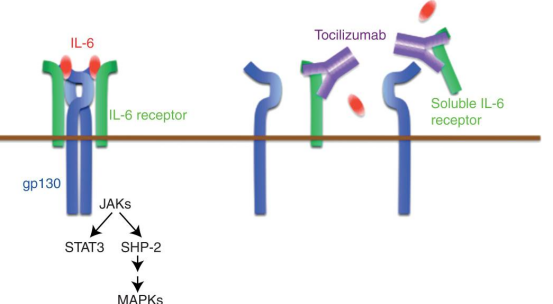
IL-6 exerts its biological functions primarily through the IL-6R/gp130/JAK/STAT3 signaling pathway. Upon binding to the IL-6 receptor (IL-6R), IL-6 recruits gp130 to form a receptor complex, leading to the activation of Janus kinases (JAKs) and subsequent phosphorylation of STAT3. Activated STAT3 then translocates to the nucleus, where it regulates the expression of genes involved in cell proliferation, survival, inflammation, and immune responses.


Within the tumor microenvironment, IL-6 frequently sustains STAT3 activation through autocrine or paracrine signaling mechanisms. Persistent activation of this pathway promotes tumor cell proliferation, inhibits apoptosis, stimulates angiogenesis, and enhances immune evasion.


As a result, the IL-6/STAT3 signaling axis is widely recognized as a key molecular link between chronic inflammation and tumor progression, and has emerged as a promising therapeutic target in cancer treatment.


IL-6: One Target, Multiple Therapeutic Strategies

IL-6 plays a critical role in the pathogenesis of multiple diseases, including rheumatoid arthritis (RA), celiac disease (CD), inflammatory bowel disease (IBD), diabetes, vitiligo, psoriasis, and multiple sclerosis (MS).


Targeting the IL-6 signaling pathway has become an important area of therapeutic development in recent years, with well-established clinical validation, particularly in autoimmune diseases. Current IL-6 pathway inhibition strategies can be broadly divided into two main categories: IL-6 receptor antagonists and IL-6 ligand antagonists.


As illustrated below, IL-6 receptor antagonists include tocilizumab, sarilumab, and satralizumab. These agents target the IL-6 receptor (IL-6R) and bind to both the membrane-bound IL-6 receptor (mIL-6R) and soluble IL-6 receptor (sIL-6R), thereby preventing IL-6 from forming the signaling complex with its receptor and blocking downstream pathway activation.


IL-6 ligand antagonists include olokizumab, siltuximab, sirukumab, clazakizumab, and MEDI 5117. These antibodies directly bind to the IL-6 cytokine, preventing its interaction with IL-6R and thereby inhibiting downstream signal transduction.


In addition, Olamkicept selectively interferes with IL-6/sIL-6R complex-mediated signaling, primarily inhibiting IL-6 trans-signaling and cell-cell signaling pathways.
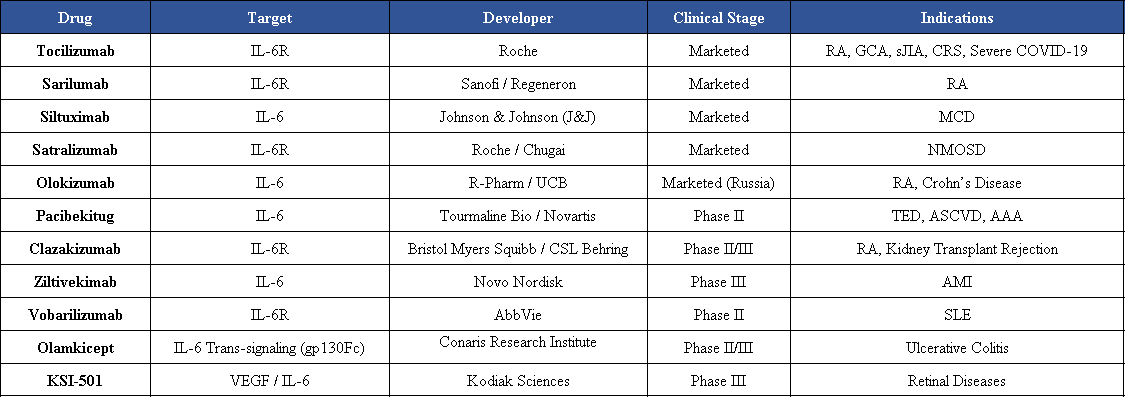


Therapeutic strategies targeting IL-6 or the IL-6 receptor (IL-6R) have already demonstrated clinical success in autoimmune diseases. The first FDA-approved anti-IL-6 therapy was tocilizumab, initially approved for the treatment of rheumatoid arthritis (RA). By blocking IL-6 signaling, tocilizumab effectively reduces inflammation and joint damage, becoming an important treatment option for RA patients.


Beyond RA, tocilizumab has since gained approvals for systemic juvenile idiopathic arthritis (sJIA), giant cell arteritis (GCA), polyarticular juvenile idiopathic arthritis (pJIA), and cytokine release syndrome (CRS). In addition, given the critical role of IL-6 in the immune dysregulation observed in severe COVID-19 patients, the U.S. FDA granted Emergency Use Authorization (EUA) for tocilizumab in June 2021 for the treatment of hospitalized adults and children aged two years and older with COVID-19.


Benefiting from its early market entry, broad clinical adoption, and later approval for COVID-19 treatment, tocilizumab achieved peak global sales of US$3.96 billion in 2021. However, as patent exclusivity has expired and biosimilars continue to enter the market, competition within the IL-6R inhibitor space has intensified. This trend has accelerated the development of IL-6 ligand inhibitors, as well as next-generation approaches such as long-acting antibodies and bispecific antibodies.


Long-acting antibodies are designed to extend drug half-life or optimize Fc-mediated pharmacokinetics, enabling sustained therapeutic exposure and less frequent dosing. Ziltivekimab, an anti-IL-6 monoclonal antibody, has demonstrated a remarkable ability to reduce high-sensitivity C-reactive protein (hsCRP) levels in chronic inflammatory cardiovascular conditions such as atherosclerotic cardiovascular disease (ASCVD) and chronic kidney disease (CKD). Its prolonged duration of action also supports the possibility of once-monthly or even less frequent administration.


Another notable example is Pacibekitug (TOUR006), the lead asset of Tourmaline Bio. Designed for quarterly dosing, Pacibekitug offers enhanced convenience for patients and has attracted significant industry attention. Recognizing its potential, Novartis acquired Tourmaline Bio in a US$1.4 billion deal in late 2025, securing Pacibekitug as a key component of its strategy to strengthen its presence in inflammation-driven cardiovascular and chronic disease therapeutics.


Beyond extending drug half-life, another emerging innovation in the IL-6 field is the development of bispecific antibodies. By simultaneously modulating two disease-driving pathways, bispecific antibodies have the potential to overcome some of the limitations associated with single-target therapies. KSI-501, developed by Kodiak Sciences, exemplifies this approach by combining VEGF and IL-6 inhibition in a single molecule, reflecting the broader industry trend toward multi-mechanism therapeutic strategies.


Conclusion

Overall, IL-6-related therapies are evolving from single-pathway inhibition toward broader, long-term therapeutic strategies across a wider range of diseases. Whether through long-acting antibodies or bispecific approaches, the underlying goal is to expand the clinical boundaries of this pathway. As more pipeline programs generate clinical data, the true therapeutic potential of IL-6-targeted therapies will continue to be redefined.


Reference

Conaris Research Institute. (n.d.). Pipeline. https://www.conaris.de/en/pipeline-eng/ 


ClinicalTrials.gov. (n.d.). A study of pacibekitug (TOUR006) in thyroid eye disease (TED) (NCT06362759). U.S. National Library of Medicine. https://clinicaltrials.gov/study/NCT06362759


ClinicalTrials.gov. (n.d.). Clazakizumab in chronic active antibody-mediated rejection (NCT05485961). U.S. National Library of Medicine. https://clinicaltrials.gov/study/NCT05485961 


ClinicalTrials.gov. (n.d.). A study of ziltivekimab in participants with a history of myocardial infarction, chronic kidney disease, and systemic inflammation (NCT07301034). U.S. National Library of Medicine. https://clinicaltrials.gov/study/NCT07301034 


ClinicalTrials.gov. (n.d.). A study to evaluate the efficacy and safety of vobarilizumab in subjects with systemic lupus erythematosus (NCT02518620). U.S. National Library of Medicine. https://clinicaltrials.gov/study/NCT02518620 


Johnson & Johnson. (2014, April 23). SYLVANT™ (siltuximab) receives FDA approval to treat multicentric Castleman’s disease (MCD). https://www.jnj.com/media-center/press-releases/sylvant-siltuximab-receives-fda-approval-to-treat-multicentric-castlemans-disease-mcd 


Kodiak Sciences. (n.d.). Our pipeline. https://kodiak.com/our-pipeline/ 


KEVZARA. (n.d.). Official KEVZARA website. https://www.kevzara.com/ 


Roche. (2019, October 30). Roche receives FDA approval for ENSPRYNG (satralizumab) for neuromyelitis optica spectrum disorder (NMOSD). https://www.roche.com/media/releases/med-cor-2019-10-30 


BioSpace. (2020, June 10). Global roundup: Russia-developed RA drug shows significant promise in phase III study. https://www.biospace.com/global-roundup-russia-developed-ra-drug-shows-significant-promise-in-phase-iii-study 


Actemra. (n.d.). Official ACTEMRA website. https://www.actemra.com/ 
Current position:News > Insights
classify
IL-6: The Next Major Target in Inflammation Research
Genomdeitech
2026-06-10

From Novartis' $1.4 billion acquisition of Tourmaline Bio’s lead asset, the IL-6 monoclonal antibody pacibekitug, to the first IL-6/VEGF bispecific antibody, IL-6 has rapidly become a focal point in recent innovative drug development.

This trend reflects more than capital allocation or pipeline strategy, it signals a deeper shift in how the industry understands the role of IL-6. Rather than being viewed solely as a classical inflammatory target, IL-6 is increasingly recognized as a key node connecting inflammation, metabolism, and disease progression. To understand this shift, it is first necessary to take a closer look at IL-6 itself.


IL-6 Signaling Mechanisms

Interleukin-6 (IL-6) is a pleiotropic cytokine and an important member of the interleukin family. It exerts a wide range of biological effects and is involved not only in inflammatory and infectious responses but also in the regulation of metabolism, tissue regeneration, and neurological processes.


IL-6 is a small glycoprotein with a molecular weight of approximately 19–28 kDa. It consists of 184 amino acids arranged into a characteristic four-α-helix structure and typically exists as a monomer. IL-6 is produced by a variety of cell types, including T lymphocytes, monocytes/macrophages, fibroblasts, and numerous tumor cells.


The IL6 gene is located on human chromosome 7p21 and is transcriptionally activated in response to infection, tissue injury, or immune stimulation. NF-κB and STAT3 are key transcription factors that regulate IL-6 gene expression, playing central roles in inflammatory and stress-related signaling pathways.

IL-6 exerts its biological functions primarily through the IL-6R/gp130/JAK/STAT3 signaling pathway. Upon binding to the IL-6 receptor (IL-6R), IL-6 recruits gp130 to form a receptor complex, leading to the activation of Janus kinases (JAKs) and subsequent phosphorylation of STAT3. Activated STAT3 then translocates to the nucleus, where it regulates the expression of genes involved in cell proliferation, survival, inflammation, and immune responses.


Within the tumor microenvironment, IL-6 frequently sustains STAT3 activation through autocrine or paracrine signaling mechanisms. Persistent activation of this pathway promotes tumor cell proliferation, inhibits apoptosis, stimulates angiogenesis, and enhances immune evasion.


As a result, the IL-6/STAT3 signaling axis is widely recognized as a key molecular link between chronic inflammation and tumor progression, and has emerged as a promising therapeutic target in cancer treatment.


IL-6: One Target, Multiple Therapeutic Strategies

IL-6 plays a critical role in the pathogenesis of multiple diseases, including rheumatoid arthritis (RA), celiac disease (CD), inflammatory bowel disease (IBD), diabetes, vitiligo, psoriasis, and multiple sclerosis (MS).


Targeting the IL-6 signaling pathway has become an important area of therapeutic development in recent years, with well-established clinical validation, particularly in autoimmune diseases. Current IL-6 pathway inhibition strategies can be broadly divided into two main categories: IL-6 receptor antagonists and IL-6 ligand antagonists.


As illustrated below, IL-6 receptor antagonists include tocilizumab, sarilumab, and satralizumab. These agents target the IL-6 receptor (IL-6R) and bind to both the membrane-bound IL-6 receptor (mIL-6R) and soluble IL-6 receptor (sIL-6R), thereby preventing IL-6 from forming the signaling complex with its receptor and blocking downstream pathway activation.


IL-6 ligand antagonists include olokizumab, siltuximab, sirukumab, clazakizumab, and MEDI 5117. These antibodies directly bind to the IL-6 cytokine, preventing its interaction with IL-6R and thereby inhibiting downstream signal transduction.


In addition, Olamkicept selectively interferes with IL-6/sIL-6R complex-mediated signaling, primarily inhibiting IL-6 trans-signaling and cell-cell signaling pathways.


Therapeutic strategies targeting IL-6 or the IL-6 receptor (IL-6R) have already demonstrated clinical success in autoimmune diseases. The first FDA-approved anti-IL-6 therapy was tocilizumab, initially approved for the treatment of rheumatoid arthritis (RA). By blocking IL-6 signaling, tocilizumab effectively reduces inflammation and joint damage, becoming an important treatment option for RA patients.


Beyond RA, tocilizumab has since gained approvals for systemic juvenile idiopathic arthritis (sJIA), giant cell arteritis (GCA), polyarticular juvenile idiopathic arthritis (pJIA), and cytokine release syndrome (CRS). In addition, given the critical role of IL-6 in the immune dysregulation observed in severe COVID-19 patients, the U.S. FDA granted Emergency Use Authorization (EUA) for tocilizumab in June 2021 for the treatment of hospitalized adults and children aged two years and older with COVID-19.


Benefiting from its early market entry, broad clinical adoption, and later approval for COVID-19 treatment, tocilizumab achieved peak global sales of US$3.96 billion in 2021. However, as patent exclusivity has expired and biosimilars continue to enter the market, competition within the IL-6R inhibitor space has intensified. This trend has accelerated the development of IL-6 ligand inhibitors, as well as next-generation approaches such as long-acting antibodies and bispecific antibodies.


Long-acting antibodies are designed to extend drug half-life or optimize Fc-mediated pharmacokinetics, enabling sustained therapeutic exposure and less frequent dosing. Ziltivekimab, an anti-IL-6 monoclonal antibody, has demonstrated a remarkable ability to reduce high-sensitivity C-reactive protein (hsCRP) levels in chronic inflammatory cardiovascular conditions such as atherosclerotic cardiovascular disease (ASCVD) and chronic kidney disease (CKD). Its prolonged duration of action also supports the possibility of once-monthly or even less frequent administration.


Another notable example is Pacibekitug (TOUR006), the lead asset of Tourmaline Bio. Designed for quarterly dosing, Pacibekitug offers enhanced convenience for patients and has attracted significant industry attention. Recognizing its potential, Novartis acquired Tourmaline Bio in a US$1.4 billion deal in late 2025, securing Pacibekitug as a key component of its strategy to strengthen its presence in inflammation-driven cardiovascular and chronic disease therapeutics.


Beyond extending drug half-life, another emerging innovation in the IL-6 field is the development of bispecific antibodies. By simultaneously modulating two disease-driving pathways, bispecific antibodies have the potential to overcome some of the limitations associated with single-target therapies. KSI-501, developed by Kodiak Sciences, exemplifies this approach by combining VEGF and IL-6 inhibition in a single molecule, reflecting the broader industry trend toward multi-mechanism therapeutic strategies.


Conclusion

Overall, IL-6-related therapies are evolving from single-pathway inhibition toward broader, long-term therapeutic strategies across a wider range of diseases. Whether through long-acting antibodies or bispecific approaches, the underlying goal is to expand the clinical boundaries of this pathway. As more pipeline programs generate clinical data, the true therapeutic potential of IL-6-targeted therapies will continue to be redefined.


Reference

Conaris Research Institute. (n.d.). Pipeline. https://www.conaris.de/en/pipeline-eng/ 


ClinicalTrials.gov. (n.d.). A study of pacibekitug (TOUR006) in thyroid eye disease (TED) (NCT06362759). U.S. National Library of Medicine. https://clinicaltrials.gov/study/NCT06362759


ClinicalTrials.gov. (n.d.). Clazakizumab in chronic active antibody-mediated rejection (NCT05485961). U.S. National Library of Medicine. https://clinicaltrials.gov/study/NCT05485961 


ClinicalTrials.gov. (n.d.). A study of ziltivekimab in participants with a history of myocardial infarction, chronic kidney disease, and systemic inflammation (NCT07301034). U.S. National Library of Medicine. https://clinicaltrials.gov/study/NCT07301034 


ClinicalTrials.gov. (n.d.). A study to evaluate the efficacy and safety of vobarilizumab in subjects with systemic lupus erythematosus (NCT02518620). U.S. National Library of Medicine. https://clinicaltrials.gov/study/NCT02518620 


Johnson & Johnson. (2014, April 23). SYLVANT™ (siltuximab) receives FDA approval to treat multicentric Castleman’s disease (MCD). https://www.jnj.com/media-center/press-releases/sylvant-siltuximab-receives-fda-approval-to-treat-multicentric-castlemans-disease-mcd 


Kodiak Sciences. (n.d.). Our pipeline. https://kodiak.com/our-pipeline/ 


KEVZARA. (n.d.). Official KEVZARA website. https://www.kevzara.com/ 


Roche. (2019, October 30). Roche receives FDA approval for ENSPRYNG (satralizumab) for neuromyelitis optica spectrum disorder (NMOSD). https://www.roche.com/media/releases/med-cor-2019-10-30 


BioSpace. (2020, June 10). Global roundup: Russia-developed RA drug shows significant promise in phase III study. https://www.biospace.com/global-roundup-russia-developed-ra-drug-shows-significant-promise-in-phase-iii-study 


Actemra. (n.d.). Official ACTEMRA website. https://www.actemra.com/ 

Message consultation
reset
submit
Message
Message consultation
reset
submit