









CD117 (c-KIT) is not a newly discovered target.
As a classic Type III receptor tyrosine kinase, CD117 has been an important focus in life science research and drug development since its identification.
CD117 primarily exerts its biological functions through binding to its only known ligand, stem cell factor (SCF). Upon SCF binding, CD117 undergoes receptor dimerization and activates downstream signaling pathways, including the PI3K/AKT, RAS/MAPK, and JAK/STAT pathways, thereby regulating a variety of biological processes such as cell proliferation, differentiation, survival, and migration.
Due to its essential roles in various cell types, including hematopoietic stem cells, mast cells, melanocytes, germ cells, and interstitial cells of Cajal, CD117 has long been recognized as a critical regulatory node involved in maintaining cellular homeostasis.
Over the past two decades, CD117-related drug development has primarily focused on the oncology field.
In particular, in gastrointestinal stromal tumors (GISTs), KIT gene mutations are considered one of the major driving factors. Small-molecule inhibitors targeting KIT kinase activity, such as imatinib, have significantly improved therapeutic outcomes in a subset of patients and established CD117 as one of the most representative targets in precision medicine.
However, with increasing clinical experience, KIT-targeted therapies have encountered new challenges, including secondary resistance, mutations within the kinase domain, and variations in KIT dependency across different disease contexts.
These limitations have encouraged researchers to further explore the potential value of CD117 beyond traditional oncology applications.
In recent years, advances in mast cell biology have revealed the critical role of the SCF/CD117 signaling axis in mast cell development, maintenance, and functional regulation. As a result, CD117 has gradually expanded from a conventional cancer target into a promising research target in immune and inflammatory disease areas.
SCF/CD117 Signaling Regulates Mast Cell Homeostasis
Among the various CD117-expressing cell populations, mast cells represent one of the most extensively studied immune cell models. The SCF/CD117 signaling axis is essential for maintaining mast cell homeostasis by regulating progenitor cell survival, differentiation, maturation, migration, and long-term functional maintenance.
Dysregulation of SCF/CD117 signaling can lead to abnormal mast cell expansion or altered immune responses, contributing to the pathogenesis of multiple mast cell–associated disorders, including chronic urticaria, asthma, and systemic mastocytosis. These findings have further highlighted the potential of CD117 as an upstream regulatory target for investigating mast cell–driven diseases.
Importantly, CD117 research is no longer limited to kinase inhibition strategies established in oncology. With advances in antibody engineering, protein technologies, and cell-based functional models, new CD117-targeted approaches are emerging to better understand and modulate CD117-mediated biological functions. These developments are creating new opportunities for CD117 research in immune regulation and beyond, expanding its potential applications across different therapeutic areas.
CD117 Therapeutic Development Enters a New Phase
With advances in antibody engineering and targeted biologics, CD117 research is expanding beyond traditional kinase inhibition strategies toward antibody-based approaches, providing new opportunities to investigate CD117 functions in non-oncology applications.
Unlike small-molecule inhibitors that primarily block intracellular kinase activity, anti-CD117 antibodies directly recognize the extracellular domain of the receptor and offer alternative mechanisms for modulating CD117 signaling, including interference with SCF/CD117 interactions and regulation of CD117-positive cell populations.
This antibody-based strategy is particularly relevant in mast cell biology, where continuous SCF/CD117 signaling plays an essential role in cell survival, maintenance, and functional regulation. By targeting CD117-positive cells or modulating CD117-mediated signaling pathways, researchers are exploring new approaches for studying mast cell–associated disorders, including chronic urticaria and systemic mast cell diseases.
Beyond therapeutic development, the emergence of CD117 antibodies and advanced cell-based models is also accelerating the functional characterization of this target, enabling deeper investigation of CD117 biology and supporting the development of next-generation CD117-targeted strategies.
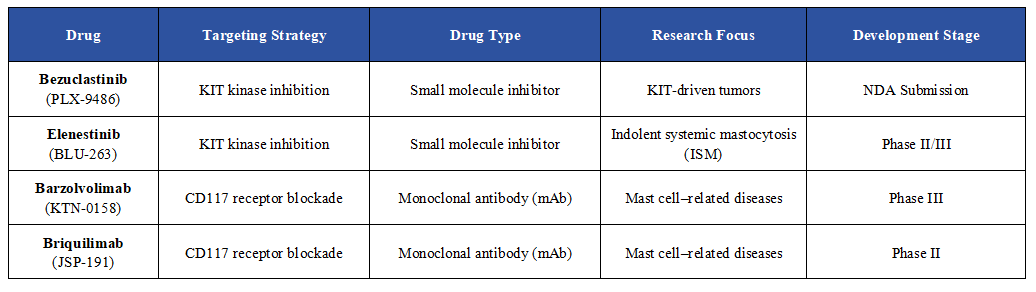
These advances highlight that CD117 is not only a well-established oncology target but also an emerging target in immune regulation and inflammatory disease research, further expanding the potential applications of CD117-targeted strategies and creating new opportunities for next-generation therapeutic development.
Supporting CD117 Target Research with Comprehensive Research Tools
As CD117 continues to expand from a classical oncology target into emerging areas such as mast cell biology, immune regulation, and inflammatory disease research, reliable research tools are essential for understanding CD117 biology and evaluating CD117-targeted therapeutic strategies.
Genomeditech has been dedicated to c-Kit (CD117) target research, providing an integrated research solution covering recombinant proteins, engineered cell lines, and antibodies. Supported by rigorous quality control systems, our CD117 research tools accelerate the development and evaluation of CD117-targeted therapeutics.
CD117-Related Cell Lines
Designed for drug functional screening, activity evaluation, pharmacodynamic studies, and CD117 signaling pathway validation.
High-Activity Recombinant Proteins
Ideal for ligand–receptor interaction studies, binding analysis, screening assays, and immunological research applications.
Highly Specific CD117 Antibodies
Supporting a wide range of detection applications, including flow cytometry, immunohistochemistry (IHC), Western blot, and ELISA, ensuring accurate and reliable experimental results.