










On August 31, 2026, Zai Lab registered a global Phase III clinical trial on ClinicalTrials.gov evaluating ZL-1310 in combination with a PD-L1 antibody as first-line treatment for extensive-stage small cell lung cancer (ES-SCLC), with 530 patients planned for enrollment. This is the second Phase III study initiated for ZL-1310, following its development in later-line treatment. Zai Lab had previously launched the global Phase III DLLEVATE study, evaluating ZL-1310 monotherapy against investigator’s choice of chemotherapy in later-line small cell lung cancer.
The pace of ZL-1310 development has attracted attention, from the enrollment of the first patient in the United States in January 2024 to the advancement of two global Phase III studies. More importantly, the progress of ZL-1310 reflects a broader shift in DLL3 development. Following the failure of Rova-T several years ago, DLL3 research entered a period of significant setbacks. The target is now being revisited through multiple therapeutic approaches, suggesting renewed interest in its potential as a drug development target.
This raises a broader question for drug developers:
What has changed in DLL3 development, and why is the target now attracting interest across multiple therapeutic modalities?
Clinical validation of the DLL3/CD3 T-cell engager mechanism by tarlatamab has provided one important line of evidence. At the same time, ADCs such as ZL-1310 are advancing rapidly, while bispecific and trispecific antibodies and CAR-T approaches are also moving into clinical development. Together, these developments indicate that DLL3 is no longer being explored through a single therapeutic strategy. Instead, it is emerging as a target that can be approached through a range of drug modalities.
From Tumor Marker to Therapeutic Target: Why DLL3 Has Drug Development Potential
DLL3 (Delta-like ligand 3) is a single-pass transmembrane protein belonging to the Notch ligand family. The human DLL3 protein consists of 619 amino acids and contains 1 DSL domain, 6 epidermal growth factor-like domains, and 1 intracellular domain.
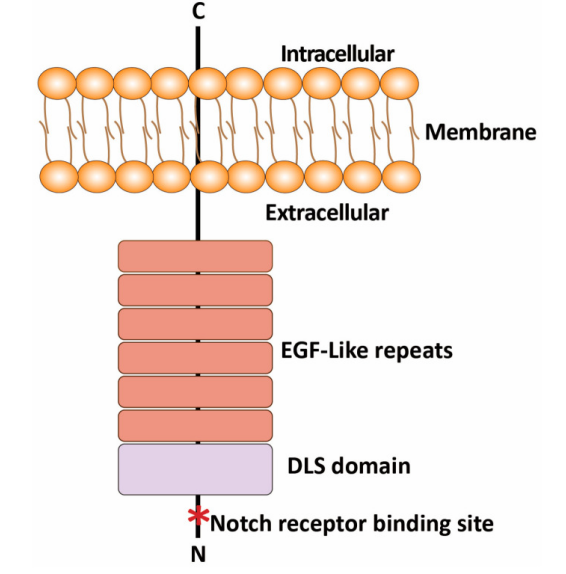
Unlike canonical Notch ligands, DLL3 primarily functions as an inhibitory regulator. It can modulate Notch receptor activation through cis-interactions and is also involved in the maturation, trafficking, and degradation of Notch receptors. DLL3 is closely associated with neuroendocrine differentiation in tumor cells and the signaling networks involved in this process.
However, for drug development, the significance of DLL3 lies less in the signaling pathways it regulates than in its differential expression between tumor cells and normal tissues.
DLL3 shows a high degree of tumor-selective expression in small cell lung cancer, while its expression in normal adult tissues is relatively limited. This expression profile gives DLL3 potential value as both a biomarker and a therapeutic target, while providing a common biological foundation for different targeted approaches, including antibodies, ADCs, and T-cell engagers.
The drug development rationale for DLL3 therefore extends beyond any single mechanism of action. As long as a therapeutic approach can effectively recognize DLL3 on the surface of tumor cells and translate target binding into tumor cell killing or functional modulation, there is room for multiple therapeutic modalities to be developed around the same target.
From Rova-T to Tarlatamab and ZL-1310: A New Phase of DLL3 Development
DLL3 development has been marked by both early promise and significant setbacks. In 2016, AbbVie acquired Stemcentrx for $5.8 billion in cash and stock, with up to $4 billion in additional milestone payments, gaining access to Rova-T, an ADC targeting DLL3. However, Rova-T failed to deliver the expected clinical benefit in subsequent studies, and results from trials such as TAHOE ultimately led to the discontinuation of the program. The setbacks also raised broader questions about the therapeutic potential of DLL3.
Yet the failure of Rova-T did not necessarily mean that DLL3 was an unsuitable target. It also raised a different question:
Could the therapeutic potential of DLL3 be better realized through a different mechanism and development strategy?
The clinical performance of an ADC depends on multiple steps, including target binding, internalization, intracellular trafficking, payload release, and the subsequent induction of tumor cell death. Limitations at any of these stages can affect the overall therapeutic outcome. Therefore, the failure of an individual ADC does not by itself establish that its target lacks drug development potential.
The subsequent development of DLL3 has provided a compelling example of this distinction. Tarlatamab introduced a different mechanism of action, using a DLL3/CD3 bispecific T-cell engager to bring T cells into proximity with DLL3-positive tumor cells and induce targeted cell killing. In May 2024, tarlatamab received accelerated approval from the FDA, becoming the first approved DLL3-targeted therapy.
The significance of tarlatamab extends beyond the success of a single drug. Its clinical development provided evidence that DLL3 could support an effective therapeutic strategy through immune-cell engagement. This was followed by growing activity across other DLL3/CD3 T-cell engager programs, while ADC development also began to regain momentum.
Zai Lab’s ZL-1310 represents one example of this renewed ADC activity. Unlike tarlatamab, which relies on T-cell recruitment, ZL-1310 uses an antibody-drug conjugate approach to selectively deliver a cytotoxic payload to DLL3-positive tumor cells. The program has now advanced into global Phase III development in small cell lung cancer, with additional clinical investigation exploring its potential in the first-line setting.
Taken together, the development of tarlatamab and ZL-1310 illustrates a broader shift in how DLL3 is being evaluated. Rather than asking whether a single drug can validate the target, researchers are increasingly exploring whether different mechanisms can unlock different aspects of DLL3 biology. The transition from T-cell engagement to targeted payload delivery suggests that DLL3 is entering a new stage of development, in which the value of the target is being tested across multiple therapeutic modalities.
DLL3 Expands Across Therapeutic Modalities
If tarlatamab and ZL-1310 represent the renewed validation of DLL3 through T-cell engagers and ADCs, respectively, the expansion of the DLL3 pipeline over the past two years points to a broader trend: DLL3 is increasingly being explored as a target for multiple therapeutic modalities.
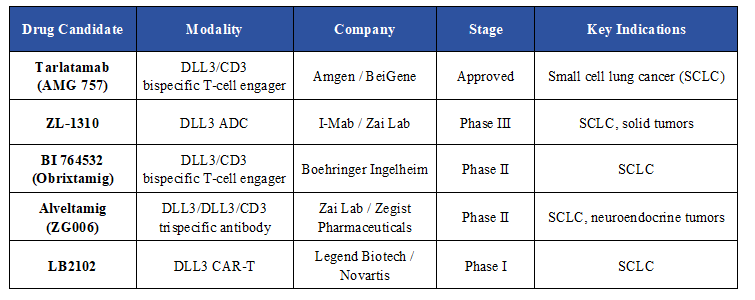
In the bispecific antibody space, Boehringer Ingelheim’s obrixtamig also employs a DLL3/CD3 T-cell engager mechanism and has advanced into later-stage clinical development in SCLC. In April 2026, Boehringer Ingelheim and Zai Lab entered into a clinical collaboration to investigate obrixtamig in combination with ZL-1310, bringing a DLL3-targeted T-cell engager and a DLL3-targeted ADC into the same therapeutic strategy.
Trispecific antibodies have also entered the DLL3 development landscape. Zegist Pharmaceuticals’ ZG006 (alveltamig) is designed as a DLL3/DLL3/CD3 trispecific antibody, incorporating two DLL3-binding arms and one CD3-binding arm to promote T-cell-mediated tumor cell killing. Its global partnership further reflects industry interest in developing multispecific antibody approaches against DLL3.
At the same time, DLL3 is expanding into the field of cell therapy.
Legend Biotech’s LB2102 is a DLL3-targeted CAR-T candidate. In 2023, Legend Biotech entered into a global exclusive licensing agreement with Novartis, under which Novartis obtained development, manufacturing, and commercialization rights to LB2102 and other DLL3-targeted CAR-T programs. Initial first-in-human data from LB2102 were subsequently presented during the 2026 ASCO meeting.
From ADCs and T-cell engagers to trispecific antibodies and CAR-T, DLL3 development is no longer centered on a single therapeutic format. Instead, multiple modalities are being explored around the same target, each using a distinct mechanism to translate DLL3 recognition into antitumor activity.
Enters a New Phase of Multimodal Drug Development
Looking back at the development of DLL3, its trajectory cannot be described simply as a story of failure followed by revival.
The failure of Rova-T exposed the limitations of pursuing DLL3 through a single ADC development strategy. Tarlatamab then provided a new form of clinical validation through a fundamentally different mechanism. As ADC programs returned to late-stage clinical development, bispecific and trispecific antibodies and CAR-T approaches also began to enter the field.
The more fundamental shift in DLL3 development is the move from finding a single DLL3-targeted drug to exploring which therapeutic mechanisms DLL3 can support.
However, multimodal development, does not mean that every therapeutic approach will succeed. Each modality still needs to address its own challenges in efficacy, safety, patient selection, and clinical positioning.
From a drug development perspective, however, DLL3 is gradually moving beyond its history as a single target tested through a single therapeutic strategy. It is becoming a target around which multiple therapeutic modalities can be explored, each seeking to translate DLL3 recognition into clinical benefit through a different mechanism
About Genomeditech
As DLL3 moves toward multimodal drug development, comprehensive research tools are becoming increasingly important for translating target biology into candidate evaluation.
Genomeditech provides a portfolio of DLL3-related cell lines and functional assays, supporting key stages from antibody screening and target characterization to activity and functional evaluation. Together, these tools provide a research foundation for advancing DLL3-targeted therapeutic development across different modalities.
Learn More: https://en.genomeditech.com/v2/search?k=DLL3
Reference
AbbVie. (2019, August 29). AbbVie discontinues rovalpituzumab tesirine (Rova-T) research and development program. AbbVie News Center. https://news.abbvie.com/2019-08-29-AbbVie-Discontinues-Rovalpituzumab-Tesirine-Rova-T-Research-and-Development-Program
Boehringer Ingelheim. (2026, April 15). Boehringer Ingelheim and Zai Lab announce collaboration on DLL3-targeting T-cell engager and ADC combination in small cell lung cancer and other neuroendocrine carcinomas. https://www.boehringer-ingelheim.com/science-innovation/human-health-innovation/boehringer-ingelheim-and-zai-lab-announce-collaboration-dll3-targeting-t-cell-engager-and-adc
ClinicalTrials.gov. (2026, August 31). A randomized, open-label, phase 3 study of ZL-1310 (DLL3 ADC) in combination with a checkpoint inhibitor as first-line therapy in extensive-stage small cell lung cancer (NCT07796100). U.S. National Library of Medicine. https://clinicaltrials.gov/study/NCT07796100
Taylor, N. P. (2026, January 5). AbbVie challenges Amgen with $100M upfront for trispecific lung cancer drug. BioSpace. https://www.biospace.com/deals/abbvie-challenges-amgen-with-100m-upfront-for-trispecific-lung-cancer-drug
Wang, H., Zheng, T., Xu, D., Sun, C., Huang, D., & Liu, X. (2025). Targeting DLL3: Innovative strategies for tumor treatment. Pharmaceutics, 17(4), 520. https://doi.org/10.3390/pharmaceutics17040520