









From the early clinical setbacks of 4-1BB agonist antibodies, to the conditional activation enabled by bispecific antibodies, and now to the first 4-1BB-targeted therapy entering NDA review, nearly two decades of exploration have brought 4-1BB (CD137), a classic immune co-stimulatory target, back to a pivotal point in cancer immunotherapy.
On August 21, 2026, Livzon Biologics announced that its independently developed PD-L1/4-1BB bispecific antibody LBL-024 (Opamtistomig) had been accepted for NDA review by the CDE of NMPA, for the treatment of patients with previously treated advanced extrapulmonary neuroendocrine carcinoma (EP-NEC). LBL-024 had previously been granted Priority Review status on July 10, 2026. Based on publicly available information, LBL-024 is the first PD-L1/4-1BB bispecific antibody globally to enter the NDA review stage. If ultimately approved, it could also become the first approved antibody therapy directly targeting 4-1BB worldwide.
For a target that first entered the drug development landscape in the early 2000s, this milestone represents more than another candidate advancing into regulatory review. More importantly, it suggests that new approaches are emerging to address the central challenge that has long constrained 4-1BB development: How to achieve sufficiently potent immune activation while maintaining an acceptable systemic safety profile and establishing a viable therapeutic window.
4-1BB: Not a Trigger, but an Amplifier of T-Cell Function
4-1BB, also known as CD137 or TNFRSF9, is an important inducible co-stimulatory receptor in cancer immunotherapy and a member of the tumor necrosis factor receptor superfamily (TNFRSF).
Unlike CD3/TCR signaling, which is primarily responsible for antigen recognition and the initial activation of T cells, 4-1BB signaling predominantly comes into play after T cells have received antigenic stimulation and entered an activated state. Following TCR engagement, 4-1BB expression is gradually upregulated, providing additional co-stimulatory signals that promote T-cell proliferation, survival, and sustained effector function. Therefore, 4-1BB is not a receptor that independently drives the initial activation of T cells. Rather, it serves as an important regulatory node that reinforces and sustains immune responses after initial T-cell activation.
4-1BB expression is not restricted to a single immune cell population. During an immune response, activated CD8⁺ T cells, CD4⁺ T cells, and NK cells can all express 4-1BB, while its expression has also been observed in other immune cell populations, including B cells and dendritic cells (DCs). In the context of antitumor immunity, 4-1BB is particularly important for maintaining CD8⁺ T-cell effector function, survival, and sustained antitumor responses.
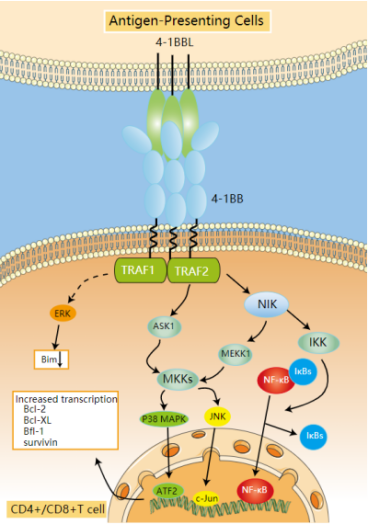
Its natural ligand, 4-1BBL (CD137L), belongs to the TNF ligand superfamily and is a type II transmembrane protein. It is primarily expressed on antigen-presenting cells, including B cells, macrophages, and dendritic cells, and can also be expressed on the surface of activated T cells and other immune cells. Binding of 4-1BB to 4-1BBL induces receptor clustering and initiates downstream signal transduction.
Structurally, human 4-1BB is a typical type I transmembrane receptor, with an extracellular region containing multiple cysteine-rich domains, followed by a transmembrane region and an intracellular signaling domain. Upon receptor clustering, 4-1BB recruits adaptor proteins such as TRAF1 and TRAF2, leading to activation of multiple downstream signaling pathways, including NF-κB, PI3K/AKT, MAPK/ERK, and p38, and regulating molecules associated with cell survival and effector function, such as Bcl-2, Bcl-XL, and survivin.
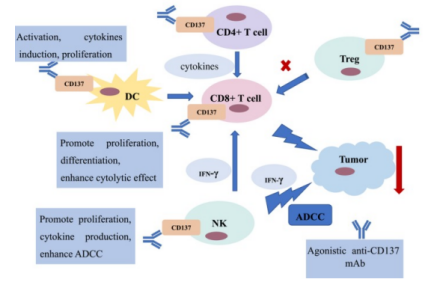
From a drug development perspective, the value of 4-1BB is therefore clear: rather than simply “turning on” the immune system, it can build upon antigen recognition and TCR activation to further enhance T-cell expansion, survival, and cytotoxicity, while engaging effector cells such as T cells and NK cells to amplify the antitumor immune response.
Yet this same potent co-stimulatory activity has also been the central challenge that 4-1BB drug development has struggled to overcome over the past two decades.
The Real Challenge: Establishing a Sufficiently Wide Therapeutic Window
The central challenge in 4-1BB drug development has never been a lack of immune-stimulatory activity. Rather, it has been how to harness this activity within a range that is sufficient to generate antitumor effects without triggering unacceptable systemic toxicity.
Early clinical studies demonstrated this challenge clearly.
Urelumab was one of the first 4-1BB agonist antibodies to enter clinical development. It was characterized by potent 4-1BB agonistic activity and could directly enhance T-cell–mediated immune signaling. However, this strong systemic activation was also associated with a significant risk of hepatotoxicity, including elevated transaminase levels and serious liver-related adverse events. Publicly available clinical data indicate that the development of Urelumab was substantially constrained by dose-limiting hepatotoxicity.
Utomilumab, another representative 4-1BB agonist, followed a different development strategy. Compared with Urelumab, it exhibited weaker 4-1BB agonistic activity and a greater dependence on FcγR-mediated crosslinking. This contributed to an improved overall safety profile, but the reduced agonistic activity also limited its clinical efficacy. Neither as monotherapy nor in combination regimens did Utomilumab demonstrate sufficient therapeutic benefit to support continued development, and its clinical program was ultimately discontinued.
Together, these two programs illustrate a fundamental dilemma in 4-1BB drug development:
Too much activation can make safety difficult to manage; too little activation may fail to generate a sufficient antitumor response.
As a result, the central question in 4-1BB development gradually evolved from simply asking whether the receptor could be activated to addressing a much more complex pharmacological challenge: where to activate it, when to activate it, how strongly to activate it, how long the activation should persist, and what degree of receptor clustering is required to generate an effective yet controllable signal.
This shift in thinking directly drove the evolution of second-generation 4-1BB drug design.
From Direct Agonism to Conditional Activation
The central question in 4-1BB drug development has gradually shifted from how to activate the receptor to how to achieve conditional and spatially restricted receptor activation.
Bispecific antibodies have therefore emerged as an important direction in next-generation 4-1BB drug development.
Unlike monospecific 4-1BB agonist antibodies that directly engage the receptor, PD-L1×4-1BB bispecific antibodies simultaneously recognize PD-L1 and 4-1BB. The underlying design principle is to leverage the expression of PD-L1 on tumor cells and other cells within the tumor microenvironment to preferentially direct 4-1BB agonistic activity toward tumor-associated sites.
From a pharmacological perspective, this approach is not simply about adding a second target. Rather, it attempts to redefine the spatial context in which 4-1BB activation occurs. By binding PD-L1 within the tumor-associated microenvironment, the antibody can potentially concentrate its activity in the tumor milieu, while engagement of 4-1BB through the second binding arm promotes receptor clustering and co-stimulatory signaling. In principle, this may help reduce the safety risks associated with systemic and nonspecific 4-1BB activation.
As a result, the competitive focus of
next-generation 4-1BB therapeutics has expanded beyond simply comparing the strength of receptor agonism. It now involves the integrated optimization of affinity, epitope, receptor clustering, FcγR dependence, bispecific architecture, and tumor localization. Emerging evidence also indicates that the agonistic potency, epitope, and FcγR-mediated crosslinking characteristics of 4-1BB antibodies can all influence their pharmacological activity and safety profiles.
Against this backdrop, PD-L1×4-1BB bispecific antibodies have emerged as one of the most representative approaches to next-generation 4-1BB drug development.
LBL-024: 4-1BB Development Enters a New Clinical Stage
LBL-024 (Opamtistomig) is a PD-L1×4-1BB bispecific antibody being developed within this evolving framework.
According to publicly available information, LBL-024 was developed using Livzon Biologics’ proprietary X-body platform and adopts a 2+2 bispecific antibody format. Its 4-1BB binding arm was deliberately engineered for lower affinity and positioned at the C-terminus of the antibody, while Fc engineering was introduced to reduce Fc-mediated effector functions such as ADCC and CDC. The overall design is intended to enable a more conditional mode of 4-1BB activation in the context of PD-L1 engagement, with the aim of addressing the systemic safety challenges associated with conventional 4-1BB agonists.
The development rationale behind this design is particularly noteworthy. For a co-stimulatory receptor such as 4-1BB, higher affinity does not necessarily translate into a better therapeutic molecule. When receptor activation itself can create dose-dependent and systemic toxicity concerns, deliberately reducing the binding strength of an individual receptor arm and relying on dual-target engagement and localized receptor clustering to restore effective functional signaling may offer a more favorable pharmacological window.
The latest clinical and regulatory progress of LBL-024 has now brought this approach into a more critical stage of clinical validation.
In August 2026, the NDA for LBL-024 was accepted for review by the CDE, with the proposed indication being previously treated patients with advanced extrapulmonary neuroendocrine carcinoma (EP-NEC). Publicly available information indicates that the application is supported by a multicenter registrational clinical study conducted across 34 clinical centers, enrolling a total of 96 patients. Detailed results from the registrational study have yet to be presented at subsequent international medical conferences.
In previously reported EP-NEC data, among 45 evaluable patients, 3 achieved complete response (CR), 12 achieved partial response (PR), and 8 achieved stable disease (SD), corresponding to an objective response rate (ORR) of 33.3% and a disease control rate (DCR) of 51.1%. From a safety perspective, no dose-limiting toxicities (DLTs) were observed in the previously reported safety population of 175 patients. The maximum tolerated dose (MTD) had not been reached at doses up to 25 mg/kg, and most adverse events were Grade 1–2 and manageable.
Meanwhile, combination data from LBL-024 in non-small cell lung cancer (NSCLC) have provided additional clinical interest in this therapeutic approach.
At the 2026 World Conference on Lung Cancer (WCLC), Phase I/II data from a clinical study evaluating LBL-024 in combination with chemotherapy as first-line treatment for patients with locally advanced or metastatic NSCLC showed an ORR of 65.0% and a DCR of 95.0% among 60 evaluable patients. In the squamous NSCLC subgroup, the ORR and DCR were 77.4% and 96.8%, respectively, while in the nonsquamous subgroup, the corresponding rates were 51.7% and 93.1%. These results were based on a median follow-up of 3.6 months, with an overall manageable safety profile and no new safety signals observed. Longer follow-up data were scheduled for further presentation in an oral session at WCLC on September 14, 2026.
These findings should nevertheless be interpreted in the context of ongoing clinical follow-up and further data maturation. For bispecific immune agonists in particular, a short-term ORR represents only one component of their clinical profile. Duration of response, PFS, OS, consistency across patient subgroups, and long-term safety will ultimately determine their clinical value and commercial potential.
Competition in 4-1BB Is Entering the Era of Mechanism-Driven Design
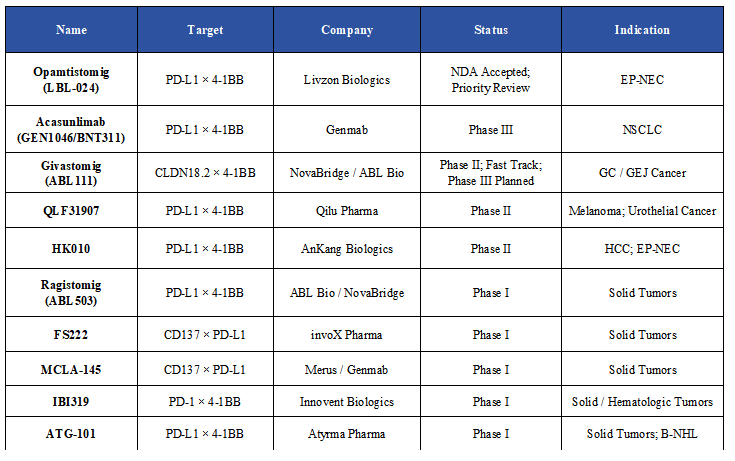
The significance of LBL-024's progress lies not simply in its proximity to potential approval, but in what it represents for the evolution of 4-1BB drug development.
Historically, 4-1BB programs focused primarily on achieving effective receptor agonism. The field is now increasingly shifting toward a more fundamental question: how can molecular design control the conditions and spatial context in which receptor agonism occurs?
As a result, competition in the 4-1BB field is no longer defined simply by which program enters clinical development first. Instead, it is increasingly centered on distinct mechanism-driven design strategies, including monospecific 4-1BB agonist antibodies, PD-(L)1×4-1BB bispecific antibodies, other tumor-associated antigen×4-1BB bispecifics, and multispecific molecules.
Among these approaches, PD-L1×4-1BB represents one of the more clinically advanced strategies. However, substantial differences remain between individual molecules, including 4-1BB affinity, binding epitope, bispecific architecture, Fc function, PD-L1 binding properties, and receptor crosslinking mechanisms.
In other words, the future differentiation of 4-1BB therapeutics may depend less on whether a molecule targets 4-1BB and more on how it targets 4-1BB.
For drug development teams, this means that simply demonstrating target binding is no longer sufficient. From early-stage candidate screening onward, development programs need to address a series of questions directly linked to mechanism of action (MoA) and candidate differentiation: Can the molecule effectively engage the target receptor? Does target engagement induce sufficient receptor clustering? How does agonistic activity relate to dose? Do different molecular formats produce distinct functional responses? Can PD-L1-mediated conditional engagement meaningfully alter 4-1BB functional activity? And does signal transduction remain consistent across different cellular contexts?
Ultimately, these questions converge on one critical requirement: a reliable, quantitative, and mechanism-relevant functional evaluation system.
Genomeditech: From Target Engagement to Functional Evaluation
For 4-1BB and other immune-regulatory targets, Genomeditech provides research tools and functional evaluation solutions covering Proteins, Cell Lines, Antibodies, and Cell-Based Assays, supporting systematic assessment from target engagement and receptor activation to downstream signaling and cellular function.
For complex molecules such as bispecific antibodies, different target-expression backgrounds and cell models can be combined to quantitatively compare potency, dose-response relationships, and functional activity, supporting candidate screening, MoA validation, and molecular optimization.
For co-stimulatory targets such as 4-1BB, the key question is not simply whether the target can be activated, but how strongly it is activated, under what conditions, and whether the resulting functional response supports a reasonable therapeutic window.
Learn More: https://en.genomeditech.com/v2/search?k=4-1BB
Reference
Nanjing Leads Biolabs Co., Ltd. (2026, August 21). Opamtistomig (LBL-024) NDA accepted by the NMPA. Leads Biolabs. https://en.leadsbiolabs.com/pressCenter/detail/dynamicDetail?id=252
Singh, R., Kim, Y.-H., Lee, S.-J., Eom, H.-S., & Choi, B. K. (2024). 4-1BB immunotherapy: Advances and hurdles. Experimental & Molecular Medicine, 56, 32–39. https://doi.org/10.1038/s12276-023-01136-4
Kim, A. M. J., Nemeth, M. R., & Lim, S.-O. (2022). 4-1BB: A promising target for cancer immunotherapy. Frontiers in Oncology, 12, 968360. https://doi.org/10.3389/fonc.2022.968360
Segal, N. H., Logan, T. F., Hodi, F. S., McDermott, D., Melero, I., Hamid, O., Schmidt, H., Robert, C., Chiarion-Sileni, V., Ascierto, P. A., Maio, M., Urba, W. J., Gangadhar, T. C., Suryawanshi, S., Neely, J., Jure-Kunkel, M. J., Krishnan, S., Kohrt, H. E., Sznol, M., & Levy, R. (2017). Results from an integrated safety analysis of urelumab, an agonist anti-CD137 monoclonal antibody. Clinical Cancer Research, 23(8), 1929–1936. https://doi.org/10.1158/1078-0432.CCR-16-1272
Segal, N. H., He, A. R., Doi, T., Levy, R., Bhatia, S., Pishvaian, M. J., ... Sznol, M. (2018). Phase I study of single-agent utomilumab (PF-05082566), a 4-1BB/CD137 agonist, in patients with advanced cancer. Clinical Cancer Research, 24(8), 1816–1823. https://doi.org/10.1158/1078-0432.CCR-17-1922
National Library of Medicine. (2026). Trial to evaluate acasunlimab and pembrolizumab combination superiority over standard of care docetaxel in non-small cell lung cancer (ABBIL1TY NSCLC-06) (NCT06635824). ClinicalTrials.gov. https://clinicaltrials.gov/study/NCT06635824