





Insights
Press Release
Current position:News > Insights
CD28: Unlocking T Cell Activation in Cancer
吉满生物
2026-07-08

About CD28

CD28 is one of the most important costimulatory receptors on T cells and provides the essential second signal during T cell antigen recognition. Following T cell receptor (TCR) engagement with peptide–MHC complexes, CD28 binds to CD80/CD86 on antigen-presenting cells, thereby activating multiple downstream signaling pathways, including PI3K–AKT, NF-κB, and MAPK. These pathways collectively promote IL-2 production, metabolic reprogramming, and the maintenance of T cell proliferation and effector function [1].
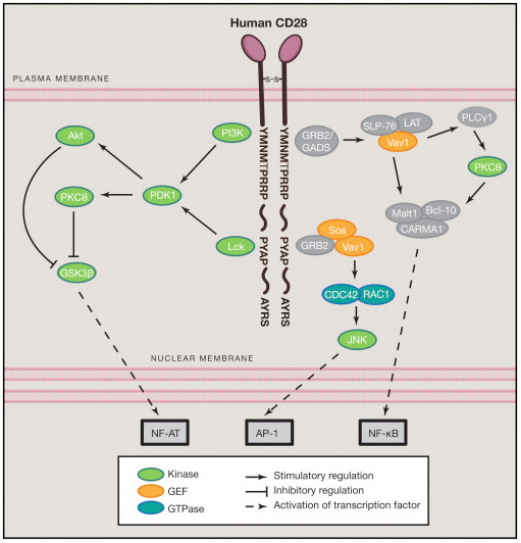
 

The fundamental role of this costimulatory axis is to amplify and stabilize the initial activation signal derived from the TCR. The magnitude of CD28 signaling output determines the efficiency with which T cells transition from a primed state to a sustained effector state. At the spatial level, CD28 signaling depends on the formation of the immunological synapse and is organized through receptor clustering and signaling complex assembly, highlighting its spatially constrained and dynamically regulated nature.


Preferential Inhibition of CD28 Signaling by PD-1

From a systems perspective, T cell activation is not governed solely by positive costimulatory inputs but reflects a dynamic balance between activating and inhibitory signaling pathways. Within this framework, PD-1 functions as a key immune checkpoint receptor that serves as a central inhibitory regulator of T cell activity.


PD-1 is an important coinhibitory receptor that negatively regulates T cell activation and has become a major therapeutic target in cancer immunotherapy. Upon binding to its ligand PD-L1, PD-1 attenuates TCR-mediated signaling, leading to reduced T cell proliferation and effector function.


Recent mechanistic studies have significantly refined this classical model. Using biochemical reconstitution systems and cellular assays, it has been demonstrated that PD-1 does not suppress TCR and costimulatory signaling uniformly. Instead, following recruitment of the SHP2 phosphatase via its intracellular ITSM motif, PD-1 preferentially targets CD28 costimulatory signaling rather than acting directly on the TCR as its primary substrate.


Specifically, phosphorylation sites within the CD28 cytoplasmic domain are more susceptible to SHP2-mediated dephosphorylation than components of the TCR signaling complex, resulting in a rapid attenuation of PI3KAKT-dependent costimulatory signaling.


Further studies have shown that under PD-L1 stimulation, both in reconstituted biochemical systems and intact T cells, CD28 phosphorylation is consistently reduced to a greater extent than TCR-associated signaling. These findings indicate that PD-1-mediated immunosuppression primarily operates through functional inactivation of the CD28 costimulatory axis rather than direct inhibition of antigen recognition signaling [2]. 


Emerging interest in CD28 costimulatory modulation

Based on this mechanistic reinterpretation, cancer immunotherapy strategies are evolving from conventional immune checkpoint blockade toward the reconstruction of costimulatory inputs and the reprogramming of T cell activation circuits. This shift has enabled emerging engineering-based approaches that position CD28 as a central node in next-generation immunotherapeutic design.
 

Pathway 1: Tumor antigenguided conditional CD28 costimulatory activation

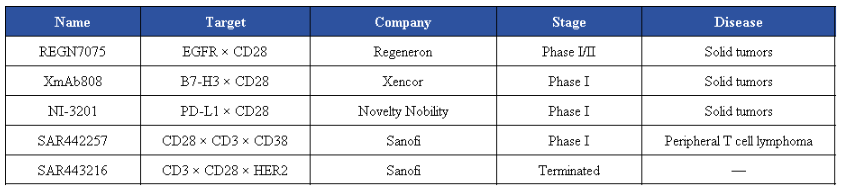
Regenerons REGN7075 (a novel costimulatory bispecific antibody targeting EGFR × CD28) enables conditional activation of CD28 within the tumor microenvironment, thereby minimizing systemic toxicity. In a first-in-human phase I/II dose-escalation study in combination with Libtayo, early clinical data in patients with microsatellite stable colorectal cancer (MSS CRC) demonstrated antitumor activity. These initial results are encouraging and suggest clinical efficacy in one of the most immunotherapy-resistant cancer types. This combination represents one of the first immunotherapy regimens to show clinical activity in MSS colorectal cancer.


Xencors XmAb808 (B7-H3 × CD28 bispecific antibody) is another representative program within this strategy. It is a tumor-selective, costimulatory XmAb 2+1 bispecific antibody designed to selectively bind the broadly expressed tumor antigen B7-H3 and the CD28 costimulatory receptor on T cells (signal 2) in the presence of tumor cells. This design restricts CD28 activation to the tumor site, thereby avoiding systemic immune overactivation and reducing the toxicity risk associated with conventional CD28 agonists. In addition, Xencors XtendFc engineering extends the serum half-life and improves overall drug exposure.


XmAb808 has completed a phase I dose-escalation study in combination with antiPD-1 therapy in patients with advanced solid tumors. Although expansion cohorts in combination with PD-1 blockade have not yet been initiated, the company is currently evaluating potential combination strategies with CD3-based T cell engager bispecific antibodies.


Pathway 2: Immune checkpointcoupled CD28 costimulatory enhancement


Novimmune has developed a PD-L1/CD28 bispecific antibody (NI-3201) using a κλ-body platform. This molecule simultaneously blocks the PD-1/PD-L1 inhibitory axis and delivers CD28-mediated costimulatory signaling upon engagement with PD-L1, thereby achieving both relief of immune suppression and direct T cell activation.


In contrast to early CD28 superagonist antibodies, next-generation PD-L1/CD28 bispecific antibodies have not demonstrated significant aberrant cytokine release in vitro cytokine release assays. This suggests that their activity is constrained by tumor-dependent ligand engagement, enabling a form of tumor-restricted activation. As a result, the risk of systemic cytokine storm is substantially reduced, representing a promising strategy for improving both efficacy and safety in CD28-based immunotherapy.


Pathway 3: CD28-based multispecific T cell activation systems


The development of CD28-targeting trispecific antibodies has remained an active area of research; however, this modality is still in its early stages, with significant challenges related to molecular engineering complexity and safety considerations.


Sanofi has developed two CD28-targeting trispecific antibody programs. Among them, SAR443216 was the first trispecific CD28-based candidate to enter clinical evaluation in 2022. However, the program was terminated in 2023, potentially reflecting limitations in early-stage molecular design, including target selection, affinity optimization, and half-life engineering


Conclusion

CD28 is evolving from a fundamental immune receptor into an engineerable T cell costimulatory signaling module, and is emerging as a central hub in next-generation bispecific and trispecific immunotherapies. At the same time, the increasing complexity of CD28-targeted drug development places higher demands on in vitro evaluation systems and functional assay platforms.


Genomeditech has been deeply engaged in the development of CD28-targeted therapeutic research, providing stable overexpression cell lines, reporter gene assay systems, antibodies, and recombinant protein products and services. Through reliable and reproducible experimental systems, we aim to support robust data generation and offer efficient research tools for both academic and industrial partners, accelerating innovation and translational development in this field.

Reference

Esensten, J. H., Helou, Y. A., Chopra, G., Weiss, A., & Bluestone, J. A. (2016). CD28 costimulation: From mechanism to therapy. Immunity, 44(5), 973–988. https://doi.org/10.1016/j.immuni.2016.04.020


Hui, E., Cheung, J., Zhu, J., Su, X., Taylor, M. J., Wallweber, H. A., Sasmal, D. K., Huang, J., Kim, J. M., Mellman, I., & Vale, R. D. (2017). T cell costimulatory receptor CD28 is a primary target for PD-1–mediated inhibition. Science, 355(6332), 1428–1433. https://doi.org/10.1126/science.aaf1292


Study Details | NCT04626635 | A Trial to Find Out How Safe REGN7075 is and How Well it Works in Combination With Cemiplimab for Adult Participants With Advanced Cancers | ClinicalTrials.gov. (n.d.). https://clinicaltrials.gov/study/NCT04626635


Study details | NCT05585034 | Phase 1, First-in-human, Dose-finding and expansion Study to evaluate XMAB®808 in combination with pembrolizumab in advanced solid tumors | ClinicalTrials.gov. (n.d.). https://clinicaltrials.gov/study/NCT05585034

Study details | NCT06805825 | A study of the C-KIT Specific Antibody-Drug Conjugate NN3201 for advanced and/or metastatic solid tumors known to express C-KIT | ClinicalTrials.gov. (n.d.). https://clinicaltrials.gov/study/NCT06805825


Study details | NCT04401020 | First-in-human Single agent study of SAR442257 in RRMM and RR-NHL | ClinicalTrials.gov. (n.d.). https://clinicaltrials.gov/study/NCT04401020


Wahner, A. (2025, March 24). SAR443216 engages HER2 with manageable toxicity in advanced HER2+ solid tumors. OncLive - Clinical Oncology News, Cancer Expert Insights. https://www.onclive.com/view/sar443216-engages-her2-with-manageable-toxicity-in-advanced-her2-solid-tumors

Current position:News > Insights
classify
CD28: Unlocking T Cell Activation in Cancer
吉满生物
2026-07-08

About CD28

CD28 is one of the most important costimulatory receptors on T cells and provides the essential second signal during T cell antigen recognition. Following T cell receptor (TCR) engagement with peptide–MHC complexes, CD28 binds to CD80/CD86 on antigen-presenting cells, thereby activating multiple downstream signaling pathways, including PI3K–AKT, NF-κB, and MAPK. These pathways collectively promote IL-2 production, metabolic reprogramming, and the maintenance of T cell proliferation and effector function [1].


The fundamental role of this costimulatory axis is to amplify and stabilize the initial activation signal derived from the TCR. The magnitude of CD28 signaling output determines the efficiency with which T cells transition from a primed state to a sustained effector state. At the spatial level, CD28 signaling depends on the formation of the immunological synapse and is organized through receptor clustering and signaling complex assembly, highlighting its spatially constrained and dynamically regulated nature.


Preferential Inhibition of CD28 Signaling by PD-1

From a systems perspective, T cell activation is not governed solely by positive costimulatory inputs but reflects a dynamic balance between activating and inhibitory signaling pathways. Within this framework, PD-1 functions as a key immune checkpoint receptor that serves as a central inhibitory regulator of T cell activity.


PD-1 is an important coinhibitory receptor that negatively regulates T cell activation and has become a major therapeutic target in cancer immunotherapy. Upon binding to its ligand PD-L1, PD-1 attenuates TCR-mediated signaling, leading to reduced T cell proliferation and effector function.


Recent mechanistic studies have significantly refined this classical model. Using biochemical reconstitution systems and cellular assays, it has been demonstrated that PD-1 does not suppress TCR and costimulatory signaling uniformly. Instead, following recruitment of the SHP2 phosphatase via its intracellular ITSM motif, PD-1 preferentially targets CD28 costimulatory signaling rather than acting directly on the TCR as its primary substrate.


Specifically, phosphorylation sites within the CD28 cytoplasmic domain are more susceptible to SHP2-mediated dephosphorylation than components of the TCR signaling complex, resulting in a rapid attenuation of PI3KAKT-dependent costimulatory signaling.


Further studies have shown that under PD-L1 stimulation, both in reconstituted biochemical systems and intact T cells, CD28 phosphorylation is consistently reduced to a greater extent than TCR-associated signaling. These findings indicate that PD-1-mediated immunosuppression primarily operates through functional inactivation of the CD28 costimulatory axis rather than direct inhibition of antigen recognition signaling [2]. 


Emerging interest in CD28 costimulatory modulation

Based on this mechanistic reinterpretation, cancer immunotherapy strategies are evolving from conventional immune checkpoint blockade toward the reconstruction of costimulatory inputs and the reprogramming of T cell activation circuits. This shift has enabled emerging engineering-based approaches that position CD28 as a central node in next-generation immunotherapeutic design.


Pathway 1: Tumor antigenguided conditional CD28 costimulatory activation

Regenerons REGN7075 (a novel costimulatory bispecific antibody targeting EGFR × CD28) enables conditional activation of CD28 within the tumor microenvironment, thereby minimizing systemic toxicity. In a first-in-human phase I/II dose-escalation study in combination with Libtayo, early clinical data in patients with microsatellite stable colorectal cancer (MSS CRC) demonstrated antitumor activity. These initial results are encouraging and suggest clinical efficacy in one of the most immunotherapy-resistant cancer types. This combination represents one of the first immunotherapy regimens to show clinical activity in MSS colorectal cancer.


Xencors XmAb808 (B7-H3 × CD28 bispecific antibody) is another representative program within this strategy. It is a tumor-selective, costimulatory XmAb 2+1 bispecific antibody designed to selectively bind the broadly expressed tumor antigen B7-H3 and the CD28 costimulatory receptor on T cells (signal 2) in the presence of tumor cells. This design restricts CD28 activation to the tumor site, thereby avoiding systemic immune overactivation and reducing the toxicity risk associated with conventional CD28 agonists. In addition, Xencors XtendFc engineering extends the serum half-life and improves overall drug exposure.


XmAb808 has completed a phase I dose-escalation study in combination with antiPD-1 therapy in patients with advanced solid tumors. Although expansion cohorts in combination with PD-1 blockade have not yet been initiated, the company is currently evaluating potential combination strategies with CD3-based T cell engager bispecific antibodies.


Pathway 2: Immune checkpointcoupled CD28 costimulatory enhancement


Novimmune has developed a PD-L1/CD28 bispecific antibody (NI-3201) using a κλ-body platform. This molecule simultaneously blocks the PD-1/PD-L1 inhibitory axis and delivers CD28-mediated costimulatory signaling upon engagement with PD-L1, thereby achieving both relief of immune suppression and direct T cell activation.


In contrast to early CD28 superagonist antibodies, next-generation PD-L1/CD28 bispecific antibodies have not demonstrated significant aberrant cytokine release in vitro cytokine release assays. This suggests that their activity is constrained by tumor-dependent ligand engagement, enabling a form of tumor-restricted activation. As a result, the risk of systemic cytokine storm is substantially reduced, representing a promising strategy for improving both efficacy and safety in CD28-based immunotherapy.


Pathway 3: CD28-based multispecific T cell activation systems


The development of CD28-targeting trispecific antibodies has remained an active area of research; however, this modality is still in its early stages, with significant challenges related to molecular engineering complexity and safety considerations.


Sanofi has developed two CD28-targeting trispecific antibody programs. Among them, SAR443216 was the first trispecific CD28-based candidate to enter clinical evaluation in 2022. However, the program was terminated in 2023, potentially reflecting limitations in early-stage molecular design, including target selection, affinity optimization, and half-life engineering


Conclusion

CD28 is evolving from a fundamental immune receptor into an engineerable T cell costimulatory signaling module, and is emerging as a central hub in next-generation bispecific and trispecific immunotherapies. At the same time, the increasing complexity of CD28-targeted drug development places higher demands on in vitro evaluation systems and functional assay platforms.


Genomeditech has been deeply engaged in the development of CD28-targeted therapeutic research, providing stable overexpression cell lines, reporter gene assay systems, antibodies, and recombinant protein products and services. Through reliable and reproducible experimental systems, we aim to support robust data generation and offer efficient research tools for both academic and industrial partners, accelerating innovation and translational development in this field.

Reference

Esensten, J. H., Helou, Y. A., Chopra, G., Weiss, A., & Bluestone, J. A. (2016). CD28 costimulation: From mechanism to therapy. Immunity, 44(5), 973–988. https://doi.org/10.1016/j.immuni.2016.04.020


Hui, E., Cheung, J., Zhu, J., Su, X., Taylor, M. J., Wallweber, H. A., Sasmal, D. K., Huang, J., Kim, J. M., Mellman, I., & Vale, R. D. (2017). T cell costimulatory receptor CD28 is a primary target for PD-1–mediated inhibition. Science, 355(6332), 1428–1433. https://doi.org/10.1126/science.aaf1292


Study Details | NCT04626635 | A Trial to Find Out How Safe REGN7075 is and How Well it Works in Combination With Cemiplimab for Adult Participants With Advanced Cancers | ClinicalTrials.gov. (n.d.). https://clinicaltrials.gov/study/NCT04626635


Study details | NCT05585034 | Phase 1, First-in-human, Dose-finding and expansion Study to evaluate XMAB®808 in combination with pembrolizumab in advanced solid tumors | ClinicalTrials.gov. (n.d.). https://clinicaltrials.gov/study/NCT05585034

Study details | NCT06805825 | A study of the C-KIT Specific Antibody-Drug Conjugate NN3201 for advanced and/or metastatic solid tumors known to express C-KIT | ClinicalTrials.gov. (n.d.). https://clinicaltrials.gov/study/NCT06805825


Study details | NCT04401020 | First-in-human Single agent study of SAR442257 in RRMM and RR-NHL | ClinicalTrials.gov. (n.d.). https://clinicaltrials.gov/study/NCT04401020


Wahner, A. (2025, March 24). SAR443216 engages HER2 with manageable toxicity in advanced HER2+ solid tumors. OncLive - Clinical Oncology News, Cancer Expert Insights. https://www.onclive.com/view/sar443216-engages-her2-with-manageable-toxicity-in-advanced-her2-solid-tumors

Message consultation
reset
submit
Message
Message consultation
reset
submit