









TSHR: From an Endocrine Target to a Multi-Disease Therapeutic Platform
In June 2026, Ethyreal Bio, a company headquartered in Cambridge, Massachusetts, announced the completion of a 101 million dollar financing round and advanced its TSHR monoclonal antibody ETHY-001 into preclinical development.
The key innovation of this program lies not in traditional suppression of thyroid hormone levels but in directly targeting the upstream pathogenic mechanism of Graves' disease by blocking the sustained activation of TSHR mediated by autoantibodies, thereby intervening in disease progression at its source.
Graves' disease, the most common autoimmune form of hyperthyroidism, has long been regarded in clinical practice as a manageable but rarely curable endocrine disorder. Its core driving mechanism is the persistent activation of the thyroid stimulating hormone receptor by pathogenic autoantibodies, which leads to excessive thyroid hormone secretion and systemic metabolic dysregulation. About half of patients further develop thyroid eye disease.
Current standard treatments for Graves' disease, including antithyroid drugs, radioactive iodine, and surgery, mainly focus on reducing hormone levels or removing thyroid tissue, but none directly interrupt the underlying autoimmune response. As a result, relapse rates remain relatively high, and prevention or improvement of thyroid eye disease remains limited.
In contrast, the strategy represented by ETHY-001 shifts the therapeutic focus upstream to immune driven mechanisms. By blocking autoantibody mediated activation of TSHR, it transforms TSHR from a traditional endocrine regulatory receptor into a central therapeutic target in autoimmune disease, laying the foundation for its potential expansion into a multi disease therapeutic platform.
TSHR: The Core Receptor in Thyroid Function Regulation
TSHR is a cell-surface glycoprotein receptor. It is a large transmembrane glycoprotein composed of 764 amino acid residues and belongs to the G protein–coupled receptor (GPCR) superfamily regulated by guanine nucleotides. Its molecular weight is approximately 87 kDa.
The TSHR gene contains 10 exons. The first nine exons encode the extracellular domain starting from the N-terminus, while exon 10 encodes the seven transmembrane helices as well as the C-terminal intracellular domain.
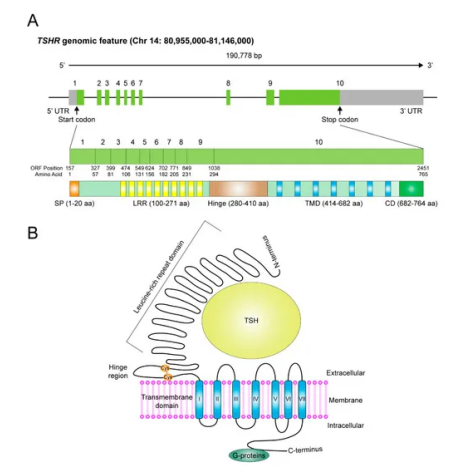
Under normal physiological conditions, thyroid-stimulating hormone (TSH) binds to TSHR to maintain the normal growth and proliferation of thyroid cells, regulate iodine metabolism, and mediate the synthesis and secretion of thyroid hormones.
TSHR is primarily located on the basolateral membrane of thyroid follicular cells. In recent years, studies have shown that in addition to the thyroid, TSHR expression and functional roles have also been reported in multiple non-thyroid tumor tissues, including melanoma, glioma, lung cancer, breast cancer, ovarian cancer, and hepatocellular carcinoma.
TSHR Signaling Transduction
TSHR couples with intracellular G proteins through its cytoplasmic domain and primarily initiates signal transduction via Gs proteins.
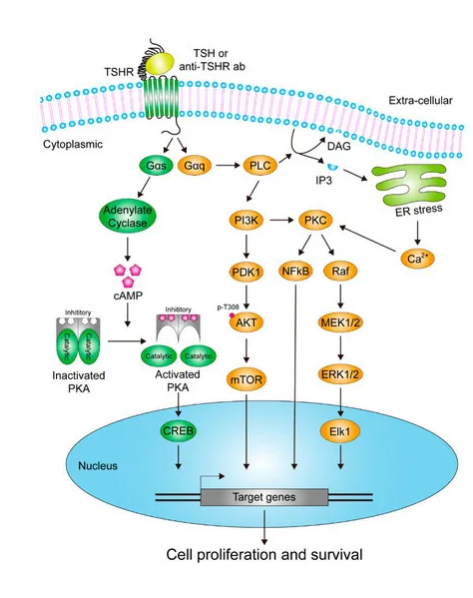
The Gs–cAMP–PKA pathway is the major canonical signaling cascade downstream of TSHR. Upon activation of the Gs pathway, intracellular cyclic adenosine monophosphate (cAMP) levels increase, leading to activation of protein kinase A (PKA). PKA phosphorylates downstream targets and regulates genes and enzymes such as thyroid peroxidase (TPO) and the sodium/iodide symporter (NIS), thereby promoting thyroid hormone synthesis and secretion.
In addition to the Gs pathway, TSHR also signals through Gq proteins. The Gαq pathway activates phospholipase C (PLC), generating IP3 and DAG, which in turn activate protein kinase C (PKC). This cascade further engages MAPK and PI3K–AKT signaling networks, collectively promoting cell proliferation, survival, and glycogen metabolism.
The downstream signaling network of TSHR exhibits extensive crosstalk. For example, cAMP can activate ERK1/2 via PKA or Rap1, while PKC can also promote ERK phosphorylation through the Ras–Raf axis, highlighting coordinated interactions among the Gs, Gq, and MAPK pathways. In addition, β-arrestins bind to activated TSHR to terminate classical G protein signaling, promote receptor internalization, and simultaneously mediate non-canonical signaling such as MAPK/ERK activation.
Recent studies have further shown that aberrant activation of the TSH–TSHR axis is not only involved in thyroid function regulation but also closely associated with tumor development. It can promote angiogenesis by increasing the secretion of vascular endothelial growth factor (VEGF) and CXC chemokine ligand 8 (CXCL8), and enhance tumor cell migration and differentiation through the PI3K/AKT/mTOR pathway. Moreover, in thyroid cancer and glioma, high TSHR expression is associated with tumor immune evasion. Inhibition of TSHR has been shown to downregulate PD-L1 expression and enhance T-cell–mediated antitumor activity.
TSHR Competitive Landscape Overview
Based on the latest developments, TSHR-targeted therapeutic strategies are gradually expanding from traditional thyroid function regulation toward a broader disease intervention framework. TSHR has been redefined as a shared pathogenic core linking Graves’ disease and thyroid eye disease (TED). Therapeutic approaches now increasingly focus on blocking autoantibody-mediated receptor activation to intervene at the mechanistic level of disease progression, reflecting a clear shift from endocrine modulation toward precision therapy for autoimmune diseases.
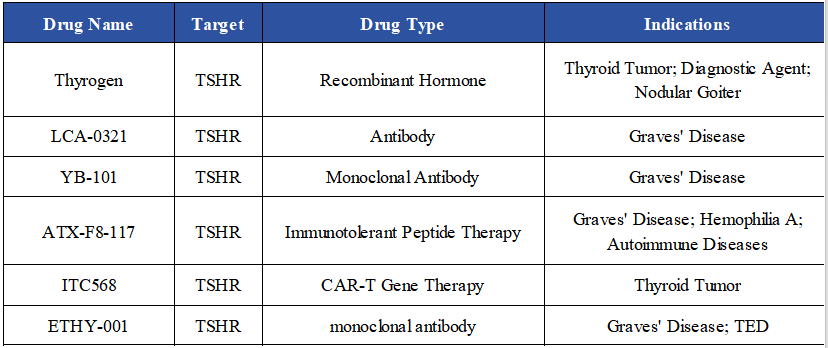
Current TSHR-related development pipelines indicate that this target is undergoing a structural transformation from a traditional endocrine receptor into a multi-disease therapeutic platform. Historically, TSHR was primarily associated with thyroid hormone regulation and differentiated thyroid cancer, with its applications largely limited to diagnostic use or supportive therapeutic roles. However, with deeper understanding of the pathogenesis of Graves’ disease (GD) and thyroid eye disease (TED), TSHR has been redefined as a central pathogenic target of autoantibody-mediated activation, shifting its biological relevance toward a disease-driving role.
In the autoimmune disease space, TSHR monoclonal antibody programs such as LCA-0321 and YB-101 are advancing through early clinical development, reflecting a strong consensus around the strategy of blocking TSHR activation as a therapeutic mechanism. In parallel, immune tolerance approaches such as ATX-F8-117 further move the intervention upstream to immune system reprogramming, aiming to reduce the production of pathogenic autoantibodies at the source. Together, these strategies illustrate an evolution from simple receptor antagonism toward broader immune modulation and disease-modifying interventions.
In oncology, TSHR is also emerging as a promising target. Cell therapy programs such as ITC568, which utilize TSHR as a tumor-associated antigen in differentiated thyroid cancer, highlight its potential applicability in cancer immunotherapy. Although still in early exploratory stages, these efforts provide initial validation of TSHR’s feasibility as a target in cell-based therapies.
Conclusion
Overall, TSHR is evolving from a single endocrine receptor into a platform-type target spanning both oncology and autoimmune diseases. The parallel development of multiple technological modalities, including antibodies, immune tolerance therapies, and cell therapies, indicates that TSHR is entering an early phase of multi-pathway competition. In the future, it may develop into a systemic drug development axis similar to TNF or the IL-17 signaling pathway.
Reference
Rapoport, B., Chazenbalk, G. D., Jaume, J. C., & McLachlan, S. M. (1998). The thyrotropin (TSH) receptor: Interaction with TSH and autoantibodies. Endocrine Reviews, 19(6), 673–716. https://doi.org/10.1210/edrv.19.6.673
Chu, Y.-D., & Yeh, C.-T. (2020). The molecular function and clinical role of thyroid stimulating hormone receptor in cancer cells. Cells, 9(7), 1730. https://doi.org/10.3390/cells9071730
Feng, F., Han, H., Wu, S., et al. (2021). Crosstalk between abnormal TSHR signaling activation and PTEN/PI3K in the dedifferentiation of thyroid cancer cells. Frontiers in Oncology, 11, 718578. https://doi.org/10.3389/fonc.2021.718578
Kleinau, G., Neumann, S., Grüters, A., et al. (2013). Novel insights on thyroid-stimulating hormone receptor signal transduction. Endocrine Reviews, 34(5), 691–724. https://doi.org/10.1210/er.2012-1072
Morshed, S. A., Ma, R., Latif, R., et al. (2018). Biased signaling by thyroid-stimulating hormone receptor-specific antibodies determines thyrocyte survival in autoimmunity. Science Signaling, 11(533), eaah4120. https://doi.org/10.1126/scisignal.aah4120
Song, Y. S., Kim, M. J., Sun, H. J., et al. (2019). Aberrant thyroid-stimulating hormone receptor signaling increases VEGF-A and CXCL8 secretion of thyroid cancer cells, contributing to angiogenesis and tumor growth. Clinical Cancer Research, 25(2), 414–425. https://doi.org/10.1158/1078-0432.CCR-18-0663
Sanofi. (n.d.). What is Thyrogen? https://www.thyrogen.com/patients/what-is-thyrogen
Yarrow. (n.d.). Pipeline programs. Lycia Therapeutics. https://lyciatx.com/pipeline/programs/
Fierce Biotech. (n.d.). Yarrow blooms $1.37B deal landing autoimmune thyroid disease drug. https://www.fiercebiotech.com/biotech/yarrow-blooms-137b-deal-landing-autoimmune-thyroid-disease-drug-chinas-gensci
PR Newswire. (n.d.). FDA grants orphan status for ATX-F8-117 for the treatment of haemophilia A patients in the US. https://www.prnewswire.com/news-releases/fda-grants-orphan-status-for-atx-f8-117-for-the-treatment-of-haemophilia-a-patients-in-the-us-506593851.html
ICT Bio. (n.d.). Pipeline. https://www.ictbio.com/pipeline/