





Where Discovery Begins
Insights
Press Release
Current position:News > Insights
CDH17: The Next Emerging Target in Gastrointestinal Cancer Therapy
吉满生物
2026-08-05

About CDH17

Cadherins are a superfamily of Ca²⁺-dependent cell adhesion molecules that play critical roles in maintaining tissue architecture and regulating cellular organization. Alterations in cadherin expression and function have been implicated in various pathological processes, including abnormal development, tumorigenesis, and cancer progression.


CDH17 (Cadherin 17), also known as liver-intestine cadherin (LI-cadherin), is a non-classical member of the cadherin superfamily. Unlike classical cadherins, CDH17 is a Ca²⁺-dependent transmembrane glycoprotein consisting of seven extracellular cadherin domains and a short cytoplasmic domain. It primarily functions as a cell adhesion molecule in intestinal epithelial tissues, contributing to the maintenance of epithelial structure and integrity.
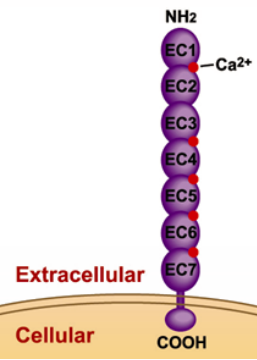


CDH17 is predominantly expressed in intestinal epithelial cells and a subset of pancreatic ductal epithelial cells, while exhibiting limited expression in most normal tissues, including hepatocytes, esophageal mucosa, and gastric mucosa. This restricted expression pattern distinguishes CDH17 from many conventional tumor targets and provides a potential advantage for tumor-selective targeting.


Accumulating evidence indicates that CDH17 is highly expressed in multiple gastrointestinal malignancies, including gastric cancer, colorectal cancer, hepatocellular carcinoma, pancreatic cancer, and cholangiocarcinoma. Furthermore, CDH17 expression has been associated with clinical characteristics such as disease prognosis and treatment response.


The differential expression profile of CDH17, with limited presence in normal tissues and elevated expression in tumor tissues, has positioned CDH17 as a promising tumor-associated antigen and an emerging target for precision oncology, particularly in the development of antibody-based therapies.

The Role of CDH17 in Tumor Development and Progression

CDH17 is not only a surface marker expressed on tumor cells but also plays functional roles in cancer development and progression. Increasing evidence suggests that dysregulation of CDH17 is associated with tumor cell proliferation, invasion, and metastatic potential.


In gastric cancer, upregulation of CDH17 has been reported to promote tumor cell proliferation and invasion through the activation of NF-κB signaling and modulation of the MAPK pathway. In hepatocellular carcinoma, CDH17 expression has been linked to activation of the Wnt/β-catenin signaling pathway, suggesting its potential involvement in tumor progression and disease development.


Beyond its role in intracellular signaling regulation, CDH17 can interact with α2β1 integrin and serves as an important regulator of integrin-mediated cell adhesion and proliferation. This interaction has also been implicated in enhancing the metastatic capacity of colorectal cancer cells, particularly their ability to colonize the liver.


Although the precise mechanisms underlying CDH17-mediated tumor progression and its broader therapeutic implications remain under investigation, CDH17 has already attracted significant attention as a therapeutic target. Several CDH17-targeted approaches, including BI 905711 and ARB102, have entered clinical studies for the treatment of gastrointestinal cancers such as gastric cancer, pancreatic cancer, esophageal cancer, and cholangiocarcinoma.


These novel therapeutic strategies utilize CDH17 expression on tumor cells to achieve selective targeting. For example, bispecific molecules targeting both CDH17 and TRAIL receptor 2 (TRAILR2) can induce tumor cell apoptosis while minimizing effects on normal CDH17-expressing tissues, highlighting the potential of CDH17 as a tumor-selective target.


CDH17 Targeted Therapy Landscape

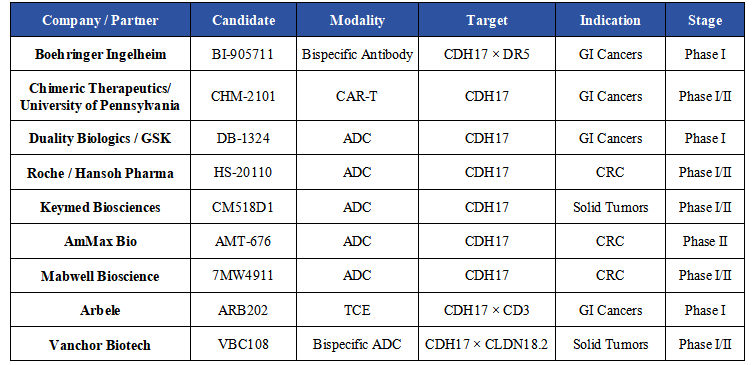
Compared with well-established targets such as PD-1 and CLDN18.2, the development of CDH17-targeted therapies started relatively recently, and no CDH17-directed products have been approved to date. Most investigational CDH17 therapies remain in early clinical development.


Nevertheless, the CDH17 landscape has gained significant momentum in recent years, with multiple CDH17-targeted candidates advancing into clinical trials. Global pharmaceutical companies, including GSK, ArriVent, and Roche, have entered the field through strategic partnerships and licensing collaborations with innovative biotech companies, further accelerating interest in this emerging target.


From a therapeutic modality perspective, ADC approaches currently represent the leading development strategy, while other platforms including bispecific antibodies, T-cell engagers (TCEs), and CAR-T therapies are also being actively explored. Current clinical development efforts are primarily focused on gastrointestinal malignancies, including gastric cancer, colorectal cancer, and pancreatic cancer.
 

Conclusion

Overall, CDH17-targeted therapies are still in the early stages of clinical evaluation, and further clinical studies are needed to fully define their therapeutic potential. Nevertheless, the rapid expansion of CDH17 programs across ADCs, bispecific antibodies, TCEs, and CAR-T approaches highlights its growing importance as an emerging oncology target. As clinical development continues to advance, reliable and comprehensive research tools will be essential to support the discovery and validation of next-generation CDH17-targeted therapies.


Keeping pace with the rapid development of CDH17-targeted therapies, Genomeditech has established a comprehensive CDH17 research portfolio, including CDH17 stable expression cell lines, antibodies, and recombinant proteins (detailed data available at the end of this article). These high-quality research tools support key workflows from target validation and antibody screening to functional evaluation, enabling efficient development and validation of CDH17-targeted therapeutic strategies.


Learn More: https://en.genomeditech.com/v2/search?k=CDH17 


References

1. Boehringer Ingelheim. Boehringer Ingelheim Advances Novel Bi-specific TRAILR2/CDH17 Antibody to Phase 1 Clinical Trial for Patients Living with Gastrointestinal Cancers. 2020.
Available at: https://www.boehringer-ingelheim.com/us/media/press-releases/boehringer-ingelheim-advances-novel-bi-specific-trailr2-cdh17-antibody-phase-1-clinical-trial 

2. ClinicalTrials.gov. A Phase 1/2 Study to Evaluate CHM-2101, an Autologous Cadherin 17 (CDH17) Chimeric Antigen Receptor (CAR) T Cell Therapy for the Treatment of Relapsed or Refractory Gastrointestinal Cancers. ClinicalTrials.gov Identifier: NCT06055439.
Available at: https://clinicaltrials.gov/study/NCT06055439 

3. Duality Biologics. Duality Biologics Announces Clinical Progress of CDH17-Targeted ADC Program.
Available at: https://en.dualitybiologics.com/news/600.html 

4. ClinicalTrials.gov. Study Details: NCT06892379.
Available at: https://clinicaltrials.gov/study/NCT06892379 

5. ClinicalTrials.gov. Study Details: NCT07019779.
Available at: https://clinicaltrials.gov/study/NCT07019779 

6. ClinicalTrials.gov. Study Details: NCT06400485.
Available at: https://clinicaltrials.gov/study/NCT06400485 

7. Mabwell. Mabwell Announces Progress of CDH17-Targeted Therapeutic Program.
Available at: https://www.mabwell.com/en/news_info/id-198.html 

8. ArreLeBio. ARB202 Continues Dosing in Clinical Study.
Available at: https://www.arbelebio.com/post/arb202-continues-dosing 

9. ClinicalTrials.gov. Study Details: NCT07700160.
Available at: https://clinicaltrials.gov/study/NCT07700160


Current position:News > Insights
classify
CDH17: The Next Emerging Target in Gastrointestinal Cancer Therapy
吉满生物
2026-08-05

About CDH17

Cadherins are a superfamily of Ca²⁺-dependent cell adhesion molecules that play critical roles in maintaining tissue architecture and regulating cellular organization. Alterations in cadherin expression and function have been implicated in various pathological processes, including abnormal development, tumorigenesis, and cancer progression.


CDH17 (Cadherin 17), also known as liver-intestine cadherin (LI-cadherin), is a non-classical member of the cadherin superfamily. Unlike classical cadherins, CDH17 is a Ca²⁺-dependent transmembrane glycoprotein consisting of seven extracellular cadherin domains and a short cytoplasmic domain. It primarily functions as a cell adhesion molecule in intestinal epithelial tissues, contributing to the maintenance of epithelial structure and integrity.


CDH17 is predominantly expressed in intestinal epithelial cells and a subset of pancreatic ductal epithelial cells, while exhibiting limited expression in most normal tissues, including hepatocytes, esophageal mucosa, and gastric mucosa. This restricted expression pattern distinguishes CDH17 from many conventional tumor targets and provides a potential advantage for tumor-selective targeting.


Accumulating evidence indicates that CDH17 is highly expressed in multiple gastrointestinal malignancies, including gastric cancer, colorectal cancer, hepatocellular carcinoma, pancreatic cancer, and cholangiocarcinoma. Furthermore, CDH17 expression has been associated with clinical characteristics such as disease prognosis and treatment response.


The differential expression profile of CDH17, with limited presence in normal tissues and elevated expression in tumor tissues, has positioned CDH17 as a promising tumor-associated antigen and an emerging target for precision oncology, particularly in the development of antibody-based therapies.

The Role of CDH17 in Tumor Development and Progression

CDH17 is not only a surface marker expressed on tumor cells but also plays functional roles in cancer development and progression. Increasing evidence suggests that dysregulation of CDH17 is associated with tumor cell proliferation, invasion, and metastatic potential.


In gastric cancer, upregulation of CDH17 has been reported to promote tumor cell proliferation and invasion through the activation of NF-κB signaling and modulation of the MAPK pathway. In hepatocellular carcinoma, CDH17 expression has been linked to activation of the Wnt/β-catenin signaling pathway, suggesting its potential involvement in tumor progression and disease development.


Beyond its role in intracellular signaling regulation, CDH17 can interact with α2β1 integrin and serves as an important regulator of integrin-mediated cell adhesion and proliferation. This interaction has also been implicated in enhancing the metastatic capacity of colorectal cancer cells, particularly their ability to colonize the liver.


Although the precise mechanisms underlying CDH17-mediated tumor progression and its broader therapeutic implications remain under investigation, CDH17 has already attracted significant attention as a therapeutic target. Several CDH17-targeted approaches, including BI 905711 and ARB102, have entered clinical studies for the treatment of gastrointestinal cancers such as gastric cancer, pancreatic cancer, esophageal cancer, and cholangiocarcinoma.


These novel therapeutic strategies utilize CDH17 expression on tumor cells to achieve selective targeting. For example, bispecific molecules targeting both CDH17 and TRAIL receptor 2 (TRAILR2) can induce tumor cell apoptosis while minimizing effects on normal CDH17-expressing tissues, highlighting the potential of CDH17 as a tumor-selective target.


CDH17 Targeted Therapy Landscape

Compared with well-established targets such as PD-1 and CLDN18.2, the development of CDH17-targeted therapies started relatively recently, and no CDH17-directed products have been approved to date. Most investigational CDH17 therapies remain in early clinical development.


Nevertheless, the CDH17 landscape has gained significant momentum in recent years, with multiple CDH17-targeted candidates advancing into clinical trials. Global pharmaceutical companies, including GSK, ArriVent, and Roche, have entered the field through strategic partnerships and licensing collaborations with innovative biotech companies, further accelerating interest in this emerging target.


From a therapeutic modality perspective, ADC approaches currently represent the leading development strategy, while other platforms including bispecific antibodies, T-cell engagers (TCEs), and CAR-T therapies are also being actively explored. Current clinical development efforts are primarily focused on gastrointestinal malignancies, including gastric cancer, colorectal cancer, and pancreatic cancer.


Conclusion

Overall, CDH17-targeted therapies are still in the early stages of clinical evaluation, and further clinical studies are needed to fully define their therapeutic potential. Nevertheless, the rapid expansion of CDH17 programs across ADCs, bispecific antibodies, TCEs, and CAR-T approaches highlights its growing importance as an emerging oncology target. As clinical development continues to advance, reliable and comprehensive research tools will be essential to support the discovery and validation of next-generation CDH17-targeted therapies.


Keeping pace with the rapid development of CDH17-targeted therapies, Genomeditech has established a comprehensive CDH17 research portfolio, including CDH17 stable expression cell lines, antibodies, and recombinant proteins (detailed data available at the end of this article). These high-quality research tools support key workflows from target validation and antibody screening to functional evaluation, enabling efficient development and validation of CDH17-targeted therapeutic strategies.


Learn More: https://en.genomeditech.com/v2/search?k=CDH17 


References

1. Boehringer Ingelheim. Boehringer Ingelheim Advances Novel Bi-specific TRAILR2/CDH17 Antibody to Phase 1 Clinical Trial for Patients Living with Gastrointestinal Cancers. 2020.
Available at: https://www.boehringer-ingelheim.com/us/media/press-releases/boehringer-ingelheim-advances-novel-bi-specific-trailr2-cdh17-antibody-phase-1-clinical-trial 

2. ClinicalTrials.gov. A Phase 1/2 Study to Evaluate CHM-2101, an Autologous Cadherin 17 (CDH17) Chimeric Antigen Receptor (CAR) T Cell Therapy for the Treatment of Relapsed or Refractory Gastrointestinal Cancers. ClinicalTrials.gov Identifier: NCT06055439.
Available at: https://clinicaltrials.gov/study/NCT06055439 

3. Duality Biologics. Duality Biologics Announces Clinical Progress of CDH17-Targeted ADC Program.
Available at: https://en.dualitybiologics.com/news/600.html 

4. ClinicalTrials.gov. Study Details: NCT06892379.
Available at: https://clinicaltrials.gov/study/NCT06892379 

5. ClinicalTrials.gov. Study Details: NCT07019779.
Available at: https://clinicaltrials.gov/study/NCT07019779 

6. ClinicalTrials.gov. Study Details: NCT06400485.
Available at: https://clinicaltrials.gov/study/NCT06400485 

7. Mabwell. Mabwell Announces Progress of CDH17-Targeted Therapeutic Program.
Available at: https://www.mabwell.com/en/news_info/id-198.html 

8. ArreLeBio. ARB202 Continues Dosing in Clinical Study.
Available at: https://www.arbelebio.com/post/arb202-continues-dosing 

9. ClinicalTrials.gov. Study Details: NCT07700160.
Available at: https://clinicaltrials.gov/study/NCT07700160

Contact
Us
Message Inquiry
reset
submit
Message
Message Inquiry
reset
submit