




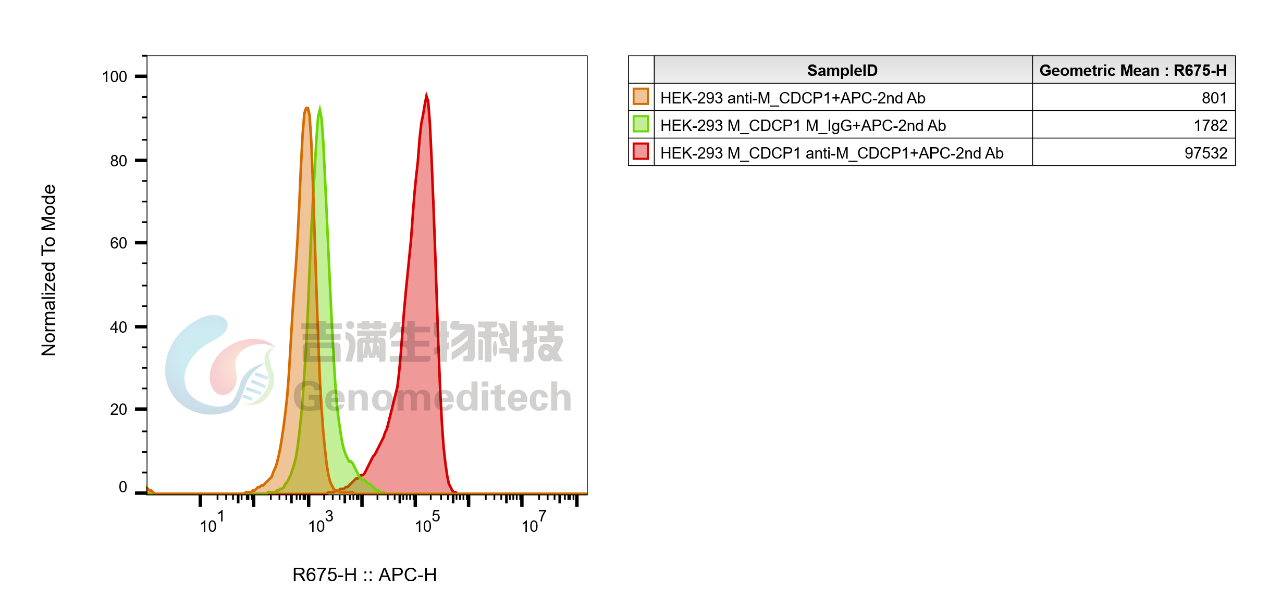




| Species Reactivity | Mouse |
| Clone | 41A10 |
| Source/Isotype | Mouse IgG2a, Kappa |
| Application | Flow Cytometry |
| Target | Detects CDCP1 |
| Gene | CDCP1 |
| Other Names | CD318, TRASK, UNQ2486, PRO5773 |
| Gene ID | 109332(Mouse) |
| Background | The anti-CDCP1 antibody (targeting CUB domain-containing protein 1) holds significant research value in oncology. CDCP1 is highly expressed in various malignant tumors (e.g., lung, breast, and colorectal cancer) and is closely associated with tumor metastasis, drug resistance, and poor prognosis. The anti-CDCP1 antibody can specifically block CDCP1 signaling pathways, inhibit tumor cell migration and invasion, offering a potential strategy for targeted therapy. Moreover, it can be used in immunohistochemistry, flow cytometry, and other assays to aid tumor diagnosis and classification. As a research tool, it helps elucidate the molecular mechanisms of CDCP1 in tumor progression, facilitating the development of novel anticancer drugs. |
| Storage | Store at 2-8℃ short term (1-2 weeks). Store at ≤ -20℃ long term. Avoid repeated freeze-thaw. |
| Formulation | Supplied as a 0.2 μm filtered solution of PBS, pH7.2-7.4. |
| Endotoxin | < 1 EU/mg, determined by LAL gel clotting assay |
| Species Reactivity | Mouse |
| Clone | 41A10 |
| Source/Isotype | Mouse IgG2a, Kappa |
| Application | Flow Cytometry |
| Target | Detects CDCP1 |
| Gene | CDCP1 |
| Other Names | CD318, TRASK, UNQ2486, PRO5773 |
| Gene ID | 109332(Mouse) |
| Background | The anti-CDCP1 antibody (targeting CUB domain-containing protein 1) holds significant research value in oncology. CDCP1 is highly expressed in various malignant tumors (e.g., lung, breast, and colorectal cancer) and is closely associated with tumor metastasis, drug resistance, and poor prognosis. The anti-CDCP1 antibody can specifically block CDCP1 signaling pathways, inhibit tumor cell migration and invasion, offering a potential strategy for targeted therapy. Moreover, it can be used in immunohistochemistry, flow cytometry, and other assays to aid tumor diagnosis and classification. As a research tool, it helps elucidate the molecular mechanisms of CDCP1 in tumor progression, facilitating the development of novel anticancer drugs. |
| Storage | Store at 2-8℃ short term (1-2 weeks). Store at ≤ -20℃ long term. Avoid repeated freeze-thaw. |
| Formulation | Supplied as a 0.2 μm filtered solution of PBS, pH7.2-7.4. |
| Endotoxin | < 1 EU/mg, determined by LAL gel clotting assay |