





Where Discovery Begins
H_GIPR β-Arrestin2 Reporter CHO-K1 Cell Line
Cat. No.
GM-C44431
Size
2 vial
Quote
Description
Data Display
Specifications
Materials
Related products
Description
GIPR (Glucose-dependent Insulinotropic Polypeptide Receptor) is a G protein-coupled receptor encoded by the GIPR gene, mainly expressed in pancreatic islets, gastrointestinal tract, adipose tissue, and the central nervous system. It plays a key role in glucose metabolism and energy homeostasis by stimulating insulin secretion and promoting nutrient uptake, and is closely associated with type 2 diabetes and obesity.

Upon GIP binding, GIPR activates Gs protein to increase cAMP levels, thereby enhancing insulin secretion, and recruits β-arrestin to mediate receptor desensitization, internalization, and additional metabolic responses. Thus, GIPR is a critical regulator of glucose homeostasis and a promising therapeutic target for metabolic diseases.

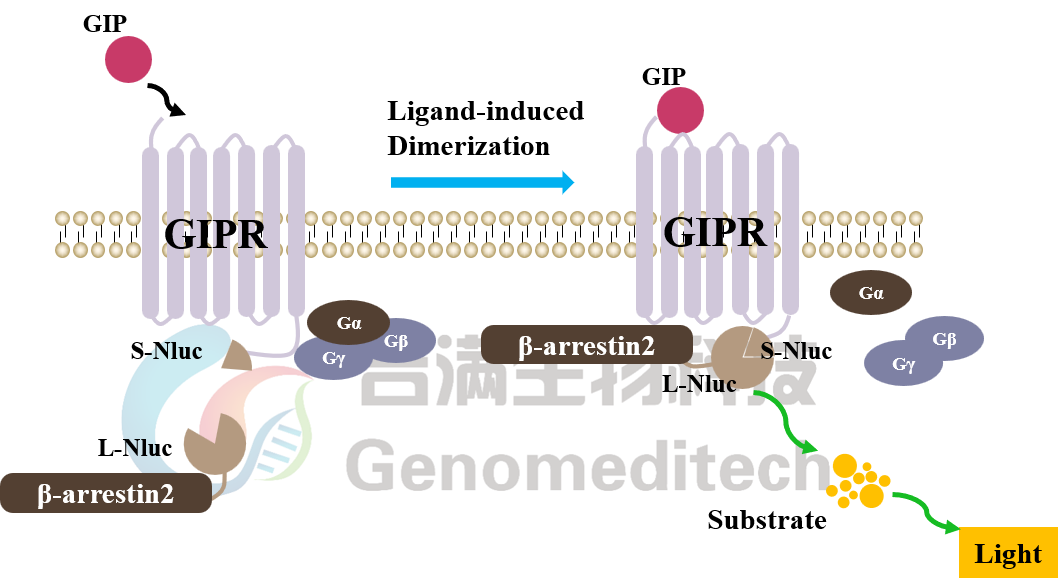
H_GIPR β-Arrestin2 Reporter CHO-K1 Cell Line is a clonal stable CHO-K1 cell line constructed using lentiviral technology, constitutive expression of the GIPR gene, and detected using luciferase reporter technology. When the ligand binds to GIPR, it recruits β-arrestin2 fused with a downstream luciferase reporter gene. Upon addition of the luciferase substrate, the enzyme catalyzes the substrate reaction, producing a detectable luminescent signal. Therefore, this system can be used to evaluate the in vitro efficacy of related drugs.
GIPR (Glucose-dependent Insulinotropic Polypeptide Receptor) is a G protein-coupled receptor encoded by the GIPR gene, mainly expressed in pancreatic islets, gastrointestinal tract, adipose tissue, and the central nervous system. It plays a key role in glucose metabolism and energy homeostasis by stimulating insulin secretion and promoting nutrient uptake, and is closely associated with type 2 diabetes and obesity.

Upon GIP binding, GIPR activates Gs protein to increase cAMP levels, thereby enhancing insulin secretion, and recruits β-arrestin to mediate receptor desensitization, internalization, and additional metabolic responses. Thus, GIPR is a critical regulator of glucose homeostasis and a promising therapeutic target for metabolic diseases.

H_GIPR β-Arrestin2 Reporter CHO-K1 Cell Line is a clonal stable CHO-K1 cell line constructed using lentiviral technology, constitutive expression of the GIPR gene, and detected using luciferase reporter technology. When the ligand binds to GIPR, it recruits β-arrestin2 fused with a downstream luciferase reporter gene. Upon addition of the luciferase substrate, the enzyme catalyzes the substrate reaction, producing a detectable luminescent signal. Therefore, this system can be used to evaluate the in vitro efficacy of related drugs.
Data Display
Signaling Pathway
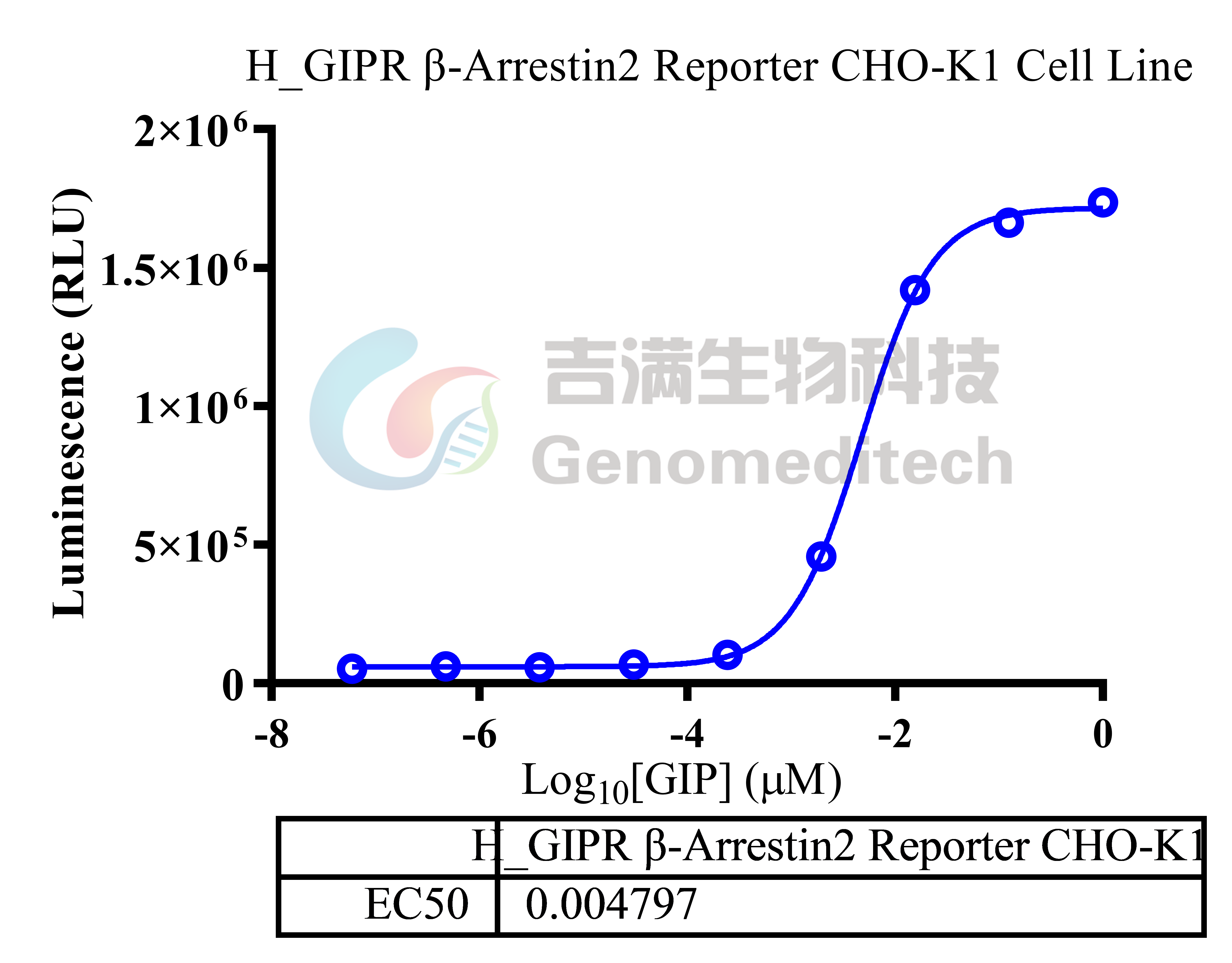
Response to GIP(Human). H_GIPR β-Arrestin2 Reporter CHO-K1 Cell Line (Cat. GM-C44431) was seeded at a density of 1E4 cells per well in a 96-well plate and incubated overnight. The next day, serial dilutions of the GIP(Human) (Genscript/RP10795) were added to the pre-seeded cells. The mixture was incubated for an additional 20 min. The luciferase activity was measured using a detection kit. The maximum induction fold was approximately [37.8]. Data are shown by drug molar concentration.
Expression
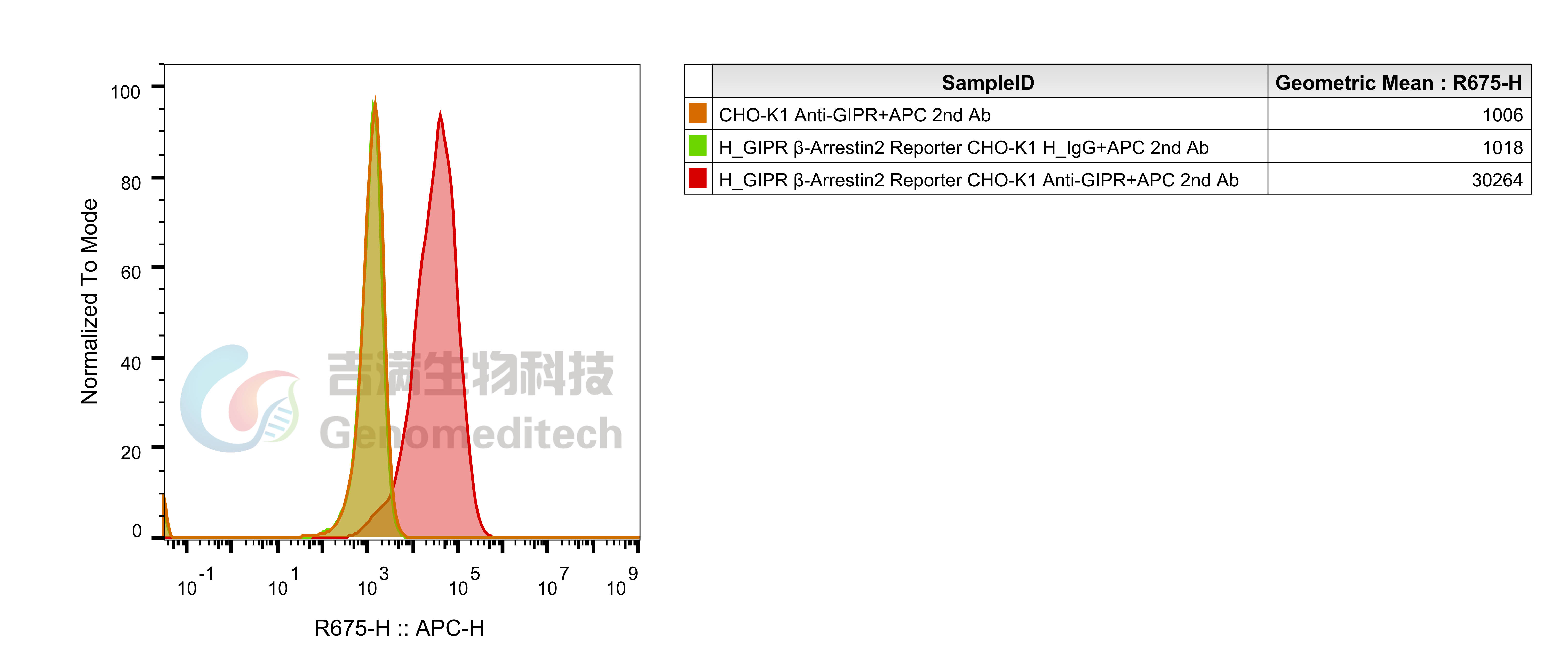
H_GIPR β-Arrestin2 Reporter CHO-K1 Cell Line (Cat. GM-C44431) was determined by flow cytometry using Anti-H_GIPR hIgG1 Antibody(AMG-133)(Cat. /GM-84915AB).
Specifications
Cat. No GM-C44431
Product H_GIPR β-Arrestin2 Reporter CHO-K1 Cell Line
Product Format 1 vial of frozen cells
Quantity 5E6 Cells per vial,1 Ml
Storage Conditions Liquid nitrogen immediately upon receipt
Recovery Medium F12K+10% FBS+1% P.S
Growth medium F12K+10% FBS+1% P.S+4 μg/mL Puromycin
Note None
Freezing Medium 90% FBS+10% DMSO
Growth properties Adherent
Growth Conditions 37°C, 5% CO₂
Safety considerations Biosafety Level 2
Mycoplasma Testing The cell line has been screened to confirm the absence of Mycoplasma species.
Cat. No GM-C44431
Product H_GIPR β-Arrestin2 Reporter CHO-K1 Cell Line
Product Format 1 vial of frozen cells
Quantity 5E6 Cells per vial,1 Ml
Storage Conditions Liquid nitrogen immediately upon receipt
Recovery Medium F12K+10% FBS+1% P.S
Growth medium F12K+10% FBS+1% P.S+4 μg/mL Puromycin
Note None
Freezing Medium 90% FBS+10% DMSO
Growth properties Adherent
Growth Conditions 37°C, 5% CO₂
Safety considerations Biosafety Level 2
Mycoplasma Testing The cell line has been screened to confirm the absence of Mycoplasma species.
Materials
Reagent Ordering Information
F12K BOSTER/PYG0036
Fetal Bovine Serum ExCell/FSP500
Pen/Strep Thermo/15140-122
Puromycin Genomeditech/GM-040401
GIP(Human) Genscript/RP10795
Nano-Glo®Live Cell Assay System Promega/N2012
Reagent Ordering Information
F12K BOSTER/PYG0036
Fetal Bovine Serum ExCell/FSP500
Pen/Strep Thermo/15140-122
Puromycin Genomeditech/GM-040401
GIP(Human) Genscript/RP10795
Nano-Glo®Live Cell Assay System Promega/N2012
Related products
GCGR
H_GCGR Reporter CHO-K1 Cell Line H_GCGR Reporter HEK-293 Cell Line H_GCGR Reporter HEK-293 DDX35TM Cell Line
Cynomolgus_GCGR HEK-293 Cell Line H_GCGR CHO-K1 Cell Line H_GCGR HEK-293 Cell Line
Mouse_GCGR HEK-293 Cell Line
Human GCGR(26-136) Protein; hFc Tag Human GCGR(26-136) Protein; His Tag  
GLP1R
H_GLP1R GIPR GCGR Triple Reporter 293 Cell Line H_GLP1R GIPR Reporter CHO-K1 Cell Line H_GLP1R Reporter CHO-K1 Cell Line
H_GLP1R Reporter HEK-293 Cell Line H_GLP1R Reporter HEK-293 DDX35TM Cell Line H_GLP1R β-Arrestin Reporter CHO-K1 Cell Line
Cynomolgus_GLP1R GIPR CHO-K1 Cell Line Cynomolgus_GLP1R HEK-293 Cell Line H_GLP1R CHO-K1 Cell Line
H_GLP1R GIPR CHO-K1 Cell Line H_GLP1R HEK-293 Cell Line Mouse_GLP1R GIPR CHO-K1 Cell Line
Mouse_GLP1R HEK-293 Cell Line Rat_GLP1R HEK-293 Cell Line  
FGFR1
H_FGF21 Reporter HEK-293 Cell Line Mouse_FGF21 Reporter HEK-293 Cell Line
Human FGF-21 Protein; His Tag    
CALCA(CGRP):CALCRL RAMP
H_CALCRL RAMP1 Reporter HEK-293 Cell Line H_CALCRL RAMP1 Reporter HEK-293 DDX35TM Cell Line Cynomolgus_CALCRL RAMP1 HEK-293 Cell Line
H_CALCRL RAMP1 CHO-K1 Cell Line H_CALCRL RAMP1 HEK-293 Cell Line  
GPR75
H_GPR75 HEK-293 Cell Line    
GIPR
H_GIPR Reporter CHO-K1 Cell Line H_GIPR Reporter HEK-293 Cell Line H_GIPR Reporter HEK-293 DDX35TM Cell Line
Cynomolgus_GIPR CHO-K1 Cell Line Cynomolgus_GIPR HEK-293 Cell Line H_GIPR CHO-K1 Cell Line
H_GIPR HEK-293 Cell Line Mouse_GIPR CHO-K1 Cell Line Mouse_GIPR HEK-293 Cell Line
ACVR2A:ACTRIIB:Active A
ACVR2A KO HEK-293 Cell Line ACVR2B KO HEK-293 Cell Line Activin A Reporter Cell Line
BRE Reporter 293 Cell Line H_ACVR2A Reporter Cell Line H_ACVR2B Reporter Cell Line
H_ACVR2B Reporter DDX35TM Cell Line H_ACVR2A HEK-293(ACVR2B KO) Cell Line H_ACVR2B CHO-K1 Cell Line
H_ACVR2B HEK-293(ACVR2A KO) Cell Line
Biotinylated Human ACVR2A Protein; His-Avi Tag Biotinylated Human ACVR2B Protein; His-Avi Tag Biotinylated Mouse ACVR2A Protein; His-Avi Tag
Biotinylated Mouse ACVR2B Protein; His-Avi Tag Human Activin A Protein; His Tag Human Activin A Protein; His Tag (CHO)
Human Activin B Protein; His Tag Human ACVR2A Protein; hFc Tag Human ACVR2A Protein; hFc Tag (Sotatercept)
Human ACVR2A Protein; His Tag Human ACVR2B Protein; hFc Tag Human ACVR2B Protein; His Tag
Human latent GDF-8 Protein; His Tag Mouse ACVR2A Protein; His Tag Mouse ACVR2B Protein; His Tag
AMY:CALCR RAMP
H_CALCR RAMP1(AMY1) Reporter CHO-K1 Cell Line H_CALCR RAMP2(AMY2) Reporter CHO-K1 Cell Line H_CALCR RAMP3(AMY3) Reporter CHO-K1 Cell Line
H_CALCR RAMP3(AMY3) β-Arrestin Reporter CHO-K1 Cell Line H_CALCR Reporter CHO-K1 Cell Line H_CALCR β-Arrestin Reporter CHO-K1 Cell Line
Rat_CALCR RAMP1(AMY1) Reporter COS-7 Cell Line Rat_CALCR RAMP3(AMY3) Reporter COS-7 Cell Line Rat_CALCR Reporter COS-7 Cell Line
THRB
H_THRβ Reporter HEK-293 Cell Line    
MC4R
H_MC4R Reporter HEK-293 Cell Line    
ASGR1
H_ASGR1 CHO-K1 Cell Line H_ASGR1 HEK-293 Cell Line
Cynomolgus ASGR1 Protein; His Tag Human ASGR1 Protein; hFc Tag Human ASGR1 Protein; His Tag
Mouse ASGR1 Protein; His Tag    
For laboratory research use only. Direct human use, including taking orally and injection and clinical use are forbidden.
H_GIPR β-Arrestin2 Reporter CHO-K1 Cell Line
Cat. No.
GM-C44431
Size
2 vial
Quote
Description
Data Display
Specifications
Materials
Related products
Description
GIPR (Glucose-dependent Insulinotropic Polypeptide Receptor) is a G protein-coupled receptor encoded by the GIPR gene, mainly expressed in pancreatic islets, gastrointestinal tract, adipose tissue, and the central nervous system. It plays a key role in glucose metabolism and energy homeostasis by stimulating insulin secretion and promoting nutrient uptake, and is closely associated with type 2 diabetes and obesity.

Upon GIP binding, GIPR activates Gs protein to increase cAMP levels, thereby enhancing insulin secretion, and recruits β-arrestin to mediate receptor desensitization, internalization, and additional metabolic responses. Thus, GIPR is a critical regulator of glucose homeostasis and a promising therapeutic target for metabolic diseases.

H_GIPR β-Arrestin2 Reporter CHO-K1 Cell Line is a clonal stable CHO-K1 cell line constructed using lentiviral technology, constitutive expression of the GIPR gene, and detected using luciferase reporter technology. When the ligand binds to GIPR, it recruits β-arrestin2 fused with a downstream luciferase reporter gene. Upon addition of the luciferase substrate, the enzyme catalyzes the substrate reaction, producing a detectable luminescent signal. Therefore, this system can be used to evaluate the in vitro efficacy of related drugs.

GIPR (Glucose-dependent Insulinotropic Polypeptide Receptor) is a G protein-coupled receptor encoded by the GIPR gene, mainly expressed in pancreatic islets, gastrointestinal tract, adipose tissue, and the central nervous system. It plays a key role in glucose metabolism and energy homeostasis by stimulating insulin secretion and promoting nutrient uptake, and is closely associated with type 2 diabetes and obesity.

Upon GIP binding, GIPR activates Gs protein to increase cAMP levels, thereby enhancing insulin secretion, and recruits β-arrestin to mediate receptor desensitization, internalization, and additional metabolic responses. Thus, GIPR is a critical regulator of glucose homeostasis and a promising therapeutic target for metabolic diseases.

H_GIPR β-Arrestin2 Reporter CHO-K1 Cell Line is a clonal stable CHO-K1 cell line constructed using lentiviral technology, constitutive expression of the GIPR gene, and detected using luciferase reporter technology. When the ligand binds to GIPR, it recruits β-arrestin2 fused with a downstream luciferase reporter gene. Upon addition of the luciferase substrate, the enzyme catalyzes the substrate reaction, producing a detectable luminescent signal. Therefore, this system can be used to evaluate the in vitro efficacy of related drugs.

Data Display
Signaling Pathway
Response to GIP(Human). H_GIPR β-Arrestin2 Reporter CHO-K1 Cell Line (Cat. GM-C44431) was seeded at a density of 1E4 cells per well in a 96-well plate and incubated overnight. The next day, serial dilutions of the GIP(Human) (Genscript/RP10795) were added to the pre-seeded cells. The mixture was incubated for an additional 20 min. The luciferase activity was measured using a detection kit. The maximum induction fold was approximately [37.8]. Data are shown by drug molar concentration.
Expression
H_GIPR β-Arrestin2 Reporter CHO-K1 Cell Line (Cat. GM-C44431) was determined by flow cytometry using Anti-H_GIPR hIgG1 Antibody(AMG-133)(Cat. /GM-84915AB).
Specifications
Cat. No GM-C44431
Product H_GIPR β-Arrestin2 Reporter CHO-K1 Cell Line
Product Format 1 vial of frozen cells
Quantity 5E6 Cells per vial,1 Ml
Storage Conditions Liquid nitrogen immediately upon receipt
Recovery Medium F12K+10% FBS+1% P.S
Growth medium F12K+10% FBS+1% P.S+4 μg/mL Puromycin
Note None
Freezing Medium 90% FBS+10% DMSO
Growth properties Adherent
Growth Conditions 37°C, 5% CO₂
Safety considerations Biosafety Level 2
Mycoplasma Testing The cell line has been screened to confirm the absence of Mycoplasma species.
Cat. No GM-C44431
Product H_GIPR β-Arrestin2 Reporter CHO-K1 Cell Line
Product Format 1 vial of frozen cells
Quantity 5E6 Cells per vial,1 Ml
Storage Conditions Liquid nitrogen immediately upon receipt
Recovery Medium F12K+10% FBS+1% P.S
Growth medium F12K+10% FBS+1% P.S+4 μg/mL Puromycin
Note None
Freezing Medium 90% FBS+10% DMSO
Growth properties Adherent
Growth Conditions 37°C, 5% CO₂
Safety considerations Biosafety Level 2
Mycoplasma Testing The cell line has been screened to confirm the absence of Mycoplasma species.
Materials
Reagent Ordering Information
F12K BOSTER/PYG0036
Fetal Bovine Serum ExCell/FSP500
Pen/Strep Thermo/15140-122
Puromycin Genomeditech/GM-040401
GIP(Human) Genscript/RP10795
Nano-Glo®Live Cell Assay System Promega/N2012
Reagent Ordering Information
F12K BOSTER/PYG0036
Fetal Bovine Serum ExCell/FSP500
Pen/Strep Thermo/15140-122
Puromycin Genomeditech/GM-040401
GIP(Human) Genscript/RP10795
Nano-Glo®Live Cell Assay System Promega/N2012
Related products
GCGR
H_GCGR Reporter CHO-K1 Cell Line H_GCGR Reporter HEK-293 Cell Line H_GCGR Reporter HEK-293 DDX35TM Cell Line
Cynomolgus_GCGR HEK-293 Cell Line H_GCGR CHO-K1 Cell Line H_GCGR HEK-293 Cell Line
Mouse_GCGR HEK-293 Cell Line
Human GCGR(26-136) Protein; hFc Tag Human GCGR(26-136) Protein; His Tag  
GLP1R
H_GLP1R GIPR GCGR Triple Reporter 293 Cell Line H_GLP1R GIPR Reporter CHO-K1 Cell Line H_GLP1R Reporter CHO-K1 Cell Line
H_GLP1R Reporter HEK-293 Cell Line H_GLP1R Reporter HEK-293 DDX35TM Cell Line H_GLP1R β-Arrestin Reporter CHO-K1 Cell Line
Cynomolgus_GLP1R GIPR CHO-K1 Cell Line Cynomolgus_GLP1R HEK-293 Cell Line H_GLP1R CHO-K1 Cell Line
H_GLP1R GIPR CHO-K1 Cell Line H_GLP1R HEK-293 Cell Line Mouse_GLP1R GIPR CHO-K1 Cell Line
Mouse_GLP1R HEK-293 Cell Line Rat_GLP1R HEK-293 Cell Line  
FGFR1
H_FGF21 Reporter HEK-293 Cell Line Mouse_FGF21 Reporter HEK-293 Cell Line
Human FGF-21 Protein; His Tag    
CALCA(CGRP):CALCRL RAMP
H_CALCRL RAMP1 Reporter HEK-293 Cell Line H_CALCRL RAMP1 Reporter HEK-293 DDX35TM Cell Line Cynomolgus_CALCRL RAMP1 HEK-293 Cell Line
H_CALCRL RAMP1 CHO-K1 Cell Line H_CALCRL RAMP1 HEK-293 Cell Line  
GPR75
H_GPR75 HEK-293 Cell Line    
GIPR
H_GIPR Reporter CHO-K1 Cell Line H_GIPR Reporter HEK-293 Cell Line H_GIPR Reporter HEK-293 DDX35TM Cell Line
Cynomolgus_GIPR CHO-K1 Cell Line Cynomolgus_GIPR HEK-293 Cell Line H_GIPR CHO-K1 Cell Line
H_GIPR HEK-293 Cell Line Mouse_GIPR CHO-K1 Cell Line Mouse_GIPR HEK-293 Cell Line
ACVR2A:ACTRIIB:Active A
ACVR2A KO HEK-293 Cell Line ACVR2B KO HEK-293 Cell Line Activin A Reporter Cell Line
BRE Reporter 293 Cell Line H_ACVR2A Reporter Cell Line H_ACVR2B Reporter Cell Line
H_ACVR2B Reporter DDX35TM Cell Line H_ACVR2A HEK-293(ACVR2B KO) Cell Line H_ACVR2B CHO-K1 Cell Line
H_ACVR2B HEK-293(ACVR2A KO) Cell Line
Biotinylated Human ACVR2A Protein; His-Avi Tag Biotinylated Human ACVR2B Protein; His-Avi Tag Biotinylated Mouse ACVR2A Protein; His-Avi Tag
Biotinylated Mouse ACVR2B Protein; His-Avi Tag Human Activin A Protein; His Tag Human Activin A Protein; His Tag (CHO)
Human Activin B Protein; His Tag Human ACVR2A Protein; hFc Tag Human ACVR2A Protein; hFc Tag (Sotatercept)
Human ACVR2A Protein; His Tag Human ACVR2B Protein; hFc Tag Human ACVR2B Protein; His Tag
Human latent GDF-8 Protein; His Tag Mouse ACVR2A Protein; His Tag Mouse ACVR2B Protein; His Tag
AMY:CALCR RAMP
H_CALCR RAMP1(AMY1) Reporter CHO-K1 Cell Line H_CALCR RAMP2(AMY2) Reporter CHO-K1 Cell Line H_CALCR RAMP3(AMY3) Reporter CHO-K1 Cell Line
H_CALCR RAMP3(AMY3) β-Arrestin Reporter CHO-K1 Cell Line H_CALCR Reporter CHO-K1 Cell Line H_CALCR β-Arrestin Reporter CHO-K1 Cell Line
Rat_CALCR RAMP1(AMY1) Reporter COS-7 Cell Line Rat_CALCR RAMP3(AMY3) Reporter COS-7 Cell Line Rat_CALCR Reporter COS-7 Cell Line
THRB
H_THRβ Reporter HEK-293 Cell Line    
MC4R
H_MC4R Reporter HEK-293 Cell Line    
ASGR1
H_ASGR1 CHO-K1 Cell Line H_ASGR1 HEK-293 Cell Line
Cynomolgus ASGR1 Protein; His Tag Human ASGR1 Protein; hFc Tag Human ASGR1 Protein; His Tag
Mouse ASGR1 Protein; His Tag    
Contact
Us
Message Inquiry
reset
submit
Message
Message Inquiry
reset
submit