H_CLDN18(isoform2)-eGFP 293 Cell Line
Cat. No.
GM-C02120
Size
1 vial
Quote
Specifications
Data Display
Materials
Cell Culture
Sequence
Related products
Specifications
Cat. No GM-C02120
Product H_CLDN18(isoform2)-eGFP 293 Cell Line
Description H_CLDN18(isoform2)-eGFP 293 Cell Line is a clonal stable HEK-293 cell line that constitutively expresses the human CLDN18(isoform2) gene, constructed using lentiviral technology.
Product Format 1 vial of frozen cells
Quantity 5E6 Cells per vial,1 mL
Storage Conditions Liquid nitrogen immediately upon receipt
Target Human_CLDN18(isoform2) & C-eGFP-3×Flag
Gene ID/Uniprot ID NP_001002026.1
Host Cell HEK-293
Recovery Medium DMEM+10% FBS+1% P.S
Growth medium DMEM+10% FBS+1% P.S+4 μg/mL Blasticidin
Note None
Freezing Medium 90% FBS+10% DMSO
Growth properties Adherent
Growth Conditions 37°C, 5% CO₂
Safety considerations Biosafety Level 2
Mycoplasma Testing The cell line has been screened to confirm the absence of Mycoplasma species.
Cat. No GM-C02120
Product H_CLDN18(isoform2)-eGFP 293 Cell Line
Description H_CLDN18(isoform2)-eGFP 293 Cell Line is a clonal stable HEK-293 cell line that constitutively expresses the human CLDN18(isoform2) gene, constructed using lentiviral technology.
Product Format 1 vial of frozen cells
Quantity 5E6 Cells per vial,1 mL
Storage Conditions Liquid nitrogen immediately upon receipt
Target Human_CLDN18(isoform2) & C-eGFP-3×Flag
Gene ID/Uniprot ID NP_001002026.1
Host Cell HEK-293
Recovery Medium DMEM+10% FBS+1% P.S
Growth medium DMEM+10% FBS+1% P.S+4 μg/mL Blasticidin
Note None
Freezing Medium 90% FBS+10% DMSO
Growth properties Adherent
Growth Conditions 37°C, 5% CO₂
Safety considerations Biosafety Level 2
Mycoplasma Testing The cell line has been screened to confirm the absence of Mycoplasma species.
Data Display
Expression
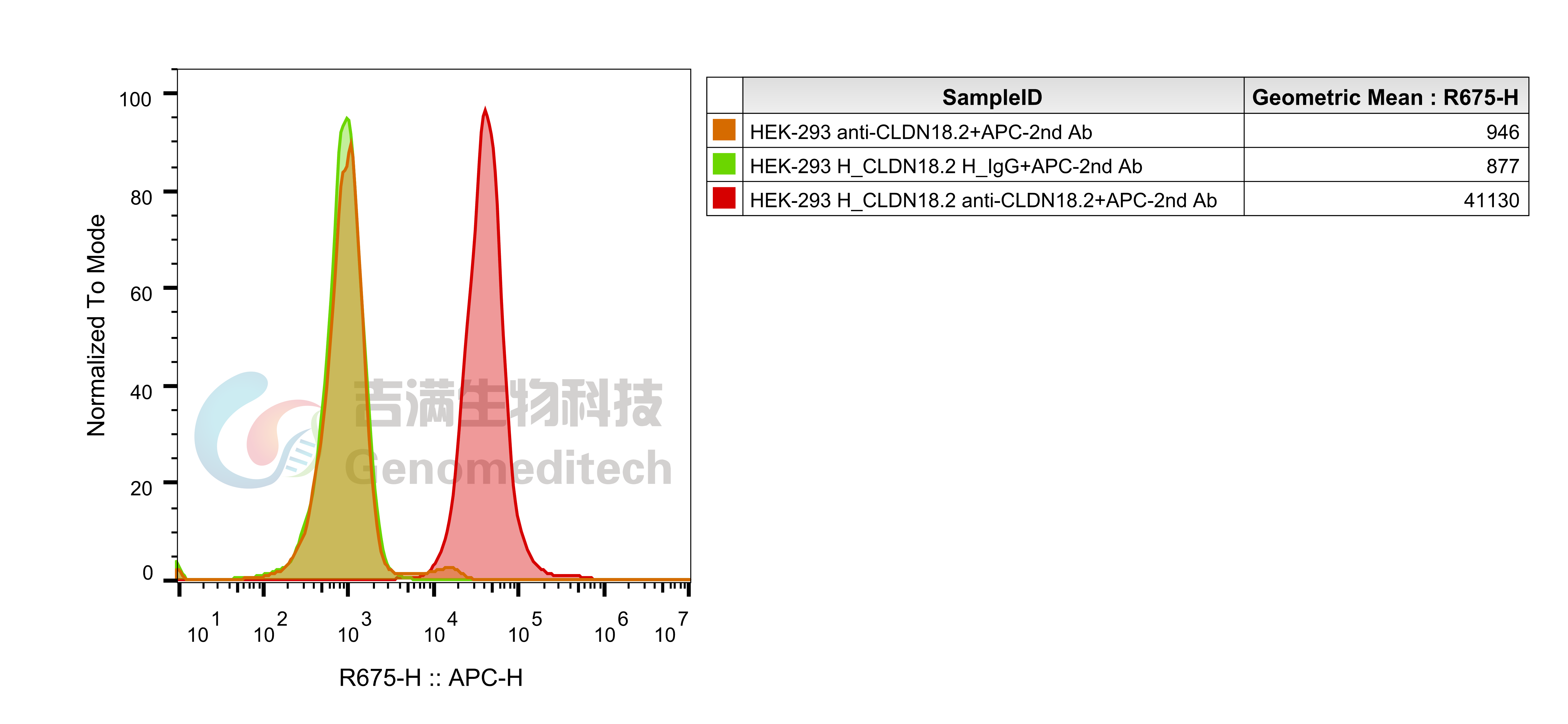
H_CLDN18(isoform2)-eGFP 293 Cell Line (Cat. GM-C02120) was determined by flow cytometry using Anti-CLDN18.2 (In house).
Materials
Reagent Ordering Information
DMEM Gibco/C11995500BT
Fetal Bovine Serum ExCell/FSP500
Pen/Strep Thermo/15140-122
Blasticidin Genomeditech/GM-040404
Anti-CLDN18.2 In house/
Reagent Ordering Information
DMEM Gibco/C11995500BT
Fetal Bovine Serum ExCell/FSP500
Pen/Strep Thermo/15140-122
Blasticidin Genomeditech/GM-040404
Anti-CLDN18.2 In house/
Cell Culture

Cell Recovery

Recovery Medium: DMEM+10% FBS+1% P.S

To insure the highest level of viability, thaw the vial and initiate the culture as soon as possible upon receipt. If upon arrival, continued storage of the frozen culture is necessary, it should be stored in liquid nitrogen vapor phase and not at -70°C. Storage at -70°C will result in loss of viability.

a)       Thaw the vial by gentle agitation in a 37°C water bath. To reduce the possibility of contamination, keep the O-ring and cap out of the water. Thawing should be rapid (approximately 2 - 3 minutes).

b)       Remove the vial from the water bath as soon as the contents are thawed, and decontaminate by dipping in or spraying with 70% ethanol. All of the operations from this point on should be carried out under strict aseptic conditions.

c)       Transfer the vial contents to a centrifuge tube containing 5.0 mL complete culture medium and spin at approximately 176 x g for 5 minutes. Discard supernatant.

d)       Resuspend cell pellet with the recommended recovery medium. And dispense into appropriate culture dishes.

e)       Incubate the culture at 37°C in a suitable incubator. A 5% CO₂ in air atmosphere is recommended if using the medium described on this product sheet.

Cell Freezing

Freezing Medium: 90% FBS+10% DMSO

a)          Centrifuge at 176 x g for 3 minutes to collect cells.

b)         Resuspend the cells in pre-cooled freezing medium and adjust the cell density to 5E6 cells/mL.

c)          Aliquot 1 mL into each vial.

d)         Place the vial in a controlled-rate freezing container and store at -80°C for at least 1 day, then transfer to liquid nitrogen as soon as possible.

Cell passage

Growth medium: DMEM+10% FBS+1% P.S+4 μg/mL Blasticidin

For the first 1 to 2 passages post-resuscitation, use the recovery medium. Once the cells have stabilized, switch to a growth medium.

a)          Subculturing is necessary when the cell density reaches 80%. It is recommended to perform subculturing at a ratio of 1:3 to 1:4 every 2-3 days. Ensure that the density does not exceed 80%, as overcrowding can lead to reduced viability due to compression.

b)         Remove and discard culture medium.

c)          Briefly rinse the cell layer with PBS to remove all traces of serum that contains trypsin inhibitor.

d)         Add 1.0 mL of 0.25% (w/v) Trypsin-EDTA solution to dish and observe cells under an inverted microscope until cell layer is dispersed (usually within 30 to 60 seconds at 37°C).

e)          Note: To avoid clumping do not agitate the cells by hitting or shaking the flask while waiting for the cells to detach. Cells that are difficult to detach may be placed at 37°C to facilitate dispersal.

f)          Add 2.0 mL of growth medium to mix well and aspirate cells by gently pipetting.

g)         After centrifugation, resuspend the pellet and add appropriate aliquots of the cell suspension to new culture vessels.

h)         Incubate cultures at 37°C.

Subcultivation Ratio: A subcultivation ratio of 1:3 - 1:4 is recommended

Medium Renewal: Every 2 to 3 days

Notes

a)          Upon initial thawing, a higher number of dead cells is observed, which is a normal phenomenon. Significant improvement is seen after adaptation. Once the cells reach a stable state, the number of dead cells decreases after subculturing and the cell growth rate becomes stable.

b)         Ensure that the cell density does not exceed 80%, as overcrowding may lead to reduced viability due to compression.

Cell Recovery

Recovery Medium: DMEM+10% FBS+1% P.S

To insure the highest level of viability, thaw the vial and initiate the culture as soon as possible upon receipt. If upon arrival, continued storage of the frozen culture is necessary, it should be stored in liquid nitrogen vapor phase and not at -70°C. Storage at -70°C will result in loss of viability.

a)       Thaw the vial by gentle agitation in a 37°C water bath. To reduce the possibility of contamination, keep the O-ring and cap out of the water. Thawing should be rapid (approximately 2 - 3 minutes).

b)       Remove the vial from the water bath as soon as the contents are thawed, and decontaminate by dipping in or spraying with 70% ethanol. All of the operations from this point on should be carried out under strict aseptic conditions.

c)       Transfer the vial contents to a centrifuge tube containing 5.0 mL complete culture medium and spin at approximately 176 x g for 5 minutes. Discard supernatant.

d)       Resuspend cell pellet with the recommended recovery medium. And dispense into appropriate culture dishes.

e)       Incubate the culture at 37°C in a suitable incubator. A 5% CO₂ in air atmosphere is recommended if using the medium described on this product sheet.

Cell Freezing

Freezing Medium: 90% FBS+10% DMSO

a)          Centrifuge at 176 x g for 3 minutes to collect cells.

b)         Resuspend the cells in pre-cooled freezing medium and adjust the cell density to 5E6 cells/mL.

c)          Aliquot 1 mL into each vial.

d)         Place the vial in a controlled-rate freezing container and store at -80°C for at least 1 day, then transfer to liquid nitrogen as soon as possible.

Cell passage

Growth medium: DMEM+10% FBS+1% P.S+4 μg/mL Blasticidin

For the first 1 to 2 passages post-resuscitation, use the recovery medium. Once the cells have stabilized, switch to a growth medium.

a)          Subculturing is necessary when the cell density reaches 80%. It is recommended to perform subculturing at a ratio of 1:3 to 1:4 every 2-3 days. Ensure that the density does not exceed 80%, as overcrowding can lead to reduced viability due to compression.

b)         Remove and discard culture medium.

c)          Briefly rinse the cell layer with PBS to remove all traces of serum that contains trypsin inhibitor.

d)         Add 1.0 mL of 0.25% (w/v) Trypsin-EDTA solution to dish and observe cells under an inverted microscope until cell layer is dispersed (usually within 30 to 60 seconds at 37°C).

e)          Note: To avoid clumping do not agitate the cells by hitting or shaking the flask while waiting for the cells to detach. Cells that are difficult to detach may be placed at 37°C to facilitate dispersal.

f)          Add 2.0 mL of growth medium to mix well and aspirate cells by gently pipetting.

g)         After centrifugation, resuspend the pellet and add appropriate aliquots of the cell suspension to new culture vessels.

h)         Incubate cultures at 37°C.

Subcultivation Ratio: A subcultivation ratio of 1:3 - 1:4 is recommended

Medium Renewal: Every 2 to 3 days

Notes

a)          Upon initial thawing, a higher number of dead cells is observed, which is a normal phenomenon. Significant improvement is seen after adaptation. Once the cells reach a stable state, the number of dead cells decreases after subculturing and the cell growth rate becomes stable.

b)         Ensure that the cell density does not exceed 80%, as overcrowding may lead to reduced viability due to compression.

Sequence

  CLDN18(isoform2) NP_001002026.1:MAVTACQGLGFVVSLIGIAGIIAATCMDQWSTQDLYNNPVTAVFNYQGLWRSCVRESSGFTECRGYFTLLGLPAMLQAVRALMIVGIVLGAIGLLVSIFALKCIRIGSMEDSAKANMTLTSGIMFIVSGLCAIAGVSVFANMLVTNFWMSTANMYTGMGGMVQTVQTRYTFGAALFVGWVAGGLTLIGGVMMCIACRGLAPEETNYKAVSYHASGHSVAYKPGGFKASTGFGSNTKNKKIYDGGARTEDEVQSYPSKHDYV

  CLDN18(isoform2) NP_001002026.1:MAVTACQGLGFVVSLIGIAGIIAATCMDQWSTQDLYNNPVTAVFNYQGLWRSCVRESSGFTECRGYFTLLGLPAMLQAVRALMIVGIVLGAIGLLVSIFALKCIRIGSMEDSAKANMTLTSGIMFIVSGLCAIAGVSVFANMLVTNFWMSTANMYTGMGGMVQTVQTRYTFGAALFVGWVAGGLTLIGGVMMCIACRGLAPEETNYKAVSYHASGHSVAYKPGGFKASTGFGSNTKNKKIYDGGARTEDEVQSYPSKHDYV

Related products
CLDN18
Cynomolgus_CLDN18.2-eGFP CHO-K1 Cell Line H_CLDN18.1-eGFP HEK-293 Cell Line H_CLDN18.2 MC38 Cell Line
H_CLDN18.2 MKN45 Cell Line(High Expression) H_CLDN18.2 MKN45 Cell Line(Low Expression) H_CLDN18.2 MKN45 Cell Line(Medium Expression)
H_CLDN18.2(isoform2) CHO-K1 Cell Line H_CLDN18.2-eGFP CT-26 Cell Line Mouse_CLDN18.2-eGFP CHO-K1 Cell Line
Rat_CLDN18.2-eGFP CHO-K1 Cell Line Rhesus_CLDN18.2-eGFP CHO-K1 Cell Line
Anti-CLDN18.2 hIgG1 Reference Antibody (IMAB362) Anti-CLDN18.2 hIgG1 Antibody(LM-102) Anti-CLDN18.2 hIgG1 Antibody(Zolbetuximab)
TROP2(TACSTD2)
Cynomolgus_Trop2 CHO-K1 Cell Line Cynomolgus_TROP2 HEK-293 Cell Line H_TROP2 CHO-K1 Cell Line
H_TROP2 CT26 Cell Line H_TROP2 HEK-293 Cell Line H_TROP2 LLC1 Cell Line
H_TROP2 MC38 Cell Line
Anti-H_TROP2 hIgG1 Antibody(Datopotamab) Anti-TROP2 hIgG1 Antibody(Hu2G10-5) Anti-Trop2 hIgG1 Reference Antibody (Sacbio)
Anti-Trop2 hIgG1 Reference Antibody(Datbio) Anti-Trop2-DXD ADC(Dar4)[Datopotamab deruxtecan,Dato-DXD] Anti-Trop2-SN38 ADC(Dar8)[Sacituzumab govitecan]
Biotinylated Cynomolgus TROP2 Protein; His-Avi Tag Biotinylated Human TROP2 Protein; His-Avi Tag Human TROP2 Protein; His Tag
GUCY2C(GC-C)
Cynomolgus_GUCY2C HEK-293 Cell Line H_GUCY2C CHO-K1 Cell Line H_GUCY2C HEK-293 Cell Line
Anti-H_GUCY2C hIgG1 Antibody(Indusatumab)    
CD3
ADCC FcγRIIIa(158V) Reporter Jurkat(CD3 KO) Cell Line Jurkat CD3-BsAb Reporter Cell Line Cynomolgus_CD3 HEK-293 Cell Line
Cynomolgus_CD3E(Membrane Bound ECD) CHO-K1 Cell Line H_CD3 CHO-K1 Cell Line H_CD3 HEK-293 Cell Line
H_CD3D CD3E KO Jurkat Cell Line H_CD3E KO Jurkat Cell Line H_CD3E(Membrane Bound ECD) CHO-K1 Cell Line
H_CD3-TCR HEK-293 Cell Line Mouse_CD3 HEK-293 Cell Line H_CD3(TCR V2) CHO-K1 Cell Line
H_CD3(TCR V2) HEK-293 Cell Line
Anti-CD19×CD3 hIgG1 Antibody[PIT-565(CD58 K34A)] Anti-CD3 epsilon hIgG1 Antibody [OKT-3 (muromonab)] Anti-CD3 hIgG1 Antibody(13A1)
Anti-CD3 hIgG1 Antibody(CH2527) Anti-CD3×CD20 hIgG1 Bispecific Antibody (Epcobio) Anti-CD3×FCRL5 hIgG1 Bispecific Antibody(cevostamab)
Anti-CD3E×BCMA hIgG4 Reference Antibody (Tecbio) Anti-CD3E×DLL3 hIgG1 Bispecific Antibody(Tarlabio) Anti-CD3E×MUC17 hIgG1 Bispecific Antibody(Vepsitbio)
Anti-mouse CD3ε mIgG2a Antibody(145-2C11)    
FGFR2
H_FGFR2b Reporter 293 Cell Line Cynomolgus_FGFR2b HEK-293 Cell Line H_FGFR2b CHO-K1 Cell Line
H_FGFR2b HEK-293 Cell Line Mouse_FGFR2b HEK-293 Cell Line
Anti-FGFR2 hIgG1 Antibody(hFR2-14_H12-L1) Anti-FGFR2 hIgG1 Referece Antibody (Bemabio)
Cynomolgus FGFR2(IIIb) D1-D3 Protein; His Tag Human FGFR2(IIIb) D1-D3 Protein; hFc Tag Human FGFR2(IIIb) D2-D3 Protein; hFc Tag
Human FGFR2(IIIb) D2-D3 Protein; His Tag Human FGFR2(IIIc) D1-D3 Protein; His Tag Mouse FGFR2(IIIb) D2-D3 Protein; His Tag
CLDN3
H_CLDN3 HEK-293 Cell Line
Anti-CLDN3 hIgG1 Antibody(H4G3)    
CLDN4
H_CLDN4 HEK-293 Cell Line
Anti-CLDN4 hIgG1 Antibody(4B8)    
CLDN6
Cynomolgus_CLDN6 CHO-K1 Cell Line H_CLDN6 CHO-K1 Cell Line H_CLDN6 HEK-293 Cell Line
H_CLDN6 LLC1 Cell Line H_CLDN6 MC38 Cell Line Mouse_CLDN6 CHO-K1 Cell Line
Rat_CLDN6 CHO-K1 Cell Line Rhesus_CLDN6 CHO-K1 Cell Line
Anti-Claudin6 hIgG1 Reference Antibody Anti-CLDN6/9 hIgG1 Antibody  
CLDN9
H_CLDN9 CHO-K1 Cell Line H_CLDN9-eGFP HEK-293 Cell Line  
CLDN1
Cynomolgus_CLDN1 CHO-K1 Cell Line H_CLDN1 CHO-K1 Cell Line H_CLDN1 HCT116 Cell Line
Mouse_CLDN1-GFP CHO-K1 Cell Line
Anti-CLDN1 hIgG1 Reference Antibody (Lixubio)    
CD44
H_CD44s CHO-K1 Cell Line H_CD44v6 CHO-K1 Cell Line H_CD44v6 CHO-K1 Cell Line (Medium Expression)
H_CD44v6 HEK-293 Cell Line
Anti-CD44v6 hIgG1 Antibody(bivatuzumab)    
ADC Related Product
Anti-DXD Mouse IgG1 Antibody (23E21C5) Anti-DXD Mouse IgG1 Antibody (4A5A12) Anti-Dxd Mouse IgG2a Antibody (17D6A4)
Anti-Eribulin Mouse IgG2a Antibody (10F8G4) Anti-MMAE Mouse IgG1 Antibody (11C10E3) Anti-MMAE Mouse IgG2a Antibody (17A1K11)
Anti-MMAE Mouse IgG2a Antibody (8F6A3) Anti-SN38 Mouse IgG1 Antibody(59H11C7) Mouse anti Human IgG1-DXD(Dar8)
Mouse anti Human IgG1-MMAE(Dar4) Human IgG1 Isotype-DXD (Dar8) Human IgG1 Isotype-Eribulin (Dar4)
Human IgG1 Isotype-MMAE (Dar4)
Recombinant DT3C Protein    
H_CLDN18(isoform2)-eGFP 293 Cell Line
Cat. No.
GM-C02120
Size
1 vial
Quote
Specifications
Data Display
Materials
Cell Culture
Sequence
Related products
Specifications
Cat. No GM-C02120
Product H_CLDN18(isoform2)-eGFP 293 Cell Line
Description H_CLDN18(isoform2)-eGFP 293 Cell Line is a clonal stable HEK-293 cell line that constitutively expresses the human CLDN18(isoform2) gene, constructed using lentiviral technology.
Product Format 1 vial of frozen cells
Quantity 5E6 Cells per vial,1 mL
Storage Conditions Liquid nitrogen immediately upon receipt
Target Human_CLDN18(isoform2) & C-eGFP-3×Flag
Gene ID/Uniprot ID NP_001002026.1
Host Cell HEK-293
Recovery Medium DMEM+10% FBS+1% P.S
Growth medium DMEM+10% FBS+1% P.S+4 μg/mL Blasticidin
Note None
Freezing Medium 90% FBS+10% DMSO
Growth properties Adherent
Growth Conditions 37°C, 5% CO₂
Safety considerations Biosafety Level 2
Mycoplasma Testing The cell line has been screened to confirm the absence of Mycoplasma species.
Cat. No GM-C02120
Product H_CLDN18(isoform2)-eGFP 293 Cell Line
Description H_CLDN18(isoform2)-eGFP 293 Cell Line is a clonal stable HEK-293 cell line that constitutively expresses the human CLDN18(isoform2) gene, constructed using lentiviral technology.
Product Format 1 vial of frozen cells
Quantity 5E6 Cells per vial,1 mL
Storage Conditions Liquid nitrogen immediately upon receipt
Target Human_CLDN18(isoform2) & C-eGFP-3×Flag
Gene ID/Uniprot ID NP_001002026.1
Host Cell HEK-293
Recovery Medium DMEM+10% FBS+1% P.S
Growth medium DMEM+10% FBS+1% P.S+4 μg/mL Blasticidin
Note None
Freezing Medium 90% FBS+10% DMSO
Growth properties Adherent
Growth Conditions 37°C, 5% CO₂
Safety considerations Biosafety Level 2
Mycoplasma Testing The cell line has been screened to confirm the absence of Mycoplasma species.
Data Display
Expression
H_CLDN18(isoform2)-eGFP 293 Cell Line (Cat. GM-C02120) was determined by flow cytometry using Anti-CLDN18.2 (In house).
Materials
Reagent Ordering Information
DMEM Gibco/C11995500BT
Fetal Bovine Serum ExCell/FSP500
Pen/Strep Thermo/15140-122
Blasticidin Genomeditech/GM-040404
Anti-CLDN18.2 In house/
Reagent Ordering Information
DMEM Gibco/C11995500BT
Fetal Bovine Serum ExCell/FSP500
Pen/Strep Thermo/15140-122
Blasticidin Genomeditech/GM-040404
Anti-CLDN18.2 In house/
Cell Culture

Cell Recovery

Recovery Medium: DMEM+10% FBS+1% P.S

To insure the highest level of viability, thaw the vial and initiate the culture as soon as possible upon receipt. If upon arrival, continued storage of the frozen culture is necessary, it should be stored in liquid nitrogen vapor phase and not at -70°C. Storage at -70°C will result in loss of viability.

a)       Thaw the vial by gentle agitation in a 37°C water bath. To reduce the possibility of contamination, keep the O-ring and cap out of the water. Thawing should be rapid (approximately 2 - 3 minutes).

b)       Remove the vial from the water bath as soon as the contents are thawed, and decontaminate by dipping in or spraying with 70% ethanol. All of the operations from this point on should be carried out under strict aseptic conditions.

c)       Transfer the vial contents to a centrifuge tube containing 5.0 mL complete culture medium and spin at approximately 176 x g for 5 minutes. Discard supernatant.

d)       Resuspend cell pellet with the recommended recovery medium. And dispense into appropriate culture dishes.

e)       Incubate the culture at 37°C in a suitable incubator. A 5% CO₂ in air atmosphere is recommended if using the medium described on this product sheet.

Cell Freezing

Freezing Medium: 90% FBS+10% DMSO

a)          Centrifuge at 176 x g for 3 minutes to collect cells.

b)         Resuspend the cells in pre-cooled freezing medium and adjust the cell density to 5E6 cells/mL.

c)          Aliquot 1 mL into each vial.

d)         Place the vial in a controlled-rate freezing container and store at -80°C for at least 1 day, then transfer to liquid nitrogen as soon as possible.

Cell passage

Growth medium: DMEM+10% FBS+1% P.S+4 μg/mL Blasticidin

For the first 1 to 2 passages post-resuscitation, use the recovery medium. Once the cells have stabilized, switch to a growth medium.

a)          Subculturing is necessary when the cell density reaches 80%. It is recommended to perform subculturing at a ratio of 1:3 to 1:4 every 2-3 days. Ensure that the density does not exceed 80%, as overcrowding can lead to reduced viability due to compression.

b)         Remove and discard culture medium.

c)          Briefly rinse the cell layer with PBS to remove all traces of serum that contains trypsin inhibitor.

d)         Add 1.0 mL of 0.25% (w/v) Trypsin-EDTA solution to dish and observe cells under an inverted microscope until cell layer is dispersed (usually within 30 to 60 seconds at 37°C).

e)          Note: To avoid clumping do not agitate the cells by hitting or shaking the flask while waiting for the cells to detach. Cells that are difficult to detach may be placed at 37°C to facilitate dispersal.

f)          Add 2.0 mL of growth medium to mix well and aspirate cells by gently pipetting.

g)         After centrifugation, resuspend the pellet and add appropriate aliquots of the cell suspension to new culture vessels.

h)         Incubate cultures at 37°C.

Subcultivation Ratio: A subcultivation ratio of 1:3 - 1:4 is recommended

Medium Renewal: Every 2 to 3 days

Notes

a)          Upon initial thawing, a higher number of dead cells is observed, which is a normal phenomenon. Significant improvement is seen after adaptation. Once the cells reach a stable state, the number of dead cells decreases after subculturing and the cell growth rate becomes stable.

b)         Ensure that the cell density does not exceed 80%, as overcrowding may lead to reduced viability due to compression.

Cell Recovery

Recovery Medium: DMEM+10% FBS+1% P.S

To insure the highest level of viability, thaw the vial and initiate the culture as soon as possible upon receipt. If upon arrival, continued storage of the frozen culture is necessary, it should be stored in liquid nitrogen vapor phase and not at -70°C. Storage at -70°C will result in loss of viability.

a)       Thaw the vial by gentle agitation in a 37°C water bath. To reduce the possibility of contamination, keep the O-ring and cap out of the water. Thawing should be rapid (approximately 2 - 3 minutes).

b)       Remove the vial from the water bath as soon as the contents are thawed, and decontaminate by dipping in or spraying with 70% ethanol. All of the operations from this point on should be carried out under strict aseptic conditions.

c)       Transfer the vial contents to a centrifuge tube containing 5.0 mL complete culture medium and spin at approximately 176 x g for 5 minutes. Discard supernatant.

d)       Resuspend cell pellet with the recommended recovery medium. And dispense into appropriate culture dishes.

e)       Incubate the culture at 37°C in a suitable incubator. A 5% CO₂ in air atmosphere is recommended if using the medium described on this product sheet.

Cell Freezing

Freezing Medium: 90% FBS+10% DMSO

a)          Centrifuge at 176 x g for 3 minutes to collect cells.

b)         Resuspend the cells in pre-cooled freezing medium and adjust the cell density to 5E6 cells/mL.

c)          Aliquot 1 mL into each vial.

d)         Place the vial in a controlled-rate freezing container and store at -80°C for at least 1 day, then transfer to liquid nitrogen as soon as possible.

Cell passage

Growth medium: DMEM+10% FBS+1% P.S+4 μg/mL Blasticidin

For the first 1 to 2 passages post-resuscitation, use the recovery medium. Once the cells have stabilized, switch to a growth medium.

a)          Subculturing is necessary when the cell density reaches 80%. It is recommended to perform subculturing at a ratio of 1:3 to 1:4 every 2-3 days. Ensure that the density does not exceed 80%, as overcrowding can lead to reduced viability due to compression.

b)         Remove and discard culture medium.

c)          Briefly rinse the cell layer with PBS to remove all traces of serum that contains trypsin inhibitor.

d)         Add 1.0 mL of 0.25% (w/v) Trypsin-EDTA solution to dish and observe cells under an inverted microscope until cell layer is dispersed (usually within 30 to 60 seconds at 37°C).

e)          Note: To avoid clumping do not agitate the cells by hitting or shaking the flask while waiting for the cells to detach. Cells that are difficult to detach may be placed at 37°C to facilitate dispersal.

f)          Add 2.0 mL of growth medium to mix well and aspirate cells by gently pipetting.

g)         After centrifugation, resuspend the pellet and add appropriate aliquots of the cell suspension to new culture vessels.

h)         Incubate cultures at 37°C.

Subcultivation Ratio: A subcultivation ratio of 1:3 - 1:4 is recommended

Medium Renewal: Every 2 to 3 days

Notes

a)          Upon initial thawing, a higher number of dead cells is observed, which is a normal phenomenon. Significant improvement is seen after adaptation. Once the cells reach a stable state, the number of dead cells decreases after subculturing and the cell growth rate becomes stable.

b)         Ensure that the cell density does not exceed 80%, as overcrowding may lead to reduced viability due to compression.

Sequence

  CLDN18(isoform2) NP_001002026.1:MAVTACQGLGFVVSLIGIAGIIAATCMDQWSTQDLYNNPVTAVFNYQGLWRSCVRESSGFTECRGYFTLLGLPAMLQAVRALMIVGIVLGAIGLLVSIFALKCIRIGSMEDSAKANMTLTSGIMFIVSGLCAIAGVSVFANMLVTNFWMSTANMYTGMGGMVQTVQTRYTFGAALFVGWVAGGLTLIGGVMMCIACRGLAPEETNYKAVSYHASGHSVAYKPGGFKASTGFGSNTKNKKIYDGGARTEDEVQSYPSKHDYV

  CLDN18(isoform2) NP_001002026.1:MAVTACQGLGFVVSLIGIAGIIAATCMDQWSTQDLYNNPVTAVFNYQGLWRSCVRESSGFTECRGYFTLLGLPAMLQAVRALMIVGIVLGAIGLLVSIFALKCIRIGSMEDSAKANMTLTSGIMFIVSGLCAIAGVSVFANMLVTNFWMSTANMYTGMGGMVQTVQTRYTFGAALFVGWVAGGLTLIGGVMMCIACRGLAPEETNYKAVSYHASGHSVAYKPGGFKASTGFGSNTKNKKIYDGGARTEDEVQSYPSKHDYV

Related products
CLDN18
Cynomolgus_CLDN18.2-eGFP CHO-K1 Cell Line H_CLDN18.1-eGFP HEK-293 Cell Line H_CLDN18.2 MC38 Cell Line
H_CLDN18.2 MKN45 Cell Line(High Expression) H_CLDN18.2 MKN45 Cell Line(Low Expression) H_CLDN18.2 MKN45 Cell Line(Medium Expression)
H_CLDN18.2(isoform2) CHO-K1 Cell Line H_CLDN18.2-eGFP CT-26 Cell Line Mouse_CLDN18.2-eGFP CHO-K1 Cell Line
Rat_CLDN18.2-eGFP CHO-K1 Cell Line Rhesus_CLDN18.2-eGFP CHO-K1 Cell Line
Anti-CLDN18.2 hIgG1 Reference Antibody (IMAB362) Anti-CLDN18.2 hIgG1 Antibody(LM-102) Anti-CLDN18.2 hIgG1 Antibody(Zolbetuximab)
TROP2(TACSTD2)
Cynomolgus_Trop2 CHO-K1 Cell Line Cynomolgus_TROP2 HEK-293 Cell Line H_TROP2 CHO-K1 Cell Line
H_TROP2 CT26 Cell Line H_TROP2 HEK-293 Cell Line H_TROP2 LLC1 Cell Line
H_TROP2 MC38 Cell Line
Anti-H_TROP2 hIgG1 Antibody(Datopotamab) Anti-TROP2 hIgG1 Antibody(Hu2G10-5) Anti-Trop2 hIgG1 Reference Antibody (Sacbio)
Anti-Trop2 hIgG1 Reference Antibody(Datbio) Anti-Trop2-DXD ADC(Dar4)[Datopotamab deruxtecan,Dato-DXD] Anti-Trop2-SN38 ADC(Dar8)[Sacituzumab govitecan]
Biotinylated Cynomolgus TROP2 Protein; His-Avi Tag Biotinylated Human TROP2 Protein; His-Avi Tag Human TROP2 Protein; His Tag
GUCY2C(GC-C)
Cynomolgus_GUCY2C HEK-293 Cell Line H_GUCY2C CHO-K1 Cell Line H_GUCY2C HEK-293 Cell Line
Anti-H_GUCY2C hIgG1 Antibody(Indusatumab)    
CD3
ADCC FcγRIIIa(158V) Reporter Jurkat(CD3 KO) Cell Line Jurkat CD3-BsAb Reporter Cell Line Cynomolgus_CD3 HEK-293 Cell Line
Cynomolgus_CD3E(Membrane Bound ECD) CHO-K1 Cell Line H_CD3 CHO-K1 Cell Line H_CD3 HEK-293 Cell Line
H_CD3D CD3E KO Jurkat Cell Line H_CD3E KO Jurkat Cell Line H_CD3E(Membrane Bound ECD) CHO-K1 Cell Line
H_CD3-TCR HEK-293 Cell Line Mouse_CD3 HEK-293 Cell Line H_CD3(TCR V2) CHO-K1 Cell Line
H_CD3(TCR V2) HEK-293 Cell Line
Anti-CD19×CD3 hIgG1 Antibody[PIT-565(CD58 K34A)] Anti-CD3 epsilon hIgG1 Antibody [OKT-3 (muromonab)] Anti-CD3 hIgG1 Antibody(13A1)
Anti-CD3 hIgG1 Antibody(CH2527) Anti-CD3×CD20 hIgG1 Bispecific Antibody (Epcobio) Anti-CD3×FCRL5 hIgG1 Bispecific Antibody(cevostamab)
Anti-CD3E×BCMA hIgG4 Reference Antibody (Tecbio) Anti-CD3E×DLL3 hIgG1 Bispecific Antibody(Tarlabio) Anti-CD3E×MUC17 hIgG1 Bispecific Antibody(Vepsitbio)
Anti-mouse CD3ε mIgG2a Antibody(145-2C11)    
FGFR2
H_FGFR2b Reporter 293 Cell Line Cynomolgus_FGFR2b HEK-293 Cell Line H_FGFR2b CHO-K1 Cell Line
H_FGFR2b HEK-293 Cell Line Mouse_FGFR2b HEK-293 Cell Line
Anti-FGFR2 hIgG1 Antibody(hFR2-14_H12-L1) Anti-FGFR2 hIgG1 Referece Antibody (Bemabio)
Cynomolgus FGFR2(IIIb) D1-D3 Protein; His Tag Human FGFR2(IIIb) D1-D3 Protein; hFc Tag Human FGFR2(IIIb) D2-D3 Protein; hFc Tag
Human FGFR2(IIIb) D2-D3 Protein; His Tag Human FGFR2(IIIc) D1-D3 Protein; His Tag Mouse FGFR2(IIIb) D2-D3 Protein; His Tag
CLDN3
H_CLDN3 HEK-293 Cell Line
Anti-CLDN3 hIgG1 Antibody(H4G3)    
CLDN4
H_CLDN4 HEK-293 Cell Line
Anti-CLDN4 hIgG1 Antibody(4B8)    
CLDN6
Cynomolgus_CLDN6 CHO-K1 Cell Line H_CLDN6 CHO-K1 Cell Line H_CLDN6 HEK-293 Cell Line
H_CLDN6 LLC1 Cell Line H_CLDN6 MC38 Cell Line Mouse_CLDN6 CHO-K1 Cell Line
Rat_CLDN6 CHO-K1 Cell Line Rhesus_CLDN6 CHO-K1 Cell Line
Anti-Claudin6 hIgG1 Reference Antibody Anti-CLDN6/9 hIgG1 Antibody  
CLDN9
H_CLDN9 CHO-K1 Cell Line H_CLDN9-eGFP HEK-293 Cell Line  
CLDN1
Cynomolgus_CLDN1 CHO-K1 Cell Line H_CLDN1 CHO-K1 Cell Line H_CLDN1 HCT116 Cell Line
Mouse_CLDN1-GFP CHO-K1 Cell Line
Anti-CLDN1 hIgG1 Reference Antibody (Lixubio)    
CD44
H_CD44s CHO-K1 Cell Line H_CD44v6 CHO-K1 Cell Line H_CD44v6 CHO-K1 Cell Line (Medium Expression)
H_CD44v6 HEK-293 Cell Line
Anti-CD44v6 hIgG1 Antibody(bivatuzumab)    
ADC Related Product
Anti-DXD Mouse IgG1 Antibody (23E21C5) Anti-DXD Mouse IgG1 Antibody (4A5A12) Anti-Dxd Mouse IgG2a Antibody (17D6A4)
Anti-Eribulin Mouse IgG2a Antibody (10F8G4) Anti-MMAE Mouse IgG1 Antibody (11C10E3) Anti-MMAE Mouse IgG2a Antibody (17A1K11)
Anti-MMAE Mouse IgG2a Antibody (8F6A3) Anti-SN38 Mouse IgG1 Antibody(59H11C7) Mouse anti Human IgG1-DXD(Dar8)
Mouse anti Human IgG1-MMAE(Dar4) Human IgG1 Isotype-DXD (Dar8) Human IgG1 Isotype-Eribulin (Dar4)
Human IgG1 Isotype-MMAE (Dar4)
Recombinant DT3C Protein    
Message consultation
reset
submit
Message
Message consultation
reset
submit